Modular Obstacle Course for Adults: What It Is and What It Brings to Your Business
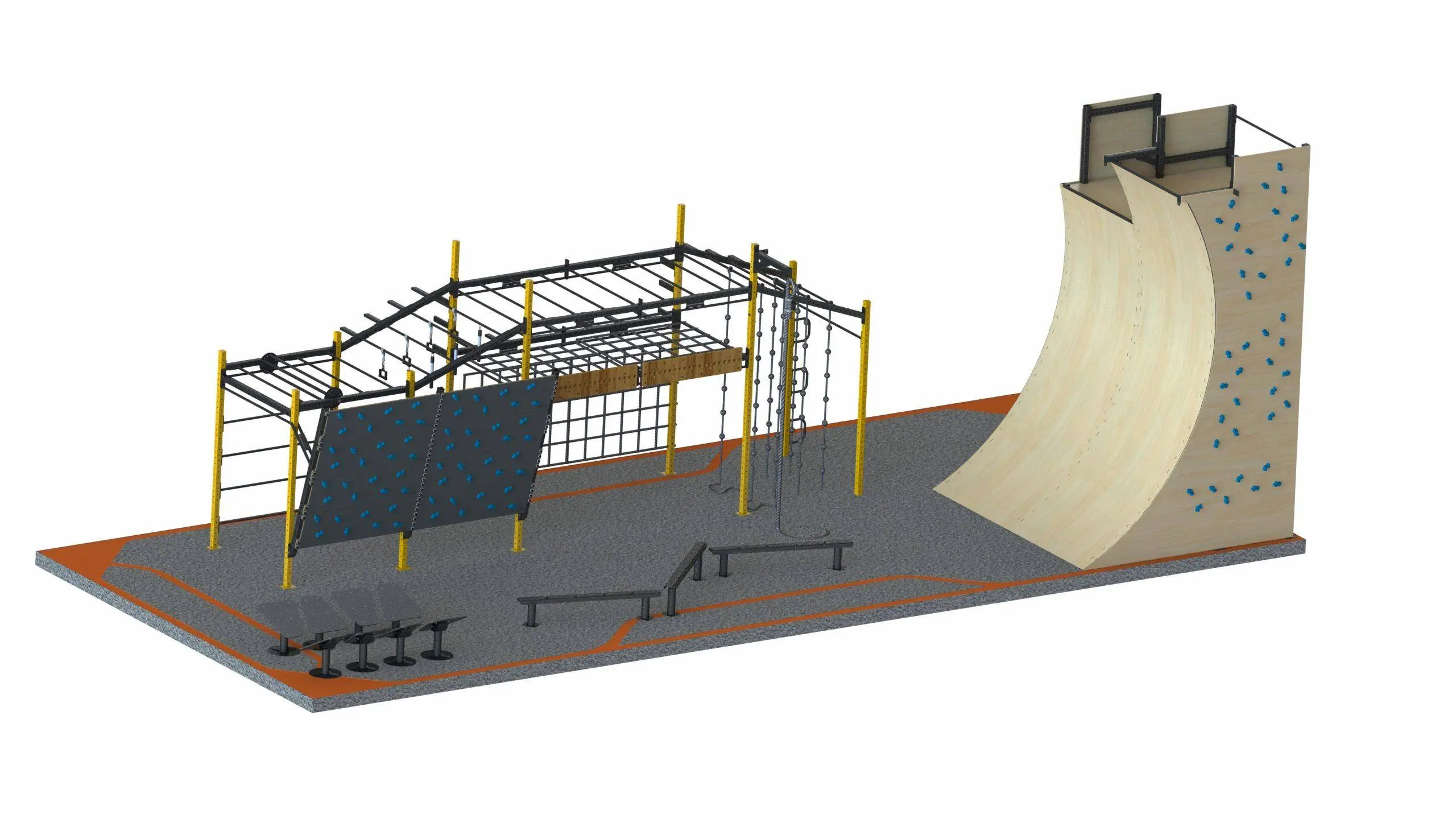
A modular obstacle course for adults is a permanently installed outdoor structure assembled from independent obstacle modules. You choose how many modules you buy, in which order they are crossed and how much ground they cover. That single difference – modularity – is what turns an obstacle course from a fixed piece of equipment into an asset you can grow, move and re-sequence as your site and your audience change.
What modular really means for an operator
Each obstacle is an autonomous unit with its own frame and its own foundations: a warped wall, a rope traverse, hanging grips, a balance line, a net wall, a monkey bar section. They are not welded into one indivisible rig. In practice this gives you three freedoms that a fixed structure does not offer.
- Phased investment. Start with a short sequence, add modules in later budget cycles, and keep a single visual identity across the whole course.
- Layout freedom. A long linear run along a fence, a loop around a lawn, a compact block on a small plot – the same modules serve all three.
- Reconfiguration. Change the running order between seasons or between events and the course feels new to returning users without any new purchase.
Our outdoor obstacle trail modules are designed exactly on this principle, and can be combined with a full OCR obstacle course when you want a complete competition-grade circuit from the start.
Why adults keep coming back to obstacle courses
Play does not stop being useful at eighteen. An obstacle course asks for grip strength, coordination, balance and decision-making in a form that feels nothing like a gym session. Users measure themselves against the course rather than against a machine, and against their own previous attempt rather than against other people. Outdoors, in daylight, that combination is a genuine mood regulator: effort, a visible result, and no barrier to entry beyond turning up.
It also works socially. Families cross it together, colleagues time each other, clubs use it for conditioning blocks. Very few outdoor installations bring a fourteen-year-old and a forty-five-year-old onto the same equipment for the same reason.
The commercial case
For a campsite, a holiday village, a hotel or a leisure park, a modular obstacle course is a visible differentiator. It photographs well, it is easy to explain in a listing, and it gives guests a reason to stay on site rather than drive somewhere else. Operators typically build three revenue layers on top of it:
- Baseline attendance. The course is part of the offer and supports the nightly or membership rate.
- Timed events. Weekly challenges, leaderboards and inter-team races cost almost nothing to run and generate repeat visits.
- External bookings. Clubs, schools, corporate away-days and emergency-service or military units all look for a real obstacle circuit and rarely find one nearby.
For a municipality the logic is different but just as strong: an obstacle course is one of the few pieces of public sports infrastructure used spontaneously, at no cost to the user, across a wide age range, and without supervision staff.
Who installs one
- Campsites, holiday villages and outdoor resorts
- Municipalities equipping a park, a sports field or a school ground
- Cross-training boxes and clubs adding an outdoor conditioning zone
- Schools, universities and training academies
- Armed forces, fire services and police training grounds
- Adventure parks and commercial leisure operators
What to settle before you order
Permanently installed outdoor fitness and obstacle equipment for adults falls under EN 16630, which covers the structure, its access zones and the free space around each obstacle. Three points decide the shape of the project:
- The plot. Usable length and width, ground type, slope, and the clearance you must keep around each module.
- The surfacing. Grass, bark, rubber or synthetic turf under the higher obstacles, matched to the fall heights of the modules you select.
- The user profile. A course for hotel guests and one for a military selection circuit use the same catalogue but not the same difficulty curve.
A ready-made reference point is the complete ninja OCR pentathlon obstacle course, which shows how a full sequence is composed before you adapt it to your own footprint.
Frequently asked questions
Can I extend the course after installation?
Yes. That is the point of a modular range: additional modules use the same design language and the same fixing principle, so a course installed this year can be lengthened next year without replacing anything.
Does it need supervision?
Public installations are normally used without staff, with clear signage on intended use and age. Operators running timed events usually supervise those sessions specifically, not the day-to-day use.
Is the same course suitable for teenagers and adults?
Adult obstacle equipment is designed for adult body mass and reach. Where the primary users are children, a dedicated childrens range designed to the playground standards is the correct choice rather than a scaled-down adult course.
What maintenance does it need?
Routine visual inspection, periodic checks of fixings and moving parts such as rings and rotating grips, and an annual structural inspection. Steel structures with a full anti-corrosion treatment need no seasonal dismantling.
Planning your course
The right starting point is not a catalogue number, it is your plot and your audience. Send us the dimensions of the area, the ground type and the profile of your users, and we will come back with a module sequence, a layout drawing and a costed proposal. Request a quote and we will build the configuration around your site.
Réalisations documentées
- Parcours ninja sur mesure, Rennes – îlot des Hautes-Ourmes
- Double mur ninja extérieur, Sallanches – Haute-Savoie
À lire aussi sur le même thème
- Where to Buy an OCR Obstacle Course: A Buyer's Guide for Clubs, Campsites and Local Authorities
- How to Install an Outdoor Fitness Trail: A Step-by-Step Guide
- How to Install an Outdoor Obstacle Course
- Outdoor Gym Equipment: How to Build an Open-Air Fitness Area
- Outdoor Fitness Equipment: Specifying an Open-Air Gym