Outdoor Gym Equipment: How to Build an Open-Air Fitness Area

Open-air gyms have become standard public infrastructure in almost every town. Local authorities have understood that an outdoor fitness area is an investment in public health: it is open to everyone, at any hour, at no cost to the user. For a council, a housing association, a campsite or a hotel group it is also one of the very few sports facilities that needs no staff, no booking system and no opening hours.
Why outdoor fitness areas keep spreading
The decisive advantage of an open-air gym is availability. There is no membership to buy and no reception desk to pass. Residents use the equipment on the way home, between two errands or during a lunch break, and the area works as a meeting point as much as a training space.
The machines cover different muscle groups and different ability levels. Because resistance comes from body weight and from the user’s own range of motion, the same station suits a teenager, a desk worker returning to exercise and an older adult keeping joints mobile. Stations designed for reduced mobility extend the area to wheelchair users without creating a separate, stigmatising zone.
The most widely installed outdoor fitness machines
Ranges vary from one manufacturer to another, but a public area is usually built around the same core stations:
- Runner – stretching and light cardio; the movement reproduces the mechanics of walking.
- Foot press – strengthens the legs and the lower body against body weight.
- Pendulum – works the abdominal muscles and the hips through a controlled swing.
- Twister – mobilises the hips and the waist and is popular as a warm-up station.
- Bench – the classic station for abdominal crunches.
- Bicycle – legs, trunk and general conditioning, with a very low barrier to entry.
- Orbitrek – reproduces the movement of Nordic walking, arms and legs together.
- Hand press and upper lift – arms, back and chest, pushing and pulling.
- Rower – back, shoulders and arms in one full-body pulling pattern.
A balanced area mixes cardio stations, upper-body pushing and pulling, and at least one mobility station. Our outdoor fitness collection and the accessible outdoor gym range are built on exactly that logic.
Street workout equipment alongside the machines
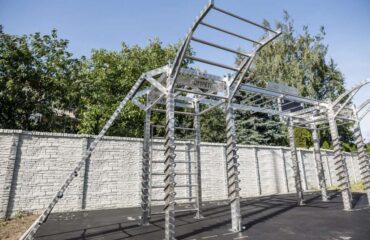
Outdoor gyms are very often completed with street workout equipment for users who already train regularly. Bars, ladders and parallel handrails allow calisthenics work, that is to say training that uses nothing but the athlete’s own body weight. The technical repertoire of that discipline is effectively unlimited, which is why a single rig keeps its users for years.
Street workout structures are especially popular with younger users, and competitive calisthenics has turned them into social landmarks. Placing a street workout rig next to the fitness machines widens the age range of the whole area and keeps it busy outside peak hours.
Health effects a specifier can defend
Regular training on outdoor fitness equipment supports the respiratory and circulatory systems, helps control body fat and maintains general condition. Training in the open air also adds daylight exposure and a break from indoor stress, which is one reason rehabilitation centres and retirement facilities are now specifying the same equipment as municipalities.
Standards and specification
Permanent outdoor fitness equipment for adults is designed and installed to EN 16630. Where the fitness area adjoins a children’s play area, the play equipment falls under EN 1176-1 and its impact-absorbing surfacing under EN 1177: the two families of standards are separate and must not be mixed on the same structure. Ask every supplier which standard each item is certified to, and have it written into the tender documents rather than into the sales conversation.
Frequently asked questions
How much space does an outdoor gym need?
It depends on the number of stations and on the safety areas each one requires. The realistic method is to start from the plot you have, the circulation around it and the user profile you are equipping for, then let the layout follow. We size the area from your plan rather than from a catalogue figure.
Can outdoor equipment stay in place all year?
Yes. Professional outdoor ranges are built for permanent unsupervised installation in the open, which is what separates them from indoor machines moved outside for a season.
Is the equipment suitable for older or less fit users?
Yes, provided the range is chosen for that. Resistance comes from body weight and from how far the user drives the movement, so effort is self-regulating. Accessible stations go further and allow training from a wheelchair.
Who is an outdoor gym for?
Municipalities and parks departments, social housing operators, campsites and holiday villages, hotels, schools, clubs, rehabilitation centres and armed forces sites all specify the same equipment families.
Planning your area
An outdoor gym is a long-life public asset: the decisions that matter are the choice of stations, the standard they are certified to and the way they are laid out on the ground. Send us the plot plan and the profile of the users you are equipping for, and we will come back with a station list and a layout. Request a quote to start the study.
Réalisations documentées
- Cage street workout ultime, Carcassonne – armée française
- Cage street workout ultime, Tahiti – armée française, Polynésie
- Cage SP Max, centre EPIDE de Combrée – établissement public d’insertion
- Cage SP Max, lycée Saint-Bénigne de Dijon – établissement scolaire
Sources et références
- NF EN 16630 – modules fixes d’entraînement physique de plein air : exigences de sécurité et méthodes d’essai (AFNOR)
- Code du sport, article L322-2 – garanties d’hygiène et de sécurité des établissements d’activités physiques et sportives (Légifrance)