How to Buy a Wooden Fitness Trail for Your Town

A wooden outdoor fitness trail is one of the few pieces of public infrastructure that is used by residents of every age, every day, free of charge. For a municipality, a park authority, a social housing landlord or a campsite operator, it is also a procurement project with a budget, a site, a safety standard and a maintenance plan attached. This guide covers the benefits that justify the project, the points to settle before ordering, and the steps from needs assessment to opening day.
Why a wooden fitness trail earns its place
Four arguments carry most projects through approval.
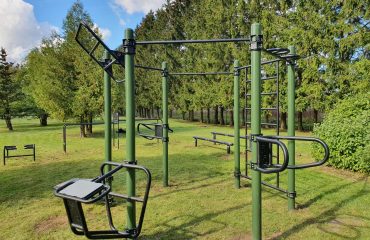
It promotes an active lifestyle. A trail puts exercise equipment within walking distance of where people live, open to everyone, with no membership and no opening hours. That reaches exactly the residents who never enter a gym.
It creates an attractive public space. Timber stations sit visually into a park, a riverside path or a woodland edge in a way that steel structures rarely do, which is why wood is so often specified where the landscape matters.
It builds social connection. A trail becomes a meeting point. People encourage each other, walking groups adopt it, and the equipment gets used far more than an isolated station in a corner of a car park.
It is a sustainable choice. Wood is a renewable material, and specifying responsibly sourced, properly treated timber keeps the environmental case of the project consistent from tender to installation.
What to settle before you order
Budget
Set the envelope before choosing stations, and make it cover more than the equipment: site preparation, foundations, surfacing where required, signage, installation and the first years of inspection. Costs vary enormously with the size of the trail and the number of stations. As an order of magnitude, our French guide gives a range of 5,000 to 50,000 EUR for a wooden fitness trail depending on size, station count and specification. Treat that as a bracket for early planning only and work from a quotation for the actual scheme.
Available space
Assess the site honestly. Each station needs its own footprint plus the free space around it required by the manufacturer, and the trail needs a comfortable circulation route between stations. A trail with eight well-spaced stations is a better public asset than twelve stations crammed into the same area.
Safety standard
This is the point most often left vague in a tender and it should not be. Permanently installed outdoor fitness equipment for adults falls under EN 16630. If the scheme also includes a children play area, that area is governed by EN 1176-1 for the equipment and EN 1177 for the impact-attenuating surfacing: these are separate standards for separate equipment and must not be applied to one another. Ask every supplier to state the applicable standard for each item in their quotation.
Maintenance
Timber equipment needs a maintenance plan: regular cleaning, inspection of the structures for damage or rot, checks on fixings and foundations, and reapplication of wood preservative treatment where the manufacturer specifies it. Decide who carries out these tasks and at what frequency before the trail is installed, not after the first winter.
Consulting residents
Involve the people who will use the trail. Public meetings and a short consultation catch the practical issues no plan shows: where people already walk, which age groups are underserved, and which corner of the park feels safe after dark.
The seven steps of the project
1. Assess needs. Identify what the community actually lacks. Account for different age groups and fitness levels so that the selected stations serve beginners, regular users and older residents rather than one profile only.
2. Research suppliers. Compare catalogues, materials, standards and after-sales terms, not only headline prices.
3. Request detailed quotations. Specify your requirements and ask each supplier for the warranty terms, the delivery lead time and the installation costs in writing.
4. Evaluate the proposals. Weigh equipment quality, price, after-sales service and the supplier track record together. The cheapest quotation is rarely the lowest total cost across fifteen years outdoors.
5. Plan the installation. Site preparation, foundations, any permits required locally and coordination with the works teams all belong in the plan before the order is placed.
6. Arrange funding. Public grant schemes for health and physical activity projects exist in many countries, and their conditions are strictly national or regional. Check with your own local and regional authorities, and consider partnerships with local businesses or a community fundraising campaign alongside the public budget.
7. Install and open. Supervise the installation against the plan, then open the trail publicly. An opening event costs very little and does more for usage in the first year than any signage.
Frequently asked questions
What does wood offer compared with other materials?
A natural appearance, integration into a landscaped or wooded setting, and a renewable material. Steel and stainless steel ranges exist for sites where maintenance access is limited or vandalism is a concern; the choice is a site decision rather than a quality ranking.
How long does installation take?
It depends on the size and complexity of the scheme, and typically runs from a few weeks to a few months including site preparation. Ask each supplier for their own lead time in writing for your project and your country.
Can the trail be customised?
Yes. Station selection, colours and additional elements such as information panels or municipal branding are commonly available. Discuss customisation at the quotation stage, since it can affect lead times.
What maintenance does the timber need?
Routine cleaning, periodic inspection for damage or rot, checks on fixings and foundations, and preservative treatment where the manufacturer requires it. Keep the inspection records: they are what a safety review will ask for.
Are grants available?
Public funding for health and physical activity projects exists in many countries, but the schemes, the eligibility rules and the application windows are national or regional. Your local authority is the correct starting point.
Starting your project
A wooden fitness trail is a lasting investment in public health and in the quality of a public space. Work through the budget, the site, the applicable standard, the maintenance plan and the consultation, and the tender becomes straightforward. Explore the wooden fitness trail range, the individual fitness trail stations and the wider outdoor fitness trail offer, then send us your site plan and intended user profile: request a quote.
Réalisations documentées
- Parcours ninja sur mesure, Rennes – îlot des Hautes-Ourmes
- Double mur ninja extérieur, Sallanches – Haute-Savoie