Outdoor Fitness Equipment for Sale: Complete Buyer Guide
Open-air training areas have moved from a nice-to-have to a standard expectation. Councils are asked for free access sport in every new park, campsites and holiday villages compete on their leisure offer, hotels want a wellness space that costs nothing to staff, and housing developers need an amenity that fills an unused lawn. If you are buying outdoor fitness equipment for one of those sites, the decision is a procurement decision, not a shopping decision. This guide covers the equipment families available, the standards that apply, and the questions to settle before you compare quotations.
Why an outdoor fitness area is worth the budget
An outdoor installation solves problems an indoor room cannot. It is open at all hours without supervision costs, it needs no heating, lighting or ventilation, and it is used by people who would never buy a gym membership. For a public body that means a genuinely universal facility. For a campsite or a hotel it means an activity that differentiates the site with no ongoing payroll. For a residential scheme it means an amenity that stays useful for twenty years.
Use is also broader than a gym floor. A well designed area is used by teenagers on the pull-up bars in the evening, by retired users on the low-impact machines in the morning, and by a running club for circuit sessions at the weekend. That is the argument to make when you present the project to a board or a council committee.
The main families of outdoor fitness equipment
Four families cover almost every brief. Most sites combine two or three of them.
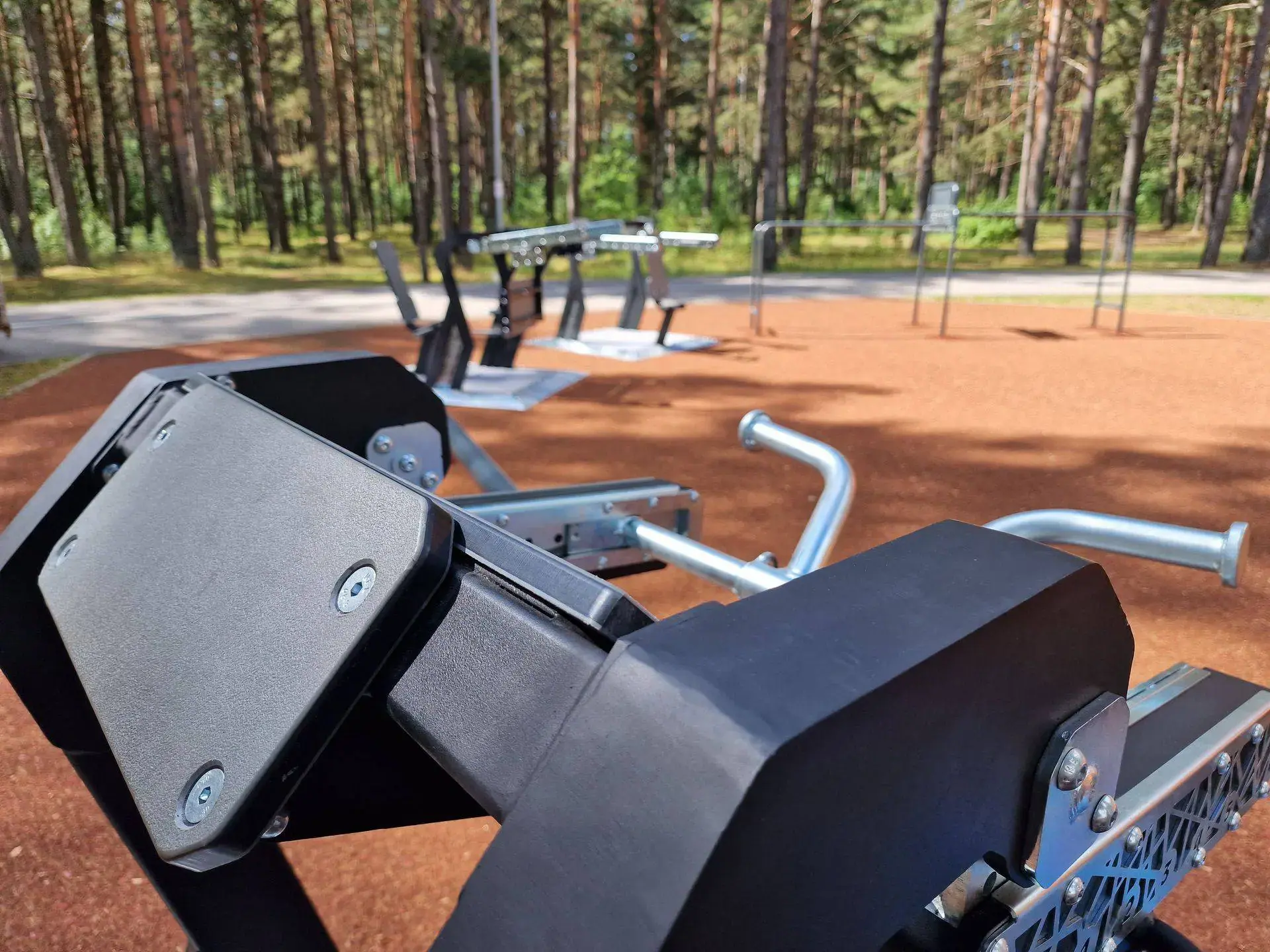
Outdoor strength and cardio stations. Individual stations reproduce the movements of an indoor gym: chest press, lat pull, leg press, air walker, elliptical, exercise bike, stepper. Resistance normally comes from body weight or from hydraulic and mechanical mechanisms, so there are no loose weights to steal or maintain. They suit parks, campsites, hotels and residential schemes because they are immediately understandable without instruction. Our full range of outdoor gym equipment is designed for unsupervised public access.
Street workout and calisthenics rigs. Bars, frames, rings and wall bars for body weight training. They cost less per user than machines, take heavy teenage and adult use, and are the natural centrepiece of a young urban site. Configurations run from a three-bar module to a full park.
Fitness trails and obstacle courses. A sequence of stations spread along a walking or running route, combining climbing, balance, jumping and strength. They fit a large green space, a lakeside path or a school ground far better than a single dense cluster of machines. See the outdoor fitness trail range for the station types available.
Accessible and multi-generation equipment. Stations designed to be used from a wheelchair, and low-resistance mobility equipment for older users, turn a fitness area into a facility for the whole population rather than for the already fit. Public buyers increasingly require this as a condition of funding.
Standards, materials and service life
Permanently installed outdoor fitness equipment for adults is covered by EN 16630. That standard sets the safety requirements for the equipment itself, for free space around each station, for entrapment risks and for the information that must be displayed on site. Ask every supplier for the certificate that covers the actual reference you are buying, not a general statement about the brand.
Equipment intended for children is a different matter. Children play equipment is covered by EN 1176-1, and the impact attenuating surface under it by EN 1177. These are separate standards from EN 16630 and they are not interchangeable: adult outdoor fitness equipment must never be specified or signed as children equipment, and children equipment must never be certified under EN 16630.
Materials decide what the installation looks like in year ten. Hot dip galvanised steel with a polyester powder coat is the workhorse specification for inland sites. Stainless steel costs more up front and is the sensible choice within a few hundred metres of the sea or in a heavily chlorinated pool environment. Whatever the frame, check the fixings, the bearings and the plastic components: those are what fail first, and what you will need to reorder.
Ground surfacing is part of the specification, not an extra. Grass is acceptable under low equipment; anything with a raised standing platform or a fall height needs a surface designed for the purpose, and children play areas need a certified impact attenuating surface.
How to choose the right equipment for your site
Start with the site, not the catalogue.
Size the area. Measure the usable footprint, then subtract the safety zone every station needs around it. A station list that fits on paper often does not fit on the ground once the free space is applied. Note the access route for the installation vehicle as well.
Define who will use it. A campsite with families needs different stations from a street workout park aimed at teenagers, and both differ from a residential scheme with a high proportion of retired residents. Count the number of people you expect at the busiest time and make sure the station count matches it, otherwise the area is either congested or visibly empty.
Set a realistic budget envelope. Outdoor fitness prices vary widely with materials, resistance mechanisms and structure size. Budget for the whole project rather than the equipment alone: groundworks, foundations, surfacing, signage, installation and the periodic inspection regime all belong in the figure you present. A compact station such as the WD-ZQ001 outdoor fitness station answers a different budget from a full multi-station park, and both are legitimate answers depending on the site.
Prioritise durability over station count. Equipment left outdoors is exposed to rain, frost, UV, salt and misuse every day of its life. It is consistently better to install six well built stations than twelve that will be fenced off within five years. Ask what the frame steel section is, what the coating system is, and how long spare parts remain available.
Ask for references you can visit. Talk to buyers who commissioned a comparable installation two or three years ago and ask what has needed attention since. That conversation is worth more than any brochure.
Buying from Light In Fitness
Light In Fitness has supplied and installed professional sport equipment since 2013, working with local authorities, campsites, hotels, schools, clubs and property developers. We work from your plan and your user profile: we propose a station list and a layout, confirm the standards that apply to your project, and quote the equipment, the surfacing and the installation as separate lines so you can see exactly what you are buying.
Ranges are configurable rather than fixed. Colours, station combinations and structure sizes are chosen for your site, and the same equipment family can be delivered as a modest three-station area or as a complete park.
Frequently asked questions
Which standard applies to outdoor fitness equipment?
EN 16630 for permanently installed outdoor fitness equipment for adults. Children play equipment falls under EN 1176-1, with impact attenuating surfacing under EN 1177.
Does outdoor equipment need maintenance?
Yes. Outdoor installations require a routine visual inspection regime and a periodic detailed inspection, plus tightening of fixings and replacement of wear parts. Budget for it from the start and specify equipment whose spare parts you can actually obtain.
What surface should go under the equipment?
It depends on the fall height and on the audience. Grass can be adequate for low equipment; raised structures need a surface designed for impact, and any children area needs a certified impact attenuating surface.
Can equipment be customised?
Colours, station mixes and structure configurations are selected per project. Tell us the identity you want the area to have and we will build the proposal around it.
Do you supply the installation as well?
Installation is quoted with the equipment. Scope and lead times depend on the country and the site, and are confirmed in writing on your quotation.
Start your outdoor fitness project
Send us the dimensions of your space, a photograph or a site plan, the audience you want to serve and the budget you are working to. You will get back a station list, a scaled layout and a costed proposal you can take to your decision makers. Request a quote and we will look at your site.
Réalisations documentées
- Cage street workout ultime, Carcassonne – armée française
- Cage street workout ultime, Tahiti – armée française, Polynésie
- Cage SP Max, centre EPIDE de Combrée – établissement public d’insertion
- Cage SP Max, lycée Saint-Bénigne de Dijon – établissement scolaire
Sources et références
- NF EN 16630 – modules fixes d’entraînement physique de plein air : exigences de sécurité et méthodes d’essai (AFNOR)
- Code du sport, article L322-2 – garanties d’hygiène et de sécurité des établissements d’activités physiques et sportives (Légifrance)