Seafront Street Workout Cages and Outdoor Fitness Trails

In brief: Street workout cages installed by the sea require a reinforced anti-corrosion specification: 316 stainless steel (marine grade) or hot-dip galvanised steel with a marine epoxy coating. Salt-laden air accelerates corrosion by a factor of three to five. A 15-year warranty is the sensible benchmark. Typical sites: seafront promenades, campsites and holiday villages, coastal hotels.
A seafront location is one of the best settings a public authority or a hospitality operator can offer for outdoor training. It is also one of the harshest. The same salt spray that makes a promenade pleasant to walk along at seven in the morning is quietly attacking every weld, every bolt and every powder-coated tube of the equipment installed along it. This article sets out what actually works on a coastal site: the material specifications, the standards that apply, realistic budgets and the maintenance routine that keeps a seafront installation looking new after ten seasons rather than tired after two.
Browse our range of stainless steel street workout cages designed for coastal and public-authority projects.
Why the seafront is a demanding environment
Coastal air carries chloride in suspension. Chloride ions break down the passive oxide layer that protects steel, and they do it continuously: there is no dry season on a promenade. Compared with an inland site, the rate of corrosion on an exposed coastal site runs three to five times faster.
The practical consequence is blunt. Standard steel with a conventional paint finish shows structural rust within twelve to eighteen months in a saline environment. On a public installation that is not a cosmetic problem, it is a liability problem: rusted bolt housings and corroded weld beads are exactly what an inspector looks for.
Two specifications that hold up
316 stainless steel (marine grade). The molybdenum content gives 316 its resistance to chloride pitting. It needs no paint, so there is no coating to chip, blister or repaint, and the finish is unchanged after a decade of exposure. It is the reference specification for a front-line seafront position.
Hot-dip galvanised steel with a marine epoxy coating. The zinc layer provides sacrificial protection, the epoxy topcoat provides the barrier and the colour. This is a strong answer for sites set back from the shoreline, and it allows colour matching to a resort or municipal identity that stainless cannot offer.
Fitness trails and street workout cages: a complementary pair
What an outdoor fitness trail delivers
An outdoor fitness trail is a sequence of stations distributed along a route, each dedicated to one movement: cardiovascular work, muscular strengthening, mobility. Spread along a promenade or a coastal path, it turns a walk into a structured session without asking anyone to book, change or pay. It is inherently inclusive: every station can be scaled to the user in front of it, which is why trails work as well for a retired couple at eight in the morning as for a running club at six in the evening.
Our outdoor fitness trail range covers wooden, galvanised steel and stainless steel builds, so the specification can follow the exposure of each site.
What a street workout cage delivers
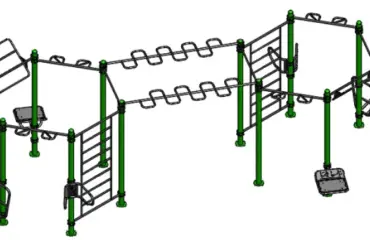
A street workout cage is a steel structure built around bodyweight training: pull-ups, dips, muscle-ups, push-ups, squats, hanging core work. One footprint covers the whole body, takes several users at once and needs no consumables, no plates and no electricity. That combination is why cages have moved from a niche urban trend to a standard line item in coastal regeneration budgets.
Individual stations can be combined with a cage to broaden the offer, for example a Street Workout Squat Machine SG609 alongside the main rig.
Standards and safety on a coastal site
Permanently installed outdoor fitness equipment for adults falls under EN 16630, which governs the safety requirements and test methods for permanent outdoor fitness equipment. It covers structural integrity, entrapment, fall heights and the information that must be supplied with the installation.
Two points matter more on the coast than inland. First, the fixing design: ground anchoring has to account for sandy or made-up ground, which is a foundation study, not a catalogue choice. Second, inspection frequency: the corrosion clock runs faster, so the inspection regime should run faster with it.
Budgets for a seafront installation
| Scope | Indicative budget |
|---|---|
| Simple trail, 4 to 5 stations | from 10,000.00 EUR excluding VAT |
| Complete trail, 12 to 15 stations, EN 16630 certified | up to 60,000.00 EUR excluding VAT |
These figures cover the equipment scope. Groundworks, foundations, surfacing and site access vary too much between coastal sites to be averaged, and they are priced against a site survey.
Maintenance: the routine that protects the investment
| Operation | Frequency |
|---|---|
| Fresh-water rinse of the structure | Twice a month |
| Visual inspection of welds and fixings | Quarterly |
| Repainting | Not required on 316 stainless steel |
The fresh-water rinse is the single highest-value operation on a coastal site: it removes the chloride deposit before it concentrates. On a stainless installation it is essentially the whole maintenance programme.
Frequently asked questions
Which material should I specify for a street workout cage by the sea?
316 stainless steel (marine grade, chloride resistant) is the reference. Hot-dip galvanised steel with a marine epoxy coating is the alternative. Standard steel rusts within twelve to eighteen months in a saline environment.
What does a seafront fitness trail cost?
From 10,000.00 EUR excluding VAT for four to five simple modules, up to 60,000.00 EUR excluding VAT for a complete twelve to fifteen station trail certified to EN 16630.
How is a coastal street workout structure maintained?
Fresh-water rinse twice a month, quarterly visual inspection of welds and fixings. No repainting is needed on 316 stainless steel.
Is outdoor training suitable for every fitness level?
Yes. Every exercise on a trail or a cage is scaled by the user through range, tempo and body angle, so the same station serves a beginner and an experienced athlete.
Why choose a cage over conventional weight machines outdoors?
A cage trains the whole body functionally using bodyweight as resistance, takes several users at once, has no moving load to service and installs directly in the open air.
What are the health benefits of training by the sea?
Outdoor training combines physical activity with fresh air and natural daylight, which supports mood and mental health, and daylight exposure contributes to vitamin D production, important for bone health and immune function.
Planning a coastal project?
Every seafront site has its own exposure, its own ground and its own user profile, and those three variables decide the specification. Send us the site and the intended use and we will come back with a configuration, a material recommendation and a costed proposal: request a quote.
Réalisations documentées
- Functional Rig inox – installations sur trois continents
- iGreenMill, tapis de course extérieur – installations sur trois continents