How to Adapt a Strength Training Area for Care Home Residents
Adapting a strength training area for care home residents rests on four principles: reduced loads of 5 to 25 kg with fine 1-2.5 kg increments, full step-free wheelchair accessibility with 1.5 m circulation aisles, integral passive safety (selectorised machines only, no heavy free weights), and senior-specific ergonomics (high seats, footrests, strong visual contrast). A typical 50 m2 layout combines six to eight selectorised machines, a balance and coordination zone and 15 mm smooth non-slip rubber flooring, for an indicative equipment budget of 18,000 to 32,000 EUR excluding VAT, before flooring and installation.
Physical activity in care homes has moved in a few years from optional extra to a recognised lever for residents’ quality of life: preserving muscle mass against sarcopenia, preventing falls, supporting cognitive function and creating social contact during sessions. In the care homes and senior residences we have equipped since 2013, resident usage, supervised by physiotherapists or activity coordinators, regularly reaches 15 to 25 percent of the residence within six months of commissioning. This article sets out how to specify the equipment correctly; for a broader product overview, see our guide to care home fitness equipment.
Principle 1: reduced loads with fine increments
A standard commercial machine starts at 10 kg with 5 kg increments. That is too much for many care home residents, whose maximal strength on some movements can be below 10 kg. Specify machines with:
- A minimum load of 2.5 or 5 kg
- Fine progression increments of 1 to 2.5 kg
- A maximum load of 25 to 35 kg, which is entirely sufficient
Several manufacturers offer dedicated senior ranges; the right choice depends on the residence’s profile (independent, mixed or high-dependency).
Principle 2: full step-free accessibility
Accessibility here goes well beyond minimum disability standards: residents routinely use wheelchairs, walking frames and sticks, so the room must allow completely fluid circulation.
- Aisles of at least 1.5 m, wider than the usual 1.4 m accessibility baseline
- No steps or thresholds at the entrance or between zones
- Continuous flooring: 15 mm rubber with a smooth non-slip finish (textured surfaces impede castors and frames)
- Machines with secure sit-to-stand access, without climbing onto a high seat
- Perimeter handrails for support while moving around the room
Principle 3: integral passive safety
- No heavy free weights: no Olympic bars, no dumbbells above 5 kg
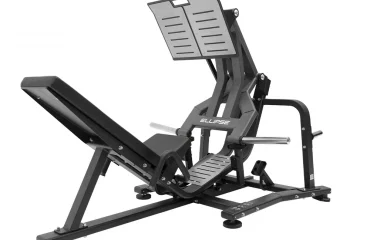
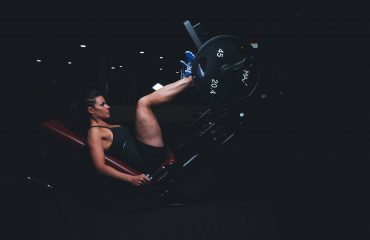
- Selectorised (weight-stack) machines only; plate-loaded units require handling discs and are excluded
- Emergency stop buttons on powered equipment (bikes, treadmills)
- A nurse-call button in the room, wired into the building’s call system
- A physiotherapist or trained activity coordinator present during opening slots
Principle 4: senior-specific ergonomics
A mainstream machine is designed for a fit adult of 1.70-1.85 m. For a resident with reduced mobility, the requirements are different:
- High seats (45-50 cm versus 35-40 cm) to ease the sit-to-stand transfer
- Adjustable, non-slip footrests
- Strong visual contrast: clearly visible pins and buttons, large-print labels
- Safety straps or belts on selected machines (shoulder press, leg extension)
- Padded contact surfaces in high-density foam rather than hard plastic
A reference 50 m2 layout
| Equipment | Typical specification | Load range |
|---|---|---|
| Senior chest press | Bodytone Authentique or dedicated senior range | 2.5-25 kg |
| Senior lat pulldown | Authentique or dedicated senior range | 2.5-25 kg |
| Senior leg extension | Authentique with safety strap | 2.5-30 kg |
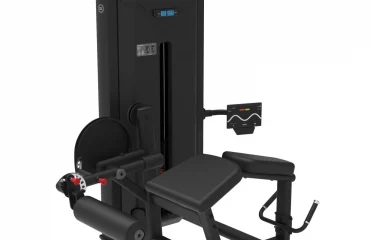
| Seated leg curl | Authentique with reinforced backrest | 2.5-30 kg |
| Hip abductor / adductor | Adapted Authentique | 2.5-20 kg |
| Light leg press | Authentique or dedicated senior range | 5-50 kg |
| Recumbent bike | Lexco senior recumbent | Adapted programmes |
| Low step-through cross trainer | Bodytone EVOE accessibility | Step-free access |
| Balance and coordination zone | Mats, Ziva accessories, balls | Neuromuscular activation |
| Perimeter handrails | Stainless steel 304, wall-fixed | Circulation safety |
| 15 mm smooth rubber floor | 50 m2 plus 10% margin = 55 m2 non-slip | Castor and frame friendly |
Indicative equipment budget for this list: 18,000 to 32,000 EUR excluding VAT depending on the range mix, plus roughly 1,500 EUR for 55 m2 of 15 mm rubber tiles and 1,500 to 2,500 EUR for installation (project estimates).
The most common specification mistake is reusing a mainstream catalogue and simply writing “lower weights”. The ergonomic design of a mainstream machine does not allow a resident with reduced autonomy to get on and off safely. Choose dedicated senior ranges from the audit stage, or a mid-range line with adaptations (straps, reinforced backrests). Savings on hardware are paid back in under-use and frustration.
Adjusting the layout to the residence profile
| Residence profile | Recommended configuration |
|---|---|
| Independent residents | Full 8-machine layout plus balance zone |
| Mixed autonomy | Full layout plus reinforced straps and nurse-call button |
| High-dependency nursing care | Reduced to 4-5 machines, recumbent bike prioritised, balance zone |
| Independent senior living residence | Similar to a hotel gym, adapted to reduced loads |
| Dementia care unit | Highly simplified configuration, permanent supervision, total safety |
Funding and supervision
In most European countries, public health and social care systems run funding streams for dependency prevention in residential care, ranging from national prevention funds to regional health authority grants and local authority investment support. The exact schemes vary by country; the funding case is strongest when the project is framed around fall prevention and maintained autonomy, with usage supervised by a physiotherapist or an adapted physical activity instructor. Facilities running medically prescribed sessions will also find our guide to health referral gym equipment useful, and projects with a stronger clinical component can draw on our rehabilitation gym equipment overview.
Frequently asked questions
What is the minimum floor area for a care home strength area?
Plan at least 40 m2 for a functional area (4-5 machines, a balance zone and 1.5 m aisles), and 50 to 80 m2 for a full layout with 6-8 machines. Below 40 m2, wheelchair circulation becomes difficult and some machines are no longer accessible.
What budget should a care home plan for?
A complete 50 m2 area typically comes to 22,000 to 38,000 EUR excluding VAT with non-slip flooring and installation included. The lower end covers 4-5 essential machines; the upper end a full 8-machine layout with a balance zone and cardio bikes. These are project estimates to be confirmed by quotation.
Must sessions be supervised by a physiotherapist?
Supervision by a physiotherapist, adapted physical activity instructor or trained coordinator is strongly recommended at all opening slots. Fully unsupervised use is not advisable in residential care, except for the most independent residents after assessment by the coordinating physician.
Can residents in wheelchairs use the machines?
Yes, provided the machines are specified for secure sit-to-stand access. For residents who remain in their wheelchair, certain machines (rowing, press) allow use directly from the chair; this should be built into the equipment list according to the resident profile. See also our guide to accessible gym design.
Does staff training matter?
Considerably. A half-day on-site commissioning session with the physiotherapist or activity team, covering each machine, resident-appropriate settings and written guides, is one of the strongest predictors of actual usage in the first six months.
Get a wheelchair-accessible 3D layout for your residence
Send us your floor plan, your resident profile (independent, mixed, high-dependency) and your budget. You will receive a free audit, with your coordinating physician involved if you wish, an accessibility-compliant 3D layout and a quotation within two working days. Request a quote from Light In Fitness, equipping care homes and senior residences since 2013.
Réalisations documentées
- Cage street workout ultime, Carcassonne – armée française
- Cage street workout ultime, Tahiti – armée française, Polynésie
- Cage SP Max, centre EPIDE de Combrée – établissement public d’insertion
- Cage SP Max, lycée Saint-Bénigne de Dijon – établissement scolaire
Sources et références
- Code du sport, articles R322-4 à R322-43 – garanties d’hygiène et de sécurité applicables aux établissements d’activités physiques et sportives (Légifrance)
À lire aussi sur le même thème
- Equipping a Shared House Gym: Budget, Equipment and Practical Guide
- Selectorised, plate loaded or cable: choosing the resistance system for your strength floor
- Power racks and half racks for clubs: specification, sizing and budget
- Etenon IRON HC vs Watson Pro dumbbells: hard chrome against solid stainless