Professional Strength Training Equipment: Everything You Need to Know
Équiper un plateau de force est un arbitrage entre familles de machines, pas une liste d'achats : charges guidées, plate-loaded et charges libres ne se substituent pas. Le ratio entre les trois dépend du public accueilli et du niveau d'encadrement. La surface disponible détermine ensuite le nombre de postes par famille.

Equipping a strength floor is not a shopping list, it is a trade-off between families of machines. Selectorised stacks, converging plate-loaded stations, cable and functional trainers, benches and racks: each answers a different audience, a different intensity of use and a different floor constraint. This guide sets out what each family actually does, how to distribute them across a floor, and which technical criteria separate a machine that survives ten years of intensive use from one that degrades in three.
The short answer
A balanced professional floor combines three families. Selectorised machines deliver safety, user throughput and accessibility for beginners. Converging plate-loaded stations deliver heavy loading, a feel close to barbell work and minimal maintenance. Cable stations and functional trainers deliver versatility per square metre. In a general-purpose club the reference split is roughly 50 to 60 per cent selectorised and 25 to 35 per cent plate-loaded, the remainder in cables and free weights, adjusted to the membership you actually serve.
What makes a strength machine professional
A professional strength machine is built for intensive collective use: dozens of sessions a day, users of very different sizes and abilities, continuous operation over ten to fifteen years. What separates it from consumer equipment goes well beyond price: tube section, bearing and cable quality, how the frame takes load, spare parts availability and standards compliance.
The applicable reference is the EN ISO 20957 series, which covers stationary training equipment. Indoor equipment for a facility open to the public is specified to class S, the studio and commercial class. Class I is the professional class covering inclusive access, for equipment that must remain usable by people with reduced mobility; it is a different specification, not a step above class S.
The criterion nobody checks at purchase is the availability of wear parts at five years. Cables, straps, upholstery, bearings and pins are consumables. A machine whose supplier does not hold stock for your market becomes unusable at the first broken cable, and a station out of order at peak hours is lost revenue.
The four families, and what they really do
Family 1: selectorised machines, the backbone of the floor
A weight stack, a selector pin, a path of motion imposed by the mechanism. The user changes load in three seconds and cannot leave the intended movement. That is what makes this the reference equipment for throughput: fast rotation between users, immediate learning, reduced risk of poor execution.
Where it wins: general-purpose clubs, hotel floors, residential care and rehabilitation centres, corporate gyms, beginners and older users. It is also the most readable family for an unsupervised user.
Its limit: an imposed path suits atypical morphologies poorly, and stabiliser work is minimal. A floor built only from selectorised stations quickly caps advanced members. See the selectorised machine range.
Family 2: plate-loaded and converging machines
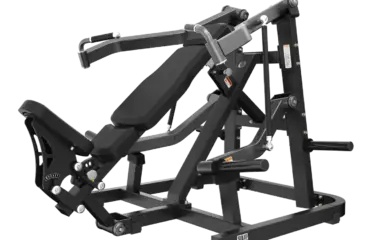
Here the load is made of Olympic plates on horns rather than a stack. Converging describes a specific geometry: the arms follow an arc that converges towards the midline of the body during the push or the pull, reproducing the natural path of a press or a row. Most of these machines use independent arms, which prevents the strong side from compensating for the weak side, a real benefit on asymmetries.
Where it wins: cross-training boxes, strength-oriented clubs, physical preparation centres, military gym halls. The feel comes close to a free barbell, with the safety of a framed path.
Operating advantage: no weight stack means fewer cables and pulleys, so noticeably lighter maintenance. In exchange, plan plate racks immediately alongside and flooring sized for load handling. See the plate-loaded range.
Family 3: cables and functional trainers
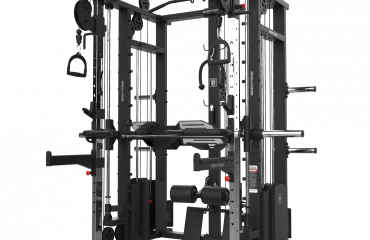
Cables, pulleys, interchangeable handles: a single station covers dozens of exercises in every plane of movement. This is the family that makes the best use of floor area, and the only one that allows genuinely functional work in rotation and diagonal patterns.
A technical point that is often stated badly: a pulley is frequently said to deliver constant resistance. What is constant is the tension applied throughout the range, including at the top and bottom positions where a dumbbell stops loading the muscle. The perceived load itself varies with cable angle and lever arm, and smoothing that force curve is precisely the role of cams and eccentric pulleys on higher-end machines.
Where it wins: small footprints, corporate gyms, functional zones, rehabilitation. A dual cable station or a functional trainer often replaces three dedicated machines.
Family 4: benches, racks and free weights
Flat, incline and decline benches, Olympic benches, squat racks, cages. This family guides nothing: it secures and supports. It decides how credible a floor looks to experienced users, and it demands the most attention at layout stage, with clearance zones, flooring suited to dropped loads and real spacing between stations.
One operating note: an adjustable bench costs more than a flat bench but replaces three stations. On a constrained floor the trade-off almost always favours adjustable. See weight benches and racks and cages.
And resistance bands?
Bands and tubes have their place, but not the same one: they are accessories, not a structural family. Their resistance rises with elongation, which makes them relevant in warm-up, assistance work, rehabilitation and mobility. They do not replace a machine on a professional floor, where user throughput and repeatable settings come first.
Comparing the families
| Criterion | Selectorised | Converging plate-loaded | Cables and functional |
|---|---|---|---|
| Target users | Beginners, older users, all audiences | Experienced, strength, cross-training | All levels, functional work |
| User throughput | High, instant load change | Medium, plates loaded and unloaded | Medium to high |
| Footprint per exercise | High, one machine per movement | High | Low, dozens of exercises per station |
| Maintenance | Cables, pulleys and upholstery to watch | Low, few wear parts | Cables and pulleys checked regularly |
| Investment per unit | Medium to high | Medium, plus plates | High per unit, low per exercise |
| Flooring required | 15 to 20 mm tiles | 30 to 40 mm depending on drops | 20 mm tiles |
Flooring choice by zone is covered in the rubber gym flooring range.
Typical split by type of facility
| Facility | Dominant family | What makes the difference |
|---|---|---|
| Mid-market general club | 50 to 60 per cent selectorised, 25 to 35 per cent plate-loaded | Throughput at peak hours. Doubling the busiest stations beats adding a rare exercise. |
| Cross-training box | Racks, plate-loaded, free weights | Free floor area and flooring. Selectorised stations stay marginal. |
| Hotel gym | Selectorised and functional trainer | Intuitive use without supervision, and quiet operation. |
| Care home, rehabilitation, health | Selectorised with a low starting load and adjustable range | The first load increment and seat accessibility, not maximum load. |
| Corporate gym | Functional trainer and compact selectorised | Versatility per square metre on a constrained floor. |
| Public authority, military base | Plate-loaded and racks | Robustness in unsupervised use and documented traceability. |
Six technical criteria that separate professional from consumer grade
- The structure. Tube section and wall thickness, weld quality, steel grade. This is what absorbs ten years of repeated loading without developing play.
- Wear parts. Sheathed cables, sealed bearing pulleys, treated axles. On an intensive machine these fail first, and their quality decides the real cost of ownership.
- Load increment. Five kilo plates suit a sporting membership but block the progression of a beginner or a patient. Half plates and micro-loads are not a gadget in a mixed facility.
- The first load increment. Often decisive in care, rehabilitation and women-focused facilities: a machine that starts at twenty kilos excludes part of its users.
- Adjustment ergonomics. A seat that adjusts standing, one handed, without tools, is a seat that will be adjusted. Otherwise the user adapts to the machine, and that is where poor execution starts.
- Documentation and after-sales. Manual, exploded drawing, part references, stock held for your market. Without them the warranty is theoretical.
Use: what actually protects your members
A guided machine reduces risk, it does not remove it. Three causes come back constantly in reported incidents: a seat setting that offsets the joint axis from the machine axis of rotation, a load chosen for ego rather than for full range, and a released eccentric phase. Clear signage on every station and proper induction at sign-up do more for safety than any technical option.
Frequently asked questions
What is the difference between a selectorised and a plate-loaded machine?
A selectorised machine carries a stack selected by a pin: changing load takes three seconds. A plate-loaded machine is loaded with Olympic plates on horns. The first favours user throughput and accessibility, the second offers a feel close to a free barbell and needs far less maintenance, since it has few cables and pulleys.
What exactly is a converging machine?
A converging machine is one whose arms follow an arc converging towards the midline of the body during the movement, reproducing the natural path of a press or a row. Most have independent arms, which stops the strong side compensating for the weak side and lets you work on asymmetries.
What ratio of selectorised to plate-loaded should a floor have?
In a general-purpose club the reference split sits around 50 to 60 per cent selectorised and 25 to 35 per cent plate-loaded, the balance in cables and free weights. In a cross-training box the ratio reverses heavily in favour of plate-loaded and racks. In hotels, care facilities and corporate gyms, selectorised stations and a functional trainer cover most of the need.
Which standard applies to indoor strength equipment?
The EN ISO 20957 series covers stationary training equipment. Indoor equipment installed in a facility open to the public is specified to class S, the studio and commercial class. Class I is the professional class for inclusive access, aimed at equipment usable by people with reduced mobility.
How long does a professional strength machine last?
A correctly maintained class S machine is operated for ten to fifteen years. The structure is almost never the limiting factor: cables, pulleys, upholstery and axles decide real service life. Hence the importance of spare parts availability, to be checked before purchase and not after the breakdown.
What flooring should go under strength equipment?
Allow 15 to 20 mm of rubber tile under guided machines and circulation areas, 30 mm in the free weight zone, and 40 mm under barbell drops and weightlifting platforms. The floor protects the building, the equipment and the acoustic environment at the same time.
Are free weights still needed alongside machines?
Yes, in almost every case. Guided machines provide safety and throughput; free weights develop the stabilisers and the coordination that an imposed path does not recruit. A floor made only of guided machines quickly caps advanced members and gives up a real commercial argument.
What budget should be planned for a strength floor?
Budget depends on floor area, the number of stations targeted and the range selected. The method is to start from your target membership and peak-hour attendance to determine the number of stations, then to split them by family. Costing follows the station count, not the other way round.
What to remember
A professional strength floor is not built machine by machine but family by family, starting from the real audience and peak-hour attendance. Selectorised stations provide throughput and safety, converging plate-loaded machines provide credibility and robustness, cables provide return per square metre, benches and racks structure the free weight zone. Everything else, steel grades, load increments, adjustment ergonomics and parts availability, decides what the floor will really cost over ten years, well beyond the price on the quotation.
Send us your floor area and your membership profile and we will come back with a layout, a split by machine family and the flooring suited to each zone: request a quote.
Sources et références
- Code du sport, articles R322-4 à R322-43 – garanties d’hygiène et de sécurité applicables aux établissements d’activités physiques et sportives (Légifrance)
- NF EN ISO 20957-1 – équipement d’entraînement fixe, partie 1 : exigences générales de sécurité et méthodes d’essai (AFNOR)
- AFNOR Normalisation – dossier thématique sur les appareils d’entraînement fixes et leurs classes d’usage