Fitness equipment trends for 2026 and 2027: what changes on the gym floor
Les tendances équipement 2026-2027 répondent à des évolutions de fond : digitalisation, conscience écologique et vieillissement des adhérents. Elles se traduisent en choix concrets d'achat, pas en gadgets : matériel sans moteur, machines accessibles à charge démarrant à zéro, zones fonctionnelles au détriment des lignes de machines. Anticiper ces arbitrages évite un renouvellement prématuré du parc.
The equipment trends that matter for 2026 and 2027 are not gadgets, they are responses to durable shifts in member behaviour: digitalisation, an ageing membership, environmental expectations and the fragmentation of the market into smaller specialist sites. For an operator, reading them correctly means buying today what becomes standard in three years rather than replacing a floor early. This guide sets out eight movements that change purchasing decisions, what each does to capital cost, and which type of facility should act on it now.
Where the money is moving
| Trend | Effect on capital cost | Acts on it first |
|---|---|---|
| AI assisted machines | 30 to 60 per cent more than a comparable conventional machine | Clubs above 500 members with a light coaching team |
| Hybrid guided and free movement | 20 to 30 per cent lower for equivalent exercise coverage | Small and mid sized floors, studios |
| Micro studios under 100 m2 | Lower total, higher cost per square metre | Personal training, specialist formats, corporate sites |
| Outdoor fitness areas | 15,000 to 80,000 EUR excluding VAT for 6 to 12 stations | Local authorities, campsites, clubs with outside space |
| Recovery as a paid service | 2,000 to 40,000 EUR depending on the modality | Premium clubs, hotels, sports recovery centres |
| Sustainability and self powered cardio | Neutral to slightly higher | Operators with a young membership and high energy bills |
| Senior specific equipment | Comparable, different specification | Clubs in ageing catchments, care and residential operators |
| Member data and gamification | Software and console driven rather than steel | Chains and clubs with a retention problem |
Machines that adapt the workout themselves
Cardio and strength machines are starting to embed algorithms that adjust resistance, incline and programme in real time from biometric data such as heart rate, power output and detected fatigue. This is no longer a stored programme, the machine coaches the member. Current examples in the market include automatically adjusting selectorised circuits and strength testing systems that set each set individually, and camera based posture correction. The trade off is straightforward: those machines cost 30 to 60 per cent more, reduce the need for individual coaching and improve retention through a personalised experience. Our reading is that the maths works from roughly 500 members upwards when the coaching team is small. We expect mid range manufacturers, including Bodytone which we distribute, to bring basic adaptive functions such as automatic load setting and user profiles to selectorised machines at accessible prices during 2027.
The line between guided and free weight is blurring
Manufacturers are building machines that do both. A three dimensional Smith machine guides the bar vertically but allows lateral and front to back travel, so the user still has to stabilise the movement while keeping the safety of the rail. Adjustable functional pulleys and cable crossovers increasingly replace four or five isolated selectorised machines, covering chest press, lat pulldown, triceps, biceps and face pull on a single frame. The practical consequence is significant: a club can offer around 30 exercises on two functional pulley stations plus one three dimensional Smith machine instead of eight to ten isolated machines, saving 30 to 40 per cent of floor space and 20 to 30 per cent of budget. For a floor under pressure, this is the single most useful trend on the list.
Fragmentation: fewer large generalist clubs, more specialist studios
The structural movement of the period is fragmentation. Personal training studios of 30 to 60 m2 with one or two coaches and 30 to 80 clients. Micro functional training boxes of 80 to 150 m2 running classes of six to eight. Single format studios built on electro muscular stimulation, reformer Pilates, indoor cycling, boxing or hot yoga. Corporate and coworking gyms of 15 to 40 m2. Small floors demand versatile, compact equipment, which is why crossover and Smith combinations, multi station gyms, adjustable benches and wall mounted storage systems have become the core specification rather than accessories.
Outdoor is no longer a municipal niche
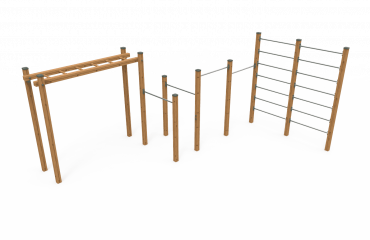
Local authorities and public space managers are investing heavily in free access outdoor fitness areas, a movement accelerated by the pandemic and sustained by public health policy. The equipment is mechanical rather than electronic: body weight, hydraulic or inertial resistance, with no cables and no power supply. Structures are hot dip galvanised and powder coated steel with UV stable finishes, moving to stainless steel on coastal sites where sea spray governs. Budget 15,000 to 80,000 EUR excluding VAT for a circuit of 6 to 12 stations, plus groundworks and surfacing. For a club operator, an outdoor area on a terrace, car park or garden reaches people who would not come inside: older adults, families and occasional exercisers.
Recovery becomes a revenue line
Recovery zones have moved from amenity to paid service, and they are the most commercially interesting development of the period.
| Modality | Capital cost excluding VAT | Commercial model |
|---|---|---|
| Massage guns | Low | Self service or 1 to 2 EUR per session from a dispenser |
| Cold plunge bath | 2,000 to 5,000 EUR | Included in a premium tier or charged per session |
| Cryotherapy cabin | 15,000 to 40,000 EUR | Per session, typically a separate price list |
| Traditional sauna | 8,000 to 20,000 EUR | Included in a premium membership |
| Infrared cabin | 3,000 to 8,000 EUR | Compact and cheaper to run than a traditional sauna |
| Pneumatic compression, 2 to 4 boots | 3,000 to 8,000 EUR | Premium option at 5 to 10 EUR per session |
A recovery area of 10 to 20 m2 can generate 1,000 to 4,000 EUR of additional revenue per month while increasing time spent on site, which is itself a retention driver. Cold water immersion has been the strongest single movement of 2025 and 2026.
Sustainability, the senior market and member data
Members under 35 increasingly weigh the environmental footprint of their club. Three changes are visible: self powered bikes and cross trainers that need no mains socket, recycled materials, where most SBR rubber tiles already use recycled tyre rubber, and LED lighting with heat recovery ventilation, which typically cuts energy bills by 30 to 50 per cent against a conventional installation. The refurbished equipment market is also organising itself, with warranties attached, although new equipment at competitive prices often closes that gap.
The senior market is the most underestimated opportunity in the sector. People over 60 will represent around a third of the French population by 2030, and the equipment specification that suits them is specific rather than expensive: selectorised machines with fine 2.5 kg increments, height adjustable seats, ergonomic handles and large character displays. Safety argues for keeping heavy free weights out of unsupervised access and for selectorised machines making up 80 to 90 per cent of the floor. The commercial argument is stronger still: senior members show retention of 70 to 85 per cent at twelve months against 40 to 50 per cent for members aged 18 to 35, and they attend off peak, filling the quiet hours without adding to peak congestion.
Finally, member data. NFC or RFID profiles let a member badge in at each machine so load, sets, repetitions and calories record automatically into a mobile app with no manual entry, and wall screens can display daily or monthly leaderboards. This is a console and software decision more than a steel decision, but it constrains which machine ranges you can buy, so settle it before the equipment order rather than after.
Frequently asked questions
Should we wait for AI equipped machines before buying?
No. Buy the floor you need now in ISO 20957-1:2024 class S professional equipment and plan adaptive machines into the first renewal cycle. Waiting costs you three years of trading.
Is a functional pulley really a substitute for several machines?
For exercise coverage, largely yes. For a beginner or older membership it is not, because selectorised machines guide the movement and require no technique. Mixed memberships need both.
What is the fastest payback among recovery options?
A cold plunge bath, on current demand. Capital cost is low, installation is simple and it attracts a distinct audience. An infrared cabin is the low energy alternative where space and running cost matter.
Is refurbished equipment a sensible option?
It can be, provided the warranty and parts availability are contractual. Compare it against new equipment quoted with a 2 to 5 year warranty before deciding, because the price gap is often narrower than expected.
Which trend should a 200 m2 club act on first?
Hybrid and functional equipment, because it directly buys back floor space, followed by a small recovery zone if there is a spare 10 m2.
Specify the floor you will still want in 2029
Light In Fitness has equipped more than 2,500 customers since 2013 from Tours, France, and distributes Bodytone, Lexco, Etenon, Ziva, Xebex, Watson, O’Live Pro, BH Fitness, Waterflex and Jordan Fitness. Send us your floor plan and positioning and you will have a costed proposal within 24 working hours. Delivery covers France, Belgium, Switzerland and Luxembourg, with export quoted per project. See strength training machines and wellness equipment, or request a quote.
Réalisations documentées
- Dalles et sols sportifs : livraisons documentées – plusieurs chantiers
- Sol sportif extérieur, square Georges-Vallerey – Taverny (95)
Sources et références
- NF EN 16630 – modules fixes d’entraînement physique de plein air : exigences de sécurité et méthodes d’essai (AFNOR)
- Code du sport, article L322-2 – garanties d’hygiène et de sécurité des établissements d’activités physiques et sportives (Légifrance)