Leg Training: A Complete Guide and the Equipment Behind It
Training the leg muscles is essential for building overall strength, improving athletic performance and maintaining good physical health. The legs are made up of several major muscle groups, notably the quadriceps, the hamstrings, the glutes and the calves. This guide sets out how to train them properly, and what a leg zone needs on the floor to make that possible.
For anyone specifying a training floor rather than following one, the second half of that sentence is the important one. A leg session recruits the heaviest loads in the building, occupies the largest footprint per user and generates the most floor impact. Getting the leg zone right is what stops the rest of the gym from being compromised by it.
Leg anatomy
- Quadriceps: at the front of the thigh, essential for knee extension.
- Hamstrings: at the back of the thigh, responsible for knee flexion and hip extension.
- Glutes: comprising the gluteus maximus, medius and minimus, essential for hip mobility and pelvic stabilisation.
- Calves: made up of the gastrocnemius and the soleus, responsible for plantar flexion of the ankle.
Four muscle groups, four different movement patterns, and no single machine that covers all of them. That is why a credible leg zone is always a combination of free weight space and machines rather than one or the other.
The best leg exercises
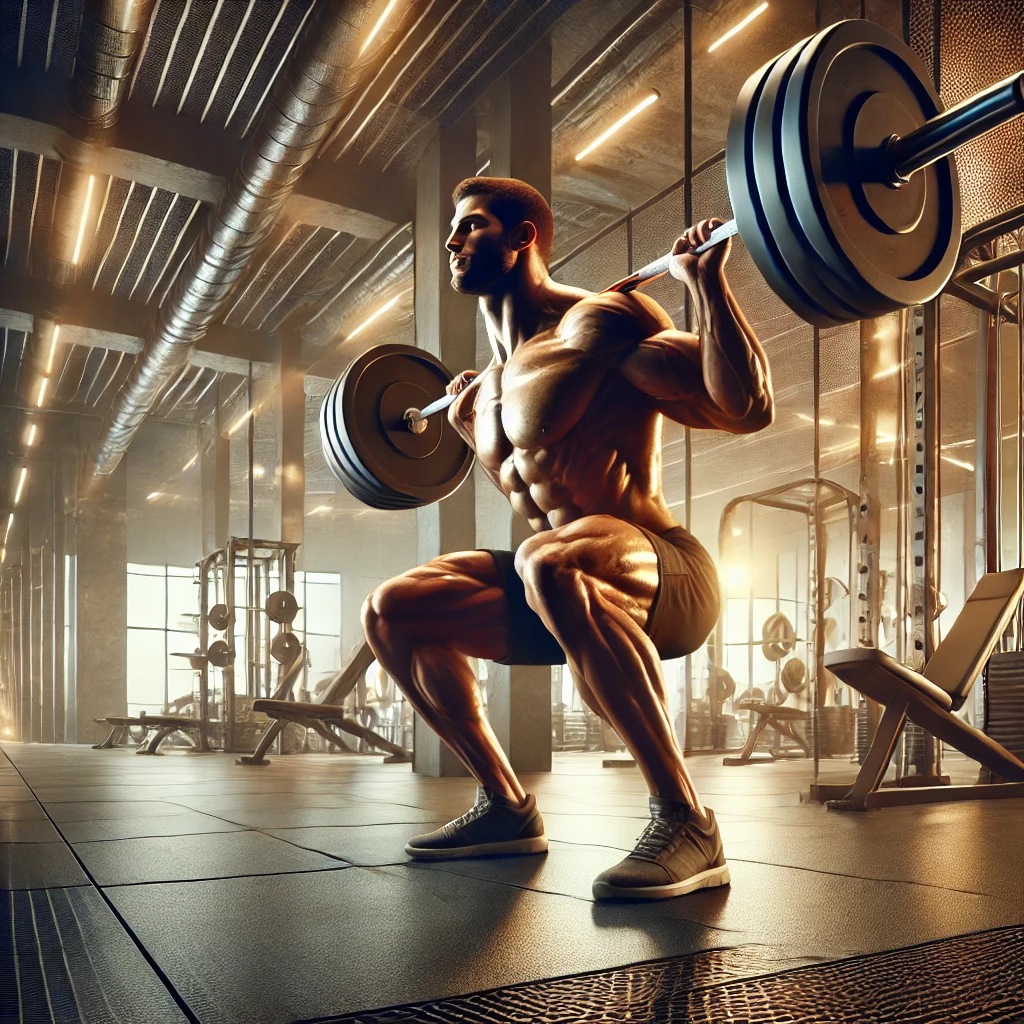
1. Squats
The squat is the foundation leg exercise, recruiting every major muscle group of the lower body.
Execution:
- Stand with the feet at shoulder width.
- Bend the knees and lower the hips as though sitting down on a chair.
- Descend until the thighs are parallel to the floor.
- Drive through the heels to return to the starting position.
Floor requirement: a squat rack or power rack with adjustable catches, an olympic barbell and flooring able to take a failed rep.
2. Lunges
Lunges are excellent for working the quadriceps, hamstrings and glutes.
Execution:
- Take a long step forward with one leg.
- Bend both knees until they form ninety-degree angles.
- Return to the starting position by driving through the heel of the front leg.
- Repeat with the other leg.
Floor requirement: a clear lane, ideally the same track used for carries and sled work.
3. Deadlifts
The deadlift targets the hamstrings, the glutes and the lower back.
Execution:
- Stand with the feet at hip width, the bar in front of you.
- Hinge at the hips and knees to grip the bar, hands slightly wider than the shoulders.
- Stand up by driving through the heels and extending the hips.
- Bring the bar up until you are standing upright, then lower it slowly.
Floor requirement: a lifting platform or dedicated weightlifting flooring, since this is the movement that destroys ordinary surfaces first.
4. Leg press
The leg press is an excellent exercise for targeting the quadriceps and glutes.
Execution:
- Sit on the leg press machine with the feet placed on the platform.
- Push the platform with the feet until the legs are almost straight.
- Return slowly to the starting position by bending the knees.
Floor requirement: a substantial footprint. This machine is the single largest item in most leg zones and should be positioned before anything else.
5. Leg extensions
This exercise isolates the quadriceps, providing targeted strengthening.
Execution:
- Sit on the leg extension machine.
- Place the feet under the lever pad.
- Extend the legs until they are straight.
- Return slowly to the starting position.
6. Leg curls
Leg curls target the hamstrings specifically.
Execution:
- Lie on the leg curl machine with the feet under the pad.
- Bend the knees to bring the pad towards the buttocks.
- Return slowly to the starting position.
7. Standing calf raises
Standing calf raises are essential for strengthening the calf muscles.
Execution:
- Stand with the feet at hip width and the heels raised on a block.
- Lift the heels as high as possible.
- Return slowly to the starting position.
Getting the most from leg training
1. Vary the exercises
Include different exercises to reach every leg muscle. Alternate between squats, lunges, deadlifts and the leg press for complete development.
2. Use progressive loading
Increase the load gradually to stimulate muscle growth. Never sacrifice form in order to lift heavier.
3. Respect rest periods
Allow the muscles to recover between sets. A rest of 60 to 90 seconds is generally recommended for strength work.
4. Maintain good technique
Perform every movement with correct technique to avoid injury and get the most from the exercise.
5. Add complementary work
Train the stabilising and antagonist muscles as well, for balanced development.
Sample training programme
Leg programme, twice per week
- Squats: 4 sets of 8 to 12 repetitions
- Lunges: 3 sets of 10 repetitions per leg
- Deadlifts: 3 sets of 8 to 10 repetitions
- Leg press: 3 sets of 10 to 12 repetitions
- Leg extensions: 3 sets of 12 to 15 repetitions
- Leg curls: 3 sets of 12 to 15 repetitions
- Standing calf raises: 4 sets of 15 to 20 repetitions
What this programme means for your equipment list
Read the programme back as a specification and the leg zone builds itself. Squats and deadlifts need squat racks and power racks with proper catches and enough clear space around them for a lifter to bail safely.
The leg press is usually the anchor of the machine side, and a vertical leg press is worth considering where floor area is tight, since it delivers heavy loading in a much smaller footprint. Extensions, curls and calf work then come from the selectorised machine range, which is what makes progressive loading practical for members who cannot yet load a bar.
All of it should be specified to EN ISO 20957-1 class S, the class intended for supervised professional and commercial use. Leg machines carry the heaviest loads in the building and are the least forgiving of an under-specified duty rating.
Frequently asked questions
How many leg stations does a gym need?
That follows from peak occupancy and programming rather than from total membership. Count how many people train legs simultaneously at your busiest hour and specify from that number.
Can a leg zone work with machines alone?
It can, but it constrains what you can programme. Squats and deadlifts need a rack and a platform, and no machine reproduces them fully, so most floors combine both approaches.
What flooring does a leg zone need?
Denser, thicker rubber than general training flooring, particularly under racks and platforms where loaded bars are set down repeatedly.
What standard applies to this equipment?
EN ISO 20957-1 class S for indoor equipment in supervised commercial use. Permanently installed outdoor adult training equipment falls under EN 16630 instead.
Specifying your leg zone
Training the legs effectively requires understanding the exercises and executing them correctly. Equipping for them requires the same clarity: know the programme, count the simultaneous users, and specify racks, machines and flooring together rather than in sequence.
Light In Fitness has equipped professional training facilities since 2013. Send us your floor plan and your peak occupancy and we will come back with a leg zone configuration and a costed proposal. Request a quote to get started.