Impact-Attenuating Surfacing for Safe Children's Playgrounds
Un revêtement d'aire de jeux doit absorber la hauteur de chute critique de chaque équipement, mesurée par le test HIC selon la norme EN 1177. L'épaisseur se calibre équipement par équipement, pas pour l'ensemble de l'aire. Un sol sous-dimensionné rend l'installation non conforme quelle que soit la qualité des structures.

Playground surfacing has to absorb the critical fall height of each individual item of equipment, measured by the HIC test under EN 1177. The thickness is calibrated equipment by equipment, not once for the whole site. An under-specified surface makes the installation non-compliant however good the play structures are.
Surfacing is the least visible line in a playground budget and the one most often reduced. It is also the line an inspector examines first, because it is the only part of the installation whose job is to work at the exact moment something goes wrong.
Why impact-attenuating surfacing matters
Children fall. That is not a design failure, it is how play works, and a playground is engineered around it rather than against it. The surface absorbs the energy of the fall and is what separates a bruise from a head injury. Around swings, climbing structures and slides – the places where fall heights are greatest – it is the single most important safety component on the site.
How fall height drives the specification
Every item of playground equipment has a critical fall height: the greatest distance from which a user can fall from it. Under EN 1177, a surfacing material is tested to a critical fall height by the HIC method – Head Injury Criterion – which measures the deceleration a head would experience on impact. The result is a certified fall height for that material at that thickness.
The consequence is straightforward and constantly ignored: the surface under a low toddler unit and the surface under a tall climbing frame are not the same specification, even when they look identical. Calibrate the thickness against the highest critical fall height in each impact area, not against an average for the site.
Where the surfacing has to extend
The impact area is not the footprint of the structure. It extends beyond it, and around swings it extends considerably further along the arc of travel. A surface that is correct directly under the equipment and stops too early is a non-compliant surface.
The material options
Rubber tiles
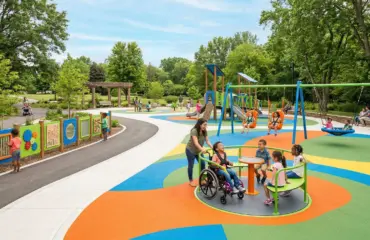
Bonded rubber tiles are the reference solution where performance has to stay stable with minimal intervention. They are supplied in thicknesses matched to certified fall heights, they resist wear and UV, they drain, and they do not migrate. They also give a firm, even surface, which is what makes them the only realistic option where wheelchair access into the play area is part of the brief. Their drawback is the higher initial cost.
Wet-pour rubber
A seamless in-situ surface with the same performance logic as tiles and more design freedom in colour and shape. It suits complex layouts and level changes, and it needs a competent installer and a sound base to deliver its tested performance.
Loose fill
Wood chips, sand and gravel attenuate impact well when they are at the right depth. Playground wood chips are the lowest-cost route to a large impact area, which is why they are so widely used on big sites. The catch is that loose fill only performs at depth: it displaces under swings and at slide exits, it compacts over time, and it has to be raked and topped up on a schedule rather than when someone complains.
Artificial grass systems
Turf laid over a shock pad combines the appearance of grass with a certified fall height. It performs well and needs a specified pad thickness to reach the fall height claimed – the turf alone attenuates almost nothing.
Comparing cost against durability
| Material | Initial cost | Maintenance demand | Best suited to |
|---|---|---|---|
| Rubber tiles | High | Low | High-traffic sites, accessible play areas |
| Wet-pour rubber | High | Low | Complex shapes, design-led schemes |
| Loose fill | Low | High and recurring | Large areas with an active maintenance team |
| Turf over shock pad | Medium to high | Medium | Sites where appearance matters |
The honest comparison is not purchase price against purchase price. It is purchase price plus ten years of upkeep, against the same for the alternative – and the decisive variable is who will maintain the site and how often they can realistically attend. A cheap surface with nobody to rake it is the most expensive option on the list, because it stops being compliant within a season.
Standards: two separate requirements
Children’s play equipment is covered by EN 1176-1. Impact-attenuating surfacing is covered by EN 1177. They are two distinct requirements and a common source of confusion. EN 1176-1 qualifies the structure; EN 1177 qualifies the ground that catches a fall from it. Compliant equipment over a non-compliant surface is a non-compliant playground.
A third boundary is worth stating: EN 16630 applies to outdoor fitness equipment intended for adults, and it does not apply to children’s play equipment. Where a scheme combines a play area with an adult fitness zone – a sound idea in a park – the two zones are specified against their own standards and physically separated.
Ask suppliers for the EN 1177 test report showing the certified critical fall height at the thickness you are buying. A material family name is not a certification, and a fall height quoted without a thickness is not usable information.
Maintenance keeps the surface compliant
A surface is only compliant while it still performs. Build the checks into the site routine: inspect for wear, displacement, compaction and shrinkage, with particular attention under swings and at slide exits where the loading is concentrated. Keep tiles clean and free of debris that impedes drainage. Rake and top up loose fill to its specified depth on a schedule. Check joints and edges, which is where tiles lift and where trip hazards begin.
Record the inspections. The written record is what an operator relies on if an incident is ever investigated, and it is also the earliest warning that a budget line is needed.
Frequently asked questions
How thick does playground surfacing need to be?
There is no single answer, and any supplier who gives one without asking about your equipment is guessing. The thickness is set by the critical fall height of the equipment above it and by the certified performance of that material at that thickness under EN 1177.
Is grass an acceptable playground surface?
Natural grass is not an impact-attenuating surface: its performance is uncontrolled and it degrades under use. Artificial turf over a specified shock pad is a tested system and a different proposition entirely.
Are rubber tiles worth the extra cost?
On high-traffic sites and wherever maintenance visits are infrequent, generally yes, because their tested performance holds with little intervention. On large areas with an active grounds team, loose fill can remain the economic choice.
Does surfacing need to be continuous across the whole playground?
No. It has to cover the impact area of each item of equipment to the fall height that item requires. Circulation areas outside those zones can be surfaced differently, provided the transition creates no trip hazard.
What does the HIC test measure?
The Head Injury Criterion measures the deceleration a head would experience on impact with the surface, and is used under EN 1177 to establish the critical fall height a material can be certified for.
Specifying your playground surfacing
Work in this order: list the equipment, take the critical fall height of each item, define the impact areas, then choose the material and thickness that is certified for the worst case in each area. Our playground surfacing range is specified this way as a matter of course. Send us the equipment list and the layout and we will return a surfacing specification zone by zone. Request a quote to start.
Réalisations documentées
- Cage street workout ultime, Carcassonne – armée française
- Cage street workout ultime, Tahiti – armée française, Polynésie
- Cage SP Max, centre EPIDE de Combrée – établissement public d’insertion
- Cage SP Max, lycée Saint-Bénigne de Dijon – établissement scolaire
Sources et références
- Décret n° 96-1136 du 18 décembre 1996 – prescriptions de sécurité relatives aux aires collectives de jeux (Légifrance)
- NF EN 1176-1 – Équipements et sols d’aires de jeux, partie 1 : exigences de sécurité et méthodes d’essai générales (AFNOR)
- NF EN 1177 – revêtements de surface amortissants : détermination de la hauteur de chute critique (AFNOR)