Spring Riders: The Simplest Way to Complete an Existing Playground
Les jeux à ressort sont la famille la plus simple à implanter : 0,4 à 0,7 m de fondation et une hauteur de chute libre faible, soit l'exigence de sol la plus basse du catalogue. C'est la seule famille qu'on ajoute à une aire existante sans reprendre le revêtement. Les 24 modèles couvrent 3 à 14 ans, en une place, biplace ou grande bascule collective, avec des articulations métal-caoutchouc sans entretien.
Spring riders are the simplest playground family to install: foundations of only 0.4 to 0.7 m and a low free fall height, which gives them the lowest impact-absorbing surfacing requirement in the catalogue. That is what makes them the natural way to complete an existing playground, since they can be added without relaying the surface already in place. The 24 models cover ages 3 to 14.
Three formats, three uses
| Format | What it brings | Typical situation |
|---|---|---|
| Single seat | Individual play, minimum footprint | Point addition, small square |
| Two seats | Two children facing each other, shared play | Neighbourhood playground, residential scheme |
| Large group rocker | Several children together, structuring item | Municipal park, leisure site |
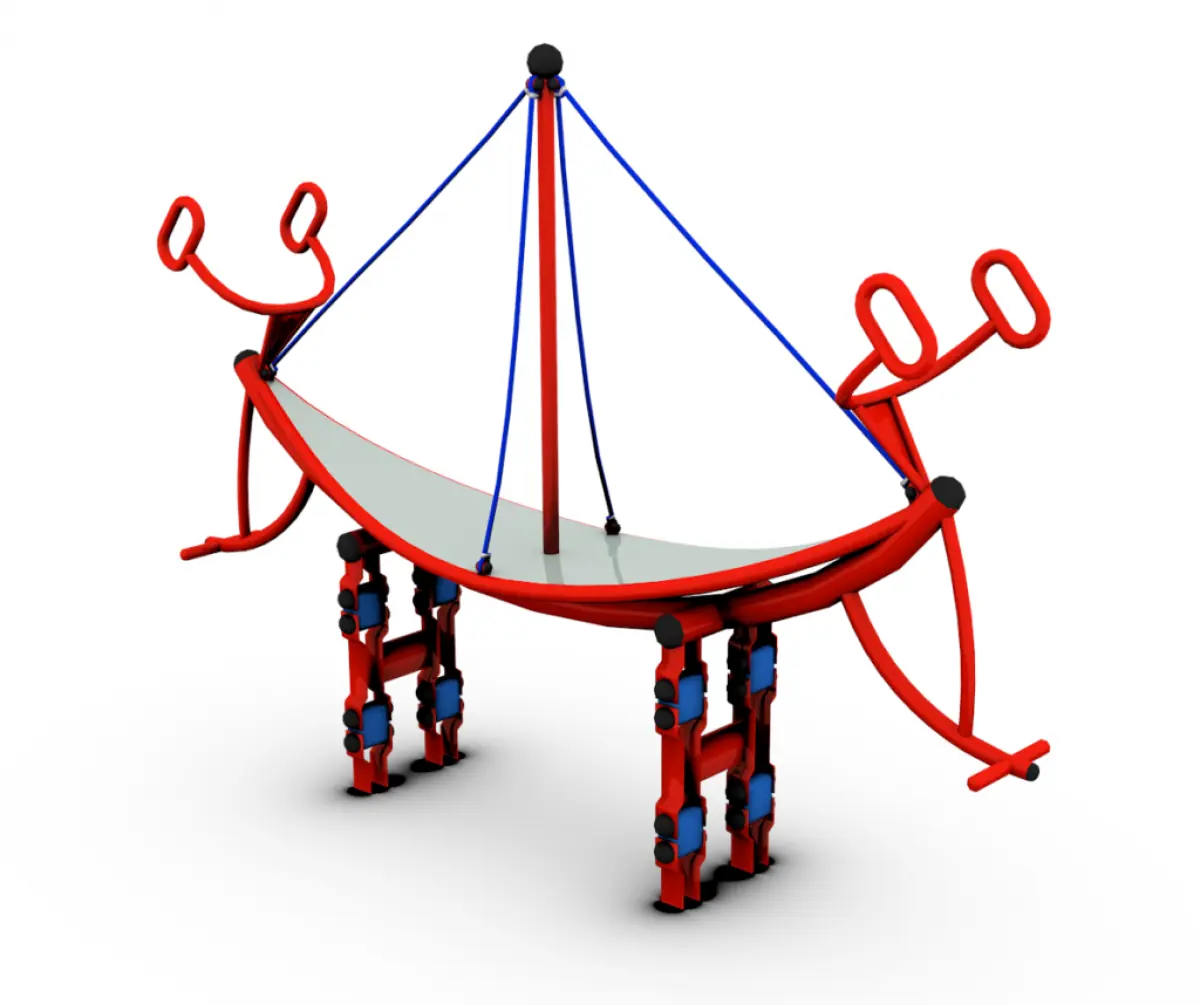
The Gondola rocking unit illustrates the group format: a large rocking unit fitted with eight maintenance-free metal-rubber joints, for a free fall height of 1.0 m. At the other end of the range, the compact Maze springer works with two joints.
Shapes that give the playground an identity
The theme is not only decoration: it gives an identity to a small playground that cannot afford a large structure. The range includes the round, brightly coloured Ball springer, the Surfboard, the Tube springer with its colourful design, and the Maze. On a neighbourhood square, the spring rider is usually the item children recognise and name.
Why maintenance is so low
The metal-rubber joints require no greasing and no adjustment: maintenance is limited to the periodic inspection required by EN 1176 and to checking the fixings. On a playground managed by an already stretched technical department, that criterion counts as much as the purchase price.
Adding them to an existing playground
This is where the family earns its place. A playground equipped with a structure for ages 5 to 14 often leaves the 3 to 5 age group with nothing. One or two spring riders close that gap for a limited amount of groundwork, whereas adding a rope pyramid or an elevated playhouse would mean relaying the surfacing across a much wider area. For the youngest children, complete the playground with swings, the only family covering ages 0 to 14.
Children playground equipment falls under EN 1176-1, and the impact-absorbing surfacing under it falls under EN 1177. The two are separate requirements and are never interchangeable; equally, a children item is never specified under the adult outdoor fitness standard.
Frequently asked questions
From what age?
The models in the range are declared for ages 3 to 14. For younger children, swings cover the 0 to 14 range.
Can a spring rider be added without redoing the surfacing?
This is the family that most often allows it: low free fall height and foundations of 0.4 to 0.7 m. The safety zone still has to be respected and is shown on the installation drawing.
What maintenance should be planned?
The metal-rubber joints are maintenance-free. What remains is the periodic EN 1176 inspection and the check of the fixings.
How many children at a time?
One on the single-seat models, two on the face-to-face two-seat versions, and several on the large group rockers such as the Gondola with its eight joints.
What foundation depth?
From 0.4 to 0.7 m depending on the model, the lowest figure of any playground equipment family.
Specifying your addition
See the full spring riders range. These models are supplied against quotation: send us the plan of the existing playground, the age groups you need to cover and the surfacing already in place, and we will return an installation study with the safety zones drawn. Request a quote and we will work from your site plan.
Sources et références
- Décret n° 96-1136 du 18 décembre 1996 – prescriptions de sécurité relatives aux aires collectives de jeux (Légifrance)
- NF EN 1176-1 – Équipements et sols d’aires de jeux, partie 1 : exigences de sécurité et méthodes d’essai générales (AFNOR)
- NF EN 1177 – revêtements de surface amortissants : détermination de la hauteur de chute critique (AFNOR)