Fibreglass Pump Track: How to Choose the Right One
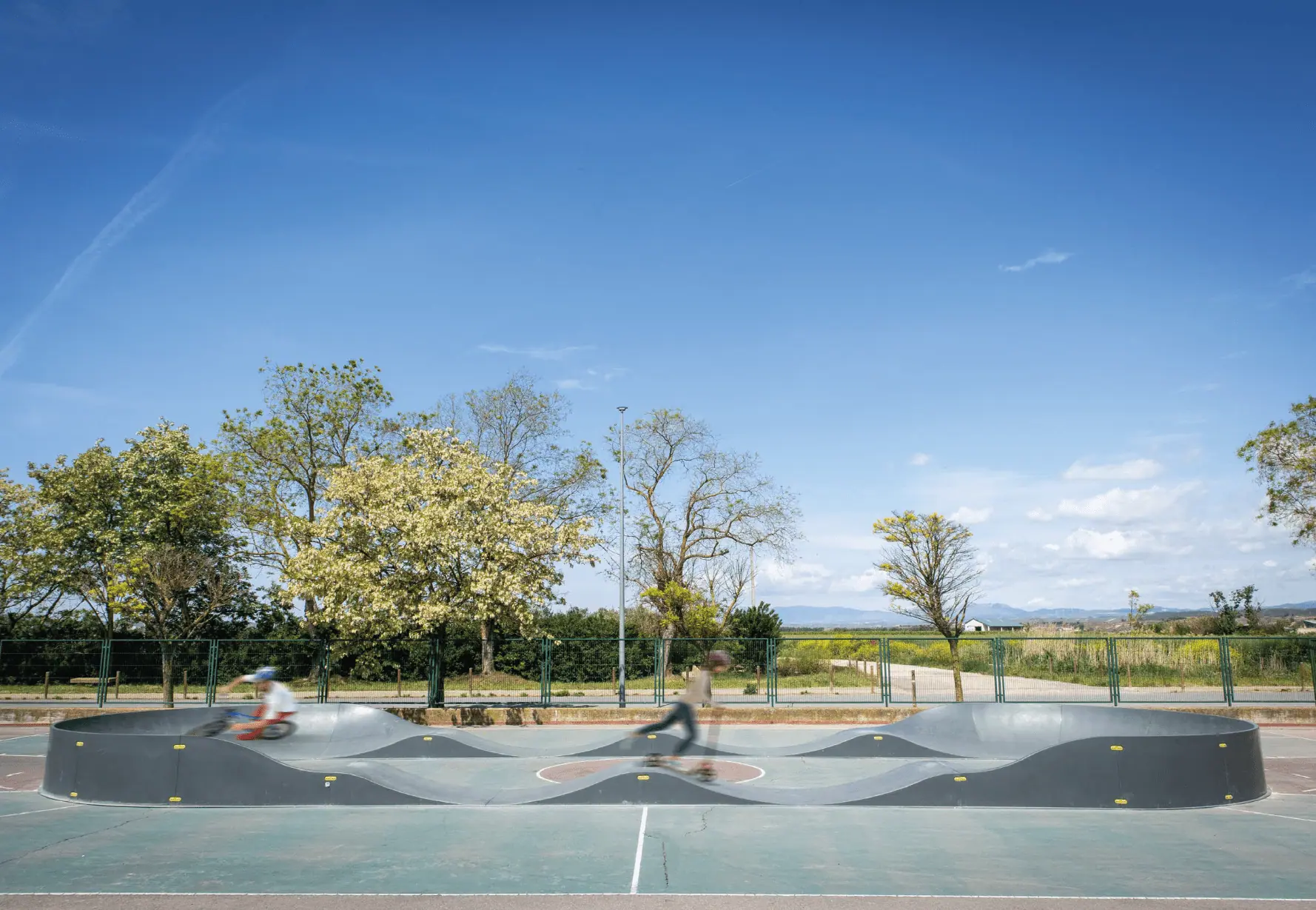
Pump tracks have moved from niche BMX culture to a mainstream outdoor amenity for municipalities, holiday parks, campsites, schools and sports clubs. They give cyclists, skateboarders and scooter riders a continuous rolling circuit that works for beginners and competitors alike. Among the materials available, glass fibre reinforced polyester has established itself as the modern, engineered option: hard wearing, durable and easy to maintain, it suits ambitious projects that have to stay open year after year. In this guide, Light In Fitness takes you through the criteria that decide whether a fibreglass pump track is a sound investment.
Why choose a glass fibre reinforced polyester pump track?
Glass fibre reinforced polyester brings a specific set of advantages to wheeled sports surfaces, and they are the reason it is now specified on public projects that were once built in timber or asphalt.
- Exceptional durability: it stands up to weather, UV exposure and constant wear.
- Smooth, fast rolling surface: a fluid, predictable ride for every discipline.
- Fast installation: prefabricated modules that are assembled on site.
- Low maintenance: fewer repairs and a simple cleaning routine.
Comparison table: what fibreglass changes
| Criterion | Glass fibre reinforced polyester | Other materials |
|---|---|---|
| Durability | Around 20 years of service, BMX use included | 10 to 15 years (timber, asphalt) |
| Initial cost | Higher, but cost effective over the life of the facility | Variable, often cheaper up front |
| Maintenance | Low, straightforward cleaning | High, regular repairs needed |
| Installation | Fast, prefabricated modules | Slower, heavy plant required |
1. Size and layout of the track
The footprint and the layout decide both the user experience and the land you need to set aside. Match the size to the project and to the people who will actually ride it: children, beginners or trained athletes.
Questions to ask before you specify
- Who will use the track? For children and beginners, choose a smaller footprint with simple modules. For athletes, go for longer circuits with technical berms.
- Where will it be installed? The available surface dictates the layout. An open site allows more complex designs.
Example configurations
- Compact: 100 to 150 sq m, ideal for tight urban sites and a single BMX loop.
- Medium: 200 to 300 sq m, the usual choice for public parks.
- Large: 400 sq m and above, for events and large destination parks.
Light In Fitness tip: specify a layout that can grow, so modules can be added as budget and demand allow.
| Size | Best suited to |
|---|---|
| Compact (100 to 150 sq m) | Play areas and urban sites for skate and BMX |
| Medium (200 to 300 sq m) | Municipal parks and community spaces |
| Large (400 sq m and above) | Sporting events and large parks open to all ages |
2. Customisable modules and design
Design and customisation drive how attractive the facility is and how long riders stay on it. Fibreglass pump tracks allow a fully bespoke layout, combining rollers, humps and tight berms. You can see the full range on our modular pump tracks pages.
Modules worth considering
- Rollers: they carry speed and make the circuit flow, on a mountain bike as much as on a BMX.
- Banked berms: they add speed and difficulty on the fast sections.
- Learning zones: flat sections where beginners can build confidence safely.
- Ramps: for skateboarders and scooter riders.
What customisation buys you
- A track that fits its users: every level is catered for on the same circuit.
- A distinctive facility: a design of its own attracts more visitors.
- Room to grow: new modules can be added without rebuilding the track.
A worked example: one leisure park installed a customisable pump track with interchangeable sections, which lets the operator refresh the ride every year without civil works.
| Module | Benefit |
|---|---|
| Rollers | Flow, and faster skill progression |
| Banked berms | Higher speed through the turns |
| Ramps | Suited to skateboarders and scooter riders |
3. Safety and applicable standards
Safety governs every decision on a pump track. Fibreglass modules give a smooth, non slip riding surface, which limits loss of grip and reduces falls.
Safety points to check
- Non slip surface: grip has to hold in wet weather, for skateboards as much as for bikes.
- Regulatory framework: a pump track is a wheeled sports facility, not playground equipment. Confirm the requirements that apply with the authority having jurisdiction in your country before the design is frozen.
- Adjacent play equipment: where the project also includes a children’s play area, that equipment falls under EN 1176-1 and its impact attenuating surfacing under EN 1177. The two are distinct and neither should be transferred onto the track itself.
- Perimeter protection: fencing or barriers keep riders and pedestrians apart.
Light In Fitness advice: post signage at the entry point setting out the rules of use and the protective equipment expected, such as helmets and knee pads.
| Reference | Scope |
|---|---|
| EN 1176-1 | Children’s playground equipment installed alongside the track |
| EN 1177 | Impact attenuating surfacing under that playground equipment |
| Non slip surface | Riding surface of the track itself |
4. Budget and cost
A fibreglass pump track looks expensive at first sight, but low maintenance and a long service life change the picture over ten or twenty years. The clearest way to build a budget is to work from real, configured circuits rather than from a cost per square metre.
| Configuration | Catalogue price | Typical use |
|---|---|---|
| Pump track, 41 linear metres | 39,500.00 EUR excluding VAT | Community sites and smaller parks |
| Pump track, 54 linear metres | 57,800.00 EUR excluding VAT | Municipal parks |
| Pump track, 90 linear metres | 92,755.00 EUR excluding VAT | Destination parks and events |
Keeping the cost down
- Modular installation: assembly time and labour costs both fall.
- Preventive maintenance: routine checks avoid expensive repairs later.
Frequently asked questions
How long does a fibreglass pump track last?
Around 20 years of service, against 10 to 15 years for timber or asphalt, provided routine maintenance is carried out.
How much space do I need?
From 100 to 150 sq m for a compact loop, 200 to 300 sq m for a park installation, and 400 sq m or more for an events grade circuit.
Can the track be extended later?
Yes. Because the modules are prefabricated and bolted, sections can be added or swapped without rebuilding the circuit.
Which disciplines can use it?
BMX, mountain bike, skateboard and scooter, on the same circuit.
Specify your pump track with Light In Fitness
A glass fibre reinforced polyester pump track is a sound choice for its durability, its speed of installation and its low maintenance. Get the footprint, the module mix and the safety framework right, and the facility will serve every level of rider for two decades. Our team can size the circuit against your site and your user profile: request a quote and we will come back with a configured layout and a firm price.