Play tower, elevated playhouse or tubular structure: how to choose
Seules les tours de jeu permettent de descendre à 1,5 m de hauteur de chute libre ; les cabanes perchées (2,6 à 3,0 m) et les structures tubulaires (2,5 à 3,0 m) imposent d'emblée le sol le plus performant. Les tubulaires demandent en plus jusqu'à 1,1 m de fondation, la valeur la plus élevée du catalogue, mais leur acier galvanisé à chaud limite l'entretien à l'inspection. Sur une tour, la hauteur de la plateforme, pas la silhouette, fixe le coût du sol.
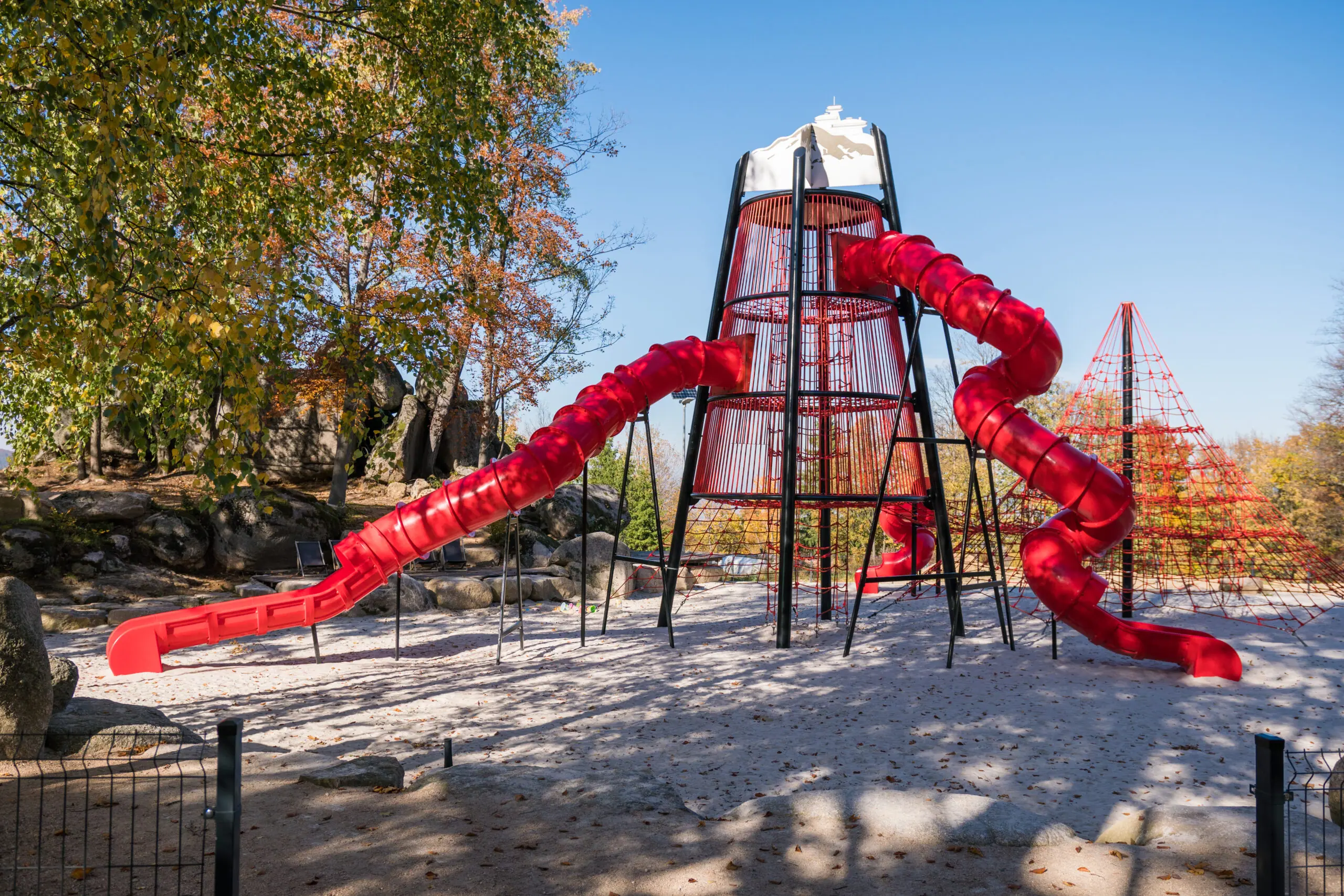
Three playground families reach free-fall heights of up to 3.0 m: play towers, elevated playhouses and tubular structures. They create the visual landmark of a park and the challenge that eight to fourteen year olds are looking for, but they also call for the highest-performing impact-attenuating surfacing and the deepest groundworks on the site. This guide compares what each family delivers and what it costs you in construction work.
The three families side by side
| Family | Models | Free-fall height | Foundation depth | What sets it apart |
|---|---|---|---|---|
| Play towers | 12 | 1.5 to 3.0 m | 1.0 m | The only family where a moderate height can be chosen |
| Elevated playhouses | 9 | 2.6 to 3.0 m | 1.0 m | Narrative and role play, off the ground |
| Tubular structures | 18 | 2.5 to 3.0 m | 0.8 to 1.1 m | Hot-dip galvanised steel, upkeep reduced to inspection |
The decisive difference comes down to a single line in that table: only the towers offer a range wide enough to come down to 1.5 m of free-fall height. The other two families start above 2.5 m, which means the surfacing requirement is fixed the moment you choose the family, not the model.
Play towers: the platform decides everything
A tower is sized on the height of its platform, not on the height of its silhouette. Across the twelve models the spread runs from 1.5 to 3.0 m, so the surfacing cost can vary by a factor of two between two towers that look much alike from the car park. The Tipi tower, a truncated pyramid on five posts, stays at 1.5 m; the Twist tower, twisted between two decagons, reaches 1.8 m; the Skytower with its three stepped levels reaches 2.5 m; and the Cubes4, four stacked and rotated steel cubes, tops out at 2.6 m.
One point specific to this family: the slide exit. Whether tubular or open, it requires a clear run-out zone at the foot, which has to be worked into the site plan before the orientation of the tower on the plot is fixed.
Elevated playhouses: a different kind of play
Playhouses are not aimed at physical performance but at narrative play: hiding, watching, inhabiting a place of one own. The nine models come as themed worlds, from the Foliage houses to the Forest houses, ranging from a pair of units to a route of six modules linked by suspended walkways.
Their free-fall height is high and consistent, 2.6 to 3.0 m, with a constant 1.0 m foundation: the surfacing to budget for is the thickest in the range, with no variation available between models. That is a cost to accept at the design stage rather than discover at tender. Worth noting too: the means of access, climbing, ladder or walkway, determines the real minimum age far more than the published age band does.
Tubular structures: less upkeep, more groundworks
Hot-dip galvanised steel tubes limit maintenance to periodic inspection. There is no repainting cycle to schedule, which matters a great deal to a technical department managing a whole estate of equipment. The trade-off is that this is the most demanding family for groundworks, with foundations down to 1.1 m, the deepest figure in the catalogue.
The range runs from an open dome on three supports (Evolo, 2.8 m) to a large structure built around a central tube with forty climbing ropes (Tiaki, 2.9 m), by way of a circular ring with a vertical climbing wall (Lupi). Two models come down to age 3, Miniroodix and Roodix, which is unusual at this height.
Choosing without misjudging the cost
- Plot with buried services: check the foundation depth before the silhouette. Tubular structures may be impossible where a tower would go in without difficulty.
- Constrained surfacing budget: the tower is the only tall family that can come down to 1.5 m of free-fall height.
- Small technical team: the hot-dip galvanising on the tubular family removes the repainting cycle.
- Mixed age groups: check how the playhouses are accessed, since that governs the real age of use.
On standards, equipment in this category falls under EN 1176-1, and the impact-attenuating surfacing beneath it under EN 1177. The two are separate requirements and the second is the one most often underestimated at budget stage. Our playground surfacing range covers the specifications these free-fall heights demand.
Frequently asked questions
Which tall family costs least in construction work?
Play towers, because they alone come down to 1.5 m of free-fall height. Elevated playhouses and tubular structures start above 2.5 m, which imposes a higher-performing impact-attenuating surface.
Why check the foundation before the model?
Tubular structures require up to 1.1 m of depth, the highest figure in the catalogue. On a site with buried services, that number can make a model unbuildable regardless of its price.
Do tubular structures need maintenance?
The tubes are hot-dip galvanised, so upkeep is limited to the periodic inspection required under EN 1176, with no repainting to schedule.
What age range do they suit?
The dominant band is 5 to 14 years. Two tubular structures, Miniroodix and Roodix, are rated from age 3. On the playhouses, it is the means of access that sets the real minimum age.
What has to be allowed for at the foot of a slide?
A clear run-out zone, worked into the plan before the orientation of the tower is fixed. It is the sensitive point of this family.
Getting a layout study
These structures are supplied to quotation. Send us the plot dimensions, the age groups to serve and any known constraints on foundation depth, and we will come back with a layout and a surfacing specification. Start with a request for a quotation.
Réalisations documentées
- Dalles et sols sportifs : livraisons documentées – plusieurs chantiers
- Sol sportif extérieur, square Georges-Vallerey – Taverny (95)
Sources et références
- Décret n° 96-1136 du 18 décembre 1996 – prescriptions de sécurité relatives aux aires collectives de jeux (Légifrance)
- NF EN 1176-1 – Équipements et sols d’aires de jeux, partie 1 : exigences de sécurité et méthodes d’essai générales (AFNOR)
- NF EN 1177 – revêtements de surface amortissants : détermination de la hauteur de chute critique (AFNOR)