Selectorised Leg Extension Machines: The Complete Guide

Selectorised leg extension machines are a core station for strengthening the quadriceps, the muscle group at the front of the thigh. They target the quadriceps precisely while keeping the movement safe and controlled, which is why they appear on almost every commercial training floor.
This guide covers what the station does, how it is used correctly and where it belongs in a balanced strength area.
Why the quadriceps deserve a dedicated station
The quadriceps are among the largest muscles in the body and are central to leg mobility, in walking, running and jumping alike. Training them on a leg extension machine builds strength and muscle mass in that group, which supports knee stability and improves athletic performance. The station offers a safe and effective way to isolate and load those muscles, without the technical prerequisites of a free squat.
Why choose a selectorised leg extension machine
Selectorised leg extension machines are built to deliver a smooth, secure movement that suits beginners and experienced athletes alike. They target the quadriceps specifically, which matters both for balanced muscle development and for injury prevention.
Advantages of a leg extension station
- Safety: the guided movement limits the risk of incorrect execution and injury, which is decisive for beginners training without close supervision.
- Muscle isolation: the effort stays concentrated on the quadriceps, so the training stimulus is not diluted across other muscle groups.
- Ease of use: the weight stack is adjusted in seconds, which allows progression to follow the strength and the objective of each user.
- Injury prevention: strengthening the quadriceps improves knee stability and reduces the risk of injuries linked to physical activity.
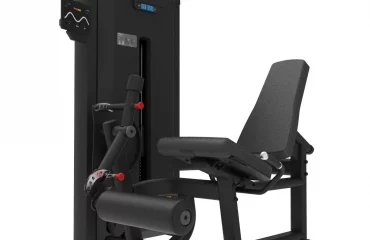
The Ellipse leg extension machine is the reference station in our range for this movement.
How a leg extension machine works
A leg extension machine combines an adjustable seat and a leg pad connected to a weight system. The user sits down and lifts the load by extending the legs, which places the demand primarily on the quadriceps.
Correct use
- Seat and pad adjustment: the seat is set so that the knees align with the axis of rotation of the machine. The pad sits just above the ankles.
- Positioning: the user sits upright with the back against the backrest, places the feet under the pad and holds the handles for stability.
- Execution: the legs extend as the quadriceps contract, until the legs are almost straight but the knees are not fully locked. The return to the starting position is slow and controlled.
These three points are worth putting on the instruction plate and into the induction session. On a shared machine, most of the value comes from the adjustment being made correctly rather than from the load itself.
Its place in a strength programme
Leg extensions are part of complete leg development. They complement leg flexion work such as squats and leg curls, which is what produces balanced development across the thigh. Strengthening the quadriceps matters for leg power, for sporting performance and for injury prevention.
In equipment terms, that means a leg extension station is normally specified together with a hamstring station rather than on its own. Both sit within the wider selectorised machine range.
Performance and rehabilitation
Leg extension machines are also used in rehabilitation settings, because they allow precise control of both the load and the movement path. That makes them useful where quadriceps strength has to be rebuilt progressively without loading the joint excessively. In that context the programme is set by the clinician, and the machine is simply the tool that makes small, repeatable load increments possible.
Frequently asked questions
What do leg extensions do for the quadriceps?
They strengthen the quadriceps, improve knee stability and contribute to injury prevention.
How often should leg extensions be programmed?
Two to three sessions a week within the leg training routine is a common frequency, adjusted to the overall programme and the objectives of the user.
Are leg extensions suitable for users with knee pain?
That is a clinical question rather than a programming one. With an appropriate load and correct technique the movement can strengthen the quadriceps, but anyone with knee pain should be assessed by a health professional before the exercise is prescribed, and the instruction should come from them.
Does a leg extension machine replace the squat?
No. It isolates the quadriceps, whereas the squat is a compound movement involving the whole lower body. They serve different purposes in the same programme.
Specifying a leg extension station
Selectorised leg extension machines are a valuable tool for strengthening the quadriceps safely and efficiently. They combine safety, ease of use and effectiveness, which makes them a natural inclusion in a leg training area for beginners and experienced members alike. The right model for your floor depends on the space available, on your expected traffic and on the rest of your strength line-up. Send us your requirements and we will confirm the specification. Request a quote.