Professional Cable and Pulley Machines for Training Floors

The cable station is the most productive square metre on a professional training floor. One frame, one weight stack and a handful of handles cover pulling, pushing, rotation and single-limb work for every muscle group, at loads fine enough for a first-week member and heavy enough for an experienced lifter. For a club, a hotel, a sports centre or a rehabilitation unit, cable equipment is what lets a limited floor area serve a very wide population. This guide explains what a cable machine is, which configurations exist, and how to specify the right ones.
What a cable machine is
A cable machine works a pulley connected by a cable to a weight stack. Resistance is set by the plates selected and modified by the pulley height and the angle of pull. Because the line of resistance can be placed anywhere from floor to overhead, the same frame trains arms, shoulders, back, chest, trunk and legs. The resistance is continuous through the range rather than dependent on gravity acting vertically, which is exactly why the cable station is the backbone of both general conditioning and rehabilitation programming.
The configurations to know
High pulley
Set above the user, the high pulley drives back, shoulder and arm work: lat pulldowns, triceps extensions, face pulls and straight-arm work. It is the single most used station on most floors.
Low pulley
Set at floor level, the low pulley covers rows, curls, upright pulls, hip work and cable-based leg exercises. Paired with the high pulley on the same frame, it doubles the exercise range for no extra footprint.
Adjustable pulley
An adjustable-height pulley is the most versatile single station on the floor. Because both the height and the direction of pull can be changed, it supports full-body movements, rotational work and sport-specific patterns that fixed pulleys cannot reproduce.
Dual cable stations and crossovers
Two independent stacks and two pulleys allow bilateral work, alternating work and true single-arm loading with a counter-balanced stance. Crossover frames are the standard answer where one station has to serve a queue at peak time. See our cable stations.
Multi-station gyms
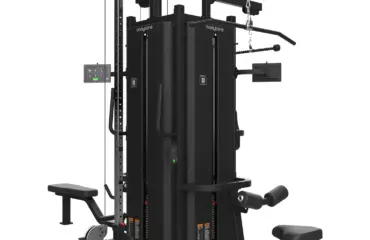
Where several people must train at once in a compact space, a multi-station frame combines pulleys with press and leg stations on one footprint. It is the usual specification for hotels, residential amenity rooms and small corporate facilities. See our multi-station gyms.
Guided barbell machines
A Smith machine is not a cable station but is often specified alongside one. Its guided bar path keeps the movement on a fixed trajectory, which makes heavy squat and press work possible with less supervision. Our professional Smith machines sit naturally next to a cable zone.
Choosing the right configuration
Start from the movements you programme
List the exercises your coaching team actually prescribes, then check which frames deliver them. A floor with three high pulleys and no adjustable station is a floor with a narrow programme, whatever the catalogue said.
Match the station to the user population
A mixed membership needs fine load increments at the bottom of the stack, generous adjustment and simple, obvious handle changes. A performance-focused room needs heavier stacks and faster changeovers. Rehabilitation settings need very fine increments and clear range control.
Plan the space, including the working envelope
Cable work needs room in front of and around the frame, not just underneath it. Crossover frames in particular demand a wide clear zone. Measure the working envelope, not the frame footprint, and check the ceiling height for overhead pulley travel.
Budget for the whole zone
Cable frames vary widely in price with stack weight, pulley count and frame quality. Specify from total cost of ownership: a frame with a proper cable and bearing specification and a real spare parts chain will outlast two cheaper ones.
Why cable equipment earns its place
Full-body coverage from one frame
Few pieces of equipment train as many muscle groups as a well-configured cable station, which is what makes it so efficient in floor-area terms.
Programming flexibility
Load, angle and handle can all be changed in seconds, so the same station serves a beginner induction, a strength session and a rehabilitation protocol on the same morning.
Joint-friendly loading
Continuous resistance without the impact of dropped loads makes cable work suitable for populations that cannot train heavily under a barbell, including older members and clients under clinical supervision.
Throughput at peak
Stations with fast load selection and no plate handling move members through faster, which matters more to a busy floor than any single specification.
Using cable equipment correctly
- Set the pulley height for the exercise.
- Select a load appropriate to the user and the objective.
- Fit the correct handle or attachment.
- Hold the handle firmly and execute the movement with controlled technique, without swinging.
- Complete the prescribed repetitions, then return the stack under control.
On a professional floor, all of this belongs in the induction and on the station instruction card, not in the hope that members work it out.
Maintenance
Cable equipment fails through cables and pulleys, and both fail progressively. Build these four points into the maintenance schedule: clean the contact surfaces after use to remove sweat and dust; lubricate moving parts as the manufacturer specifies for smooth travel; inspect the cables for fraying, abrasion and stiff spots and replace before failure; and keep the equipment in a dry environment to prevent corrosion. A documented weekly cable check is the cheapest safety measure on the floor.
Frequently asked questions
How many cable stations does a floor need?
Size from peak occupancy and from the sessions you programme, not from membership. Cable stations queue faster than any other station, so plan for the busiest hour.
Single stack or dual stack?
Dual stacks allow independent loading for each side and support far more exercises, but need more space. Single stacks are the right answer in compact rooms with a general conditioning brief.
What use class should the equipment meet?
Indoor equipment for a supervised facility with unrestricted access must be professional equipment to EN ISO 20957-1 class S.
Are cable machines suitable for rehabilitation?
They are widely used in rehabilitation because load and angle can be controlled precisely, always within the protocol set by the clinical team responsible.
Specifying your cable zone
The right cable specification comes from the movements you programme, the population you serve and the space you have. Send us your floor plan, your programme and your peak occupancy, and our technical team will propose a cable configuration alongside the rest of your strength training machines. Request a quote and we will come back with a costed layout.