Stainless Steel Strength Equipment: Advantages, Drawbacks and Comparison with Wood and Plastic

Material is the single specification line that decides how long a piece of training equipment survives, what it costs to maintain and how safe it stays under heavy use. Stainless steel, wood and plastic each answer a different brief. This comparison sets out where each one belongs in a professional installation, indoors and outdoors.
Why the material decides the specification
The material directly drives durability, maintenance, safety and performance. Choosing correctly extends the service life of the installation, improves the training experience and reduces the risk of injury. Four factors carry the decision:
- Durability. Resistance to impact and to weather, which is decisive for anything installed outdoors.
- Safety. The material determines stability under load and comfort in contact.
- Maintenance. Some materials need specific treatment to avoid degradation; others need almost none.
- Cost. Purchase price varies considerably by material, and so does the cost of keeping the equipment in service.
What stainless steel gives you
Stainless steel is the default choice for professional strength equipment because of what it resists.
- Extreme durability. It resists corrosion, scratching and impact better than the alternatives.
- Low maintenance. It cleans easily and needs no specific treatment, no varnish, no sealing.
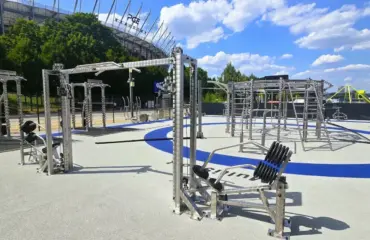
- Weather resistance. It holds up under demanding climatic conditions, which makes it the reference material for outdoor stainless steel fitness equipment.
- Modern appearance. The bright, clean finish suits professional installations and stays presentable for years.
- Hygiene. The smooth, non-porous surface prevents germs from accumulating, which matters in high-traffic and shared facilities.
Where stainless steel costs you
The material is not without trade-offs, and an honest specification acknowledges them.
- Higher purchase price. Stainless steel costs more than the alternatives and raises the price of the finished equipment.
- Visible scratching. Resistant as it is, it still shows scratches, particularly in heavily used facilities.
- Weight. Stainless steel equipment is heavier, which makes it less practical in tight spaces or where equipment has to be moved.
- Cold to the touch. Some users find the contact less comfortable, especially in cold climates.
Stainless steel, wood and plastic side by side
| Material | Advantages | Drawbacks | Cost | Best suited to |
|---|---|---|---|---|
| Stainless steel | Durable, weather-resistant, hygienic | High cost, visible scratches, weight | High | Outdoor installations, professional facilities |
| Wood | Attractive, light, pleasant to touch | Less durable, sensitive to moisture | Medium | Indoor spaces, studio environments |
| Plastic | Light, affordable, available in colours | Less resistant, frequent maintenance | Low | Temporary installations, children’s equipment |
Wood is used where appearance and feel matter: it is pleasant in contact but deteriorates quickly outdoors, which is why our wooden fitness trail range is built from timber selected and treated for outdoor exposure rather than from ordinary joinery timber. Plastic is affordable and available in bright colours, which is why it appears in children’s equipment and in temporary installations; it is less resistant and can crack over time.
Maintenance by material
Stainless steel
- Cleaning. A damp cloth or a mild detergent is enough.
- Scratch care. Polishing products reduce the visibility of light scratches.
- Minimal upkeep. Unlike wood, it needs no treatment and no varnish.
Wood
- Regular treatment. Timber has to be treated against moisture to prevent mould.
- Sanding and varnishing. Keeping the finish means re-varnishing regularly, above all outdoors.
- Moisture sensitivity. This is what limits the use of wood in exposed positions.
Plastic
- Frequent cleaning. Plastic soils easily and needs cleaning more often.
- Temperature sensitivity. It can crack or deform under high temperatures.
- Shorter service life. Expect replacement cycles rather than repair.
Appearance and comfort
Look and feel matter as soon as the equipment is part of a space that members choose to spend time in.
- Stainless steel: modern and professional. The industrial finish suits contemporary facilities and sits well with minimalist design.
- Wood: warm and natural. It brings a sense of comfort suited to yoga and Pilates studios and is pleasant in contact indoors.
- Plastic: colour and lightness. Available in many colours, it fits playful environments and light or temporary installations.
Safety and stability
Safety is the first criterion in a facility that runs unsupervised or at high occupancy.
| Material | Stability | Risks | Safety level |
|---|---|---|---|
| Stainless steel | Very stable, heavy | Possible scratching | High |
| Wood | Less stable outdoors | Cracking and mould | Medium |
| Plastic | Light, can tip | Fragility, rapid wear | Low |
Stainless steel offers the best stability, which reduces the risk of incident during intensive work. Wood is stable but sensitive to moisture, while plastic is the least secure option for anything carrying significant load.
Which standard applies to which installation
Material choice does not replace conformity. The applicable reference depends on where the equipment is installed and who uses it.
- Indoor training equipment: EN ISO 20957-1 class S, the reference for equipment in professional, supervised facilities.
- Outdoor adult fitness equipment: EN 16630, which covers permanently installed outdoor training equipment. This is where stainless steel earns its price, as in our outdoor stainless steel strength machines.
- Children’s play equipment: EN 1176-1 for the equipment itself and EN 1177 for the impact-attenuating surface. These are two separate standards and neither replaces the other. EN 16630 never applies to children’s equipment.
Frequently asked questions
Is stainless steel worth the extra cost outdoors?
For a permanent outdoor installation, yes. Corrosion resistance and the absence of any treatment cycle are what make the difference over the life of the equipment, and our stainless steel structures carry a lifetime warranty against corrosion, against up to twenty years on our steel structures.
Can wood be used outdoors at all?
Yes, provided the timber is selected and treated for exposure and re-treated on a maintenance schedule. Ordinary indoor timber will not survive an unsheltered position.
Where does plastic actually belong?
In children’s play equipment, in colour-driven environments and in temporary installations. It is not a material for load-bearing adult strength equipment.
Does stainless steel scratch?
It does, in high-traffic facilities. Scratches are cosmetic rather than structural, and polishing products reduce their visibility.
Choosing for your site
Stainless steel is the right answer for professional use, outdoors or in a busy facility: durability and weather resistance make it a long-term investment. Wood suits indoor environments where warmth and appearance lead, at the cost of a real maintenance routine. Plastic is the affordable, lightweight option for temporary installations and children’s equipment. Whichever you choose, weigh maintenance and safety alongside the purchase price. Tell us where the equipment will stand and who will use it, and we will specify the material with you: request a quote.
Réalisations documentées
- Cage street workout ultime, Carcassonne – armée française
- Cage street workout ultime, Tahiti – armée française, Polynésie
- Cage SP Max, centre EPIDE de Combrée – établissement public d’insertion
- Cage SP Max, lycée Saint-Bénigne de Dijon – établissement scolaire