Chest Press Machine vs Bench Press: The Complete Guide

The chest press machine and the barbell bench press are both essential for building pectoral strength and size, yet despite their similarity they are not interchangeable. Knowing when to programme the machine and when to programme the free-weight press changes what a training block delivers, and for an operator it changes what belongs on the floor. This guide compares the two movements by objective, by user level and by what each one asks of the equipment.
Why compare the two
Both target the pectorals, but each has its own character.
- Different muscle recruitment: the chest press machine guides the movement, while the bench press requires the lifter to stabilise the load.
- Different objectives: one favours isolation and controlled loading, the other builds functional stability alongside hypertrophy.
- Different accessibility: the machine is generally easier for beginners, while the bench press is preferred by advanced lifters.
Comparison table
| Criterion | Chest press machine | Bench press |
|---|---|---|
| Muscles worked | Pectorals, triceps, anterior deltoids | Pectorals, triceps, stabilising muscles |
| Safety | Very safe, guided movement | Less safe, a spotter is needed |
| Strength required | Less stabilisation needed | More strength and stability required |
| Best for | Isolation, rehabilitation, beginners | Maximal strength, hypertrophy, advanced users |
1. The chest press machine: isolation and safety
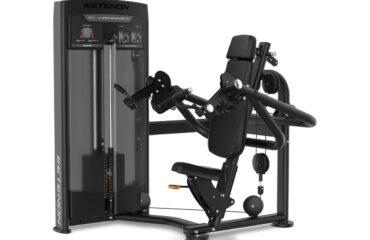
The chest press machine is a guided station designed to deliver a smooth, controlled movement. It lets the user work the pectorals without having to stabilise the load.
Advantages
- Muscular isolation: it targets the pectorals precisely and reduces the involvement of the stabilising muscles.
- Higher safety: the guided path minimises injury risk, which suits beginners and users in rehabilitation.
- Ease of use: ideal for users with physical limitations or for anyone who needs to avoid loading the shoulder.
Drawbacks
- Fixed path: the movement is constrained and does not suit every morphology.
- Less global recruitment: the stabilising muscles work less, which limits functional carry-over.
Programming example: three sets of twelve repetitions at a moderate load to build pectoral definition without joint stress.
On our chest press machines, the seat is adjustable across multiple angles, the padding is ergonomic with non-slip handles, and the stated maximum load capacity reaches 300 kg. Always confirm the figure on the technical sheet of the exact reference before you specify it.
2. The bench press: maximal strength and hypertrophy
The bench press is a free-weight movement performed with a barbell or dumbbells. It is the reference lift for anyone building strength and muscle mass.
Advantages
- Global recruitment: it works the pectorals, triceps, deltoids and the stabilising musculature.
- Functional strength: more muscles are involved, which improves coordination and stability.
- Variety: it can be performed with a barbell or dumbbells, on a flat, incline or decline bench.
Drawbacks
- Higher injury risk: poor execution or an excessive load raises the risk substantially.
- Technical demand: it requires good control of the movement and usually a spotter at heavy loads.
Programming example: for maximal strength, five sets of five repetitions at a heavy load, increasing the weight progressively.
Our weight benches use a reinforced steel structure with non-slip supports, adjust to incline, decline and flat, and carry a stated maximum load capacity of up to 500 kg. As always, the figure to specify is the one on the technical sheet of the reference you order.
3. Muscles worked: a closer look
Both movements load the pectorals first, but they differ beyond that. The chest press machine adds the triceps and the anterior deltoids while deliberately reducing the contribution of the stabilisers. The bench press loads the same prime movers but adds the whole stabilising chain, from the rotator cuff to the trunk, because the lifter has to control the bar path as well as press it. That difference is the whole reason both belong on a well-planned floor.
4. When to choose the chest press machine
- Beginners: they can focus on technique without any risk of losing balance under the load.
- Users in rehabilitation: the controlled movement avoids overloading the joints.
- Pectoral isolation: ideal for targeting the chest without excessive demand on the triceps or shoulders.
Practical tip: use the chest press at the end of the session to finish the pectorals after free-weight work.
5. When to choose the bench press
- Advanced lifters: it develops maximal strength and muscle mass.
- Functional work: it improves coordination and stabilisation, which transfers to sporting performance.
- Load progression: it allows heavier loading, which drives muscular growth.
Practical tip: start the session with the bench press to make the most of available strength, then finish with the chest press for isolation work.
FAQ
Does a gym need both? On a commercial floor, yes. They serve different member profiles and different phases of a session.
Which is safer during unsupervised hours? The chest press machine, because the load stays captive on a guided path.
Can the machine replace the bench press for advanced users? Not entirely. It is excellent for accessory volume, but it does not train the stabilisation that free-weight pressing develops.
Choose the right equipment
The machine is the answer for isolation and safety; the bench press builds global strength and mass. Both are specified for continuous multi-user duty under EN ISO 20957-1 class S in our professional ranges. Request a quote and we will propose the combination that fits your floor and your members.
À lire aussi sur le même thème
- Rubber Tiles Compared: Recycled, Virgin and EPDM
- Pump Track Materials Compared: Fibreglass vs Asphalt vs Timber
- Professional Gym Equipment Ranges Compared: Making the Right Choice
- Buying Guide: How to Choose a Professional Chest Press Machine for Your Gym
- Comment éviter les blessures lors de l’utilisation de la presse à cuisses verticale