The best outdoor fitness trail equipment: what actually gets used
Un parcours santé complet associe agrès de traction, barres parallèles, modules d'équilibre, bancs d'abdominaux et stations d'étirement. Cette combinaison couvre force, mobilité et coordination sur un même itinéraire. Le matériau, acier galvanisé ou inox, se choisit selon l'exposition du site.
The best outdoor fitness trail is not the one with the most stations, it is the one where every station is used. In practice that means six to twelve stations rather than twenty, a progressive sequence from mobility to strength, at least one third of the equipment accessible to a complete beginner, and a material specification matched to the environment. Everything else, including the brochure photography, is secondary.
An outdoor fitness trail is a route through a public space with fixed exercise stations along it, designed for free, unsupervised use. Because it is permanently installed outdoor fitness equipment in a public space, it falls under EN 16630, and any station with a significant free fall height needs an impact attenuating surface specified to EN 1177.
The station families that actually get used
Usage across a trail is never evenly distributed. Stations that are immediately legible, require no learning and produce a sensation of effort within thirty seconds carry most of the traffic. Stations that demand strength most users do not have stay empty, however impressive they look in a tender document.
| Station family | What it trains | Accessibility | Priority on a trail |
|---|---|---|---|
| Gentle cardio: outdoor elliptical, rower, step | Cardiovascular endurance, legs | Open to everyone, no technique needed | Essential, install first |
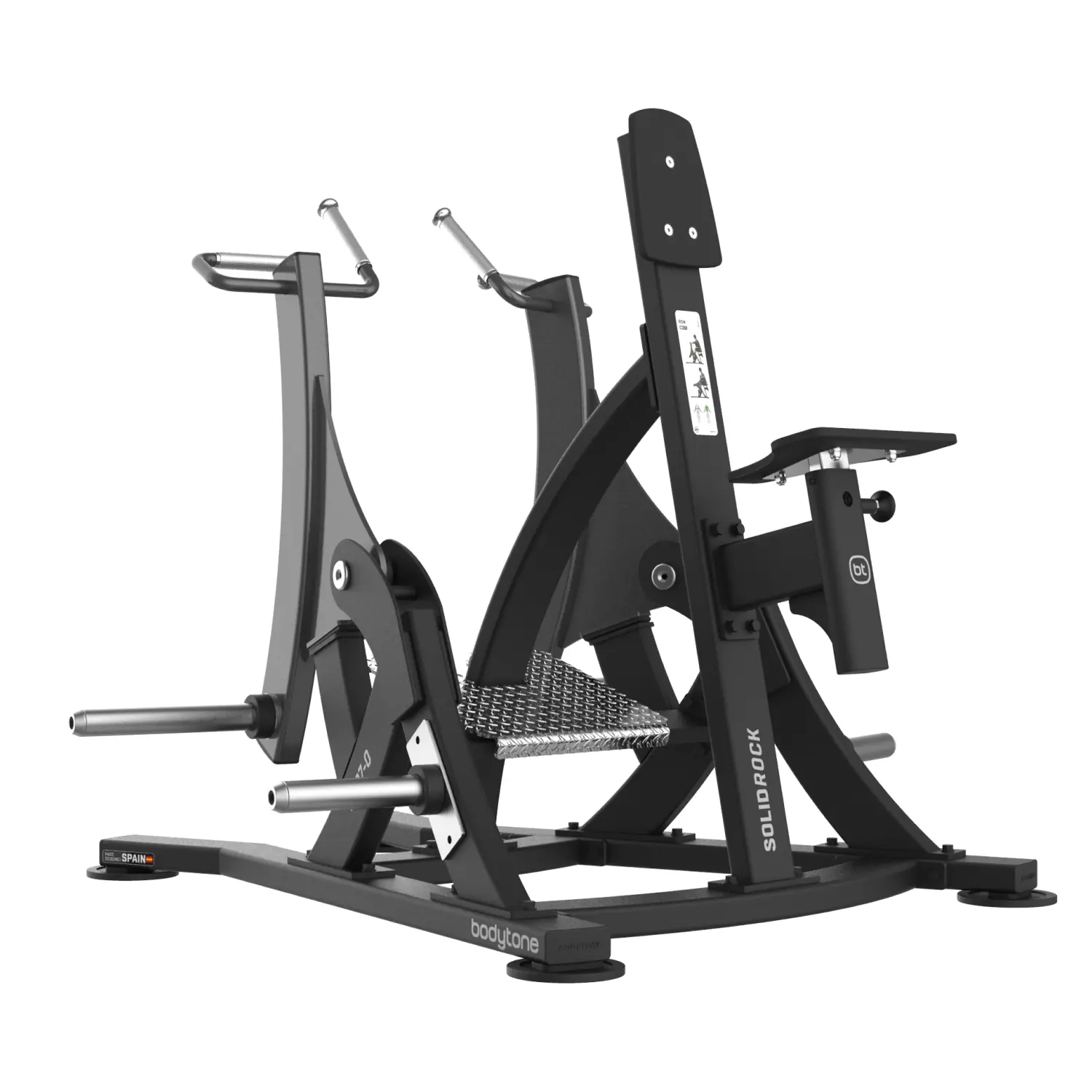
| Guided load machines: press, row, pull down | Targeted strength with a controlled path | Beginner friendly, self explanatory | Essential |
| Mobility and stretching frames, wall bars | Flexibility, core, warm up and cool down | Open to everyone including older users | Essential, place at both ends |
| Balance and coordination modules | Proprioception, stability, fall prevention | Open to everyone, valuable for older adults | High value, often omitted |
| Bodyweight bars: pull up, dips, parallel bars | Upper body and core strength | Intermediate to advanced | Include, but not as the majority |
| Street workout rig, calisthenics frame | Full body, advanced progressions | Advanced, attracts a dedicated community | One focal point, where footfall justifies it |
| Abdominal and back benches | Core and posterior chain | Beginner friendly | Useful, low cost |
| Accessible stations for reduced mobility | Upper body, coordination, rehabilitation | Designed for seated and assisted use | Widens use significantly |
How to sequence a trail
A trail is a route, not a car park for apparatus. The sequence that works follows the logic of a training session: mobility and warm up at the entry point, gentle cardio next, guided strength in the middle, bodyweight and rig work at the point of highest footfall, then balance work and stretching towards the exit. Users who arrive without a plan simply follow the order they are given, which is why the order is a design decision rather than a landscaping one.
Three practical rules. Keep the walking distance between stations short enough that momentum is not lost, typically 20 to 80 m on a park trail. Put seating in the sequence, not outside it, because carers, parents and recovering users need somewhere in the middle. And place instruction signage at every station, showing the movement and the muscles worked, since nobody is there to demonstrate it.
How many stations, on what area
| Site | Stations | Content |
|---|---|---|
| Pocket park or residential estate | 1 compact multi station | One module covering full body work, up to 10 simultaneous users |
| Neighbourhood park | 4 to 6 stations | Mobility, gentle cardio, two guided machines, bodyweight bars |
| Town park or riverside route | 8 to 12 stations | Full progressive sequence plus one rig as a focal point |
| Regional trail or coastal promenade | 12 stations and above | Themed clusters along the route, accessible stations, signage system |
Beyond twelve stations, adding more rarely increases use; distributing the same equipment across two locations usually does. This is the single most common oversizing error in outdoor fitness tenders.
Material selection, decided by the site
Galvanised steel is the default for inland municipal installations in intensive use: durable, low maintenance and the best return on investment. Stainless steel, and 316L grade in particular, is specified within reach of salt air, on coastal promenades and in humid environments, where it prevents the corrosion that forces early replacement. Timber suits landscaped parks, campsites and tourism settings where visual integration is the priority, at the cost of more frequent maintenance. Choosing on price alone and installing painted steel on a seafront is the most expensive decision available.
What separates a trail that lives from one that does not
Four things, in our experience of these projects since 2013. Legibility: a user should understand each station without reading a manual. Progression: something for the beginner and something for the trained user, on the same route. Inclusion: at least one accessible station, which widens the user base far more than an extra pull up bar. And maintenance planning: a documented inspection regime and available spare parts, because a broken station taped off for six months does more reputational damage than never having installed it.
Frequently asked questions
Should a trail be free to use and unsupervised?
Yes, that is the point of the format. It removes cost and membership as barriers to physical activity. What it does not remove is the operator’s duty of care, which is discharged through compliant equipment, correct impact attenuating surfacing, clear signage and a documented inspection regime.
Is outdoor fitness equipment suitable for older users?
Yes, and they are often the heaviest users of a well designed trail. Prioritise gentle cardio, guided load machines, balance modules and mobility frames, keep the walking distances short and provide seating. Avoid making bodyweight bars the majority of the provision if this is your target group.
What surfacing is required?
Where a station creates a significant free fall height, an impact attenuating surface specified to EN 1177 for that height, bonded on a free draining slab and extended to the safety zone required around the apparatus, which under EN 16630 means 1.50 m. Grass and bark are not equivalent solutions on a fitness trail.
What is the lead time and what does the delivery include?
Quotations are returned within 24 working hours and stock references ship within 5 to 10 working days. Standard delivery covers France, Belgium, Switzerland and Luxembourg, with export priced per project. Each item arrives with its CE documentation and maintenance logbook, and warranties run from two to five years depending on the range.
Designing a fitness trail?
Tell us the length of your route, your target users and your environment, and we will propose a station sequence, a material specification and a costed layout. Request a quotation and we reply within 24 working hours. Browse the outdoor fitness trail, outdoor gym equipment and stainless steel outdoor fitness ranges, and see our public sector pages.
Réalisations documentées
- Parcours ninja sur mesure, Rennes – îlot des Hautes-Ourmes
- Double mur ninja extérieur, Sallanches – Haute-Savoie
Sources et références
- Décret n° 96-1136 du 18 décembre 1996 – prescriptions de sécurité relatives aux aires collectives de jeux (Légifrance)
- NF EN 1176-1 – Équipements et sols d’aires de jeux, partie 1 : exigences de sécurité et méthodes d’essai générales (AFNOR)
- NF EN 1177 – revêtements de surface amortissants : détermination de la hauteur de chute critique (AFNOR)