Outdoor fitness trail equipment for councils: specification, compliance and upkeep
Un parcours santé communal offre une pratique physique gratuite, sans inscription ni horaire, dans l'espace public. Les agrès relèvent de la norme EN 16630 et supposent un sol de réception adapté. La commune reste exploitante et doit tenir un registre de contrôle daté.
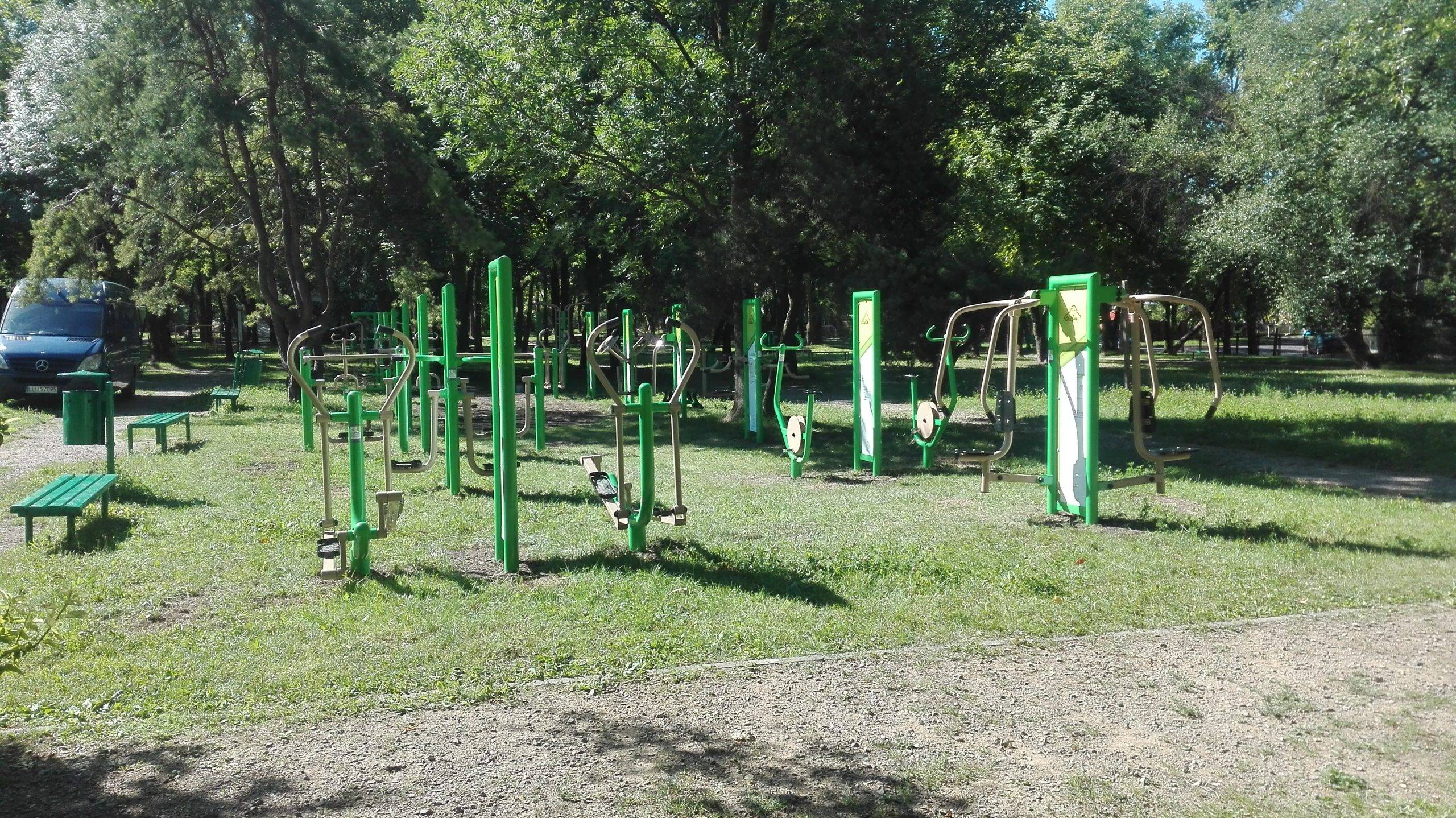
Outdoor fitness trail equipment gives a council free, permanently available physical activity provision that reaches residents who will never buy a gym membership, and it is one of the least expensive public health interventions available per user reached. What decides whether it works is not the budget but the specification: equipment compliant with EN 16630, impact attenuating surfacing to EN 1177 where a fall height exists, a material grade matched to the local environment, and a documented inspection regime from day one.
This guide is written for councillors, technical services, sports and youth departments, and the consultants who write their specifications.
What the provision delivers
Four benefits are consistently cited in the business case for these installations, and they are worth stating separately because they are approved by different committees.
Physical activity. Free, accessible outdoor exercise supports cardiovascular health, muscle and bone strength and weight management, and it removes cost and opening hours as barriers.
Chronic disease prevention. Regular physical activity is associated with reduced risk of cardiovascular disease, type 2 diabetes and several other chronic conditions. Provision that is free at the point of use reaches the residents least likely to be reached by commercial facilities.
Mental health. Regular exercise helps reduce stress and anxiety and supports emotional wellbeing, and doing it outdoors in a shared public space adds an effect that a treadmill in a basement does not.
Community. A fitness trail becomes a meeting point. It creates interaction between residents who would not otherwise cross paths, and it strengthens the sense that a public space belongs to the people who use it.
The equipment families to specify
| Family | What it provides | Typical content |
|---|---|---|
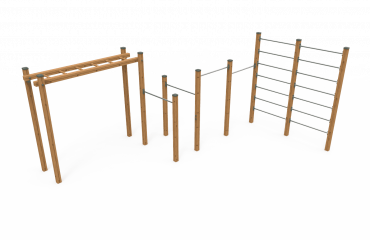
| Outdoor strength stations | Muscular strengthening and general conditioning | Pull up bars, abdominal benches, parallel bars, wall bars |
| Obstacle and agility modules | Coordination, balance and flexibility | Balance beams, walkways, ladders, climbing ropes |
| Outdoor cardio equipment | Cardiovascular health and endurance | Outdoor ellipticals, exercise bikes, steppers, rowers |
| Stretching and mobility areas | Flexibility and joint mobility | Stretching bars, mobility frames, stretching benches |
| Accessible stations | Inclusive provision and rehabilitation | Seated and assisted use modules, coordination equipment |
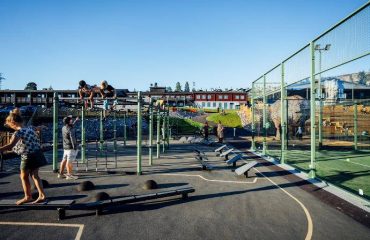
| Street workout rig | A focal point for younger and trained users | Composite calisthenics structure with multiple bar heights |
The mix matters more than the count. A route made largely of bodyweight bars serves only the residents who already train; the addition of gentle cardio, mobility and at least one accessible station is what makes the provision genuinely universal.
Compliance and operator liability
Two European standards govern the installation. EN 16630 applies to permanently installed outdoor fitness equipment for public use and covers free space zones, entrapment prevention, anchoring and user information. EN 1177 governs impact attenuating surfacing, specified for the free fall height of the equipment above it. Where children’s play equipment is present on the same site, EN 1176 applies to it and the two publics must be zoned apart, with a separation of at least 5 m.
Compliance is documentation as much as hardware. Ask for the CE documentation and notified body test reports with the tender submission, not after the order. Then put the inspection regime in place before the site opens.
| Inspection | Frequency | By whom |
|---|---|---|
| Routine visual inspection | Weekly or fortnightly | Technical services staff |
| Operational inspection | Monthly | Technical services staff, every moving part tested |
| Annual main inspection | Yearly | Independent inspection body |
Each item of equipment is supplied with a maintenance logbook that forms the record for these inspections. Retain it for the whole operating life of the installation: after an incident, it is the first document anyone asks to see.
Specifying for the environment
Galvanised steel is the standard specification for inland municipal sites in intensive use, giving durability with low maintenance. Stainless steel, and 316L grade in particular, is specified on coastal and humid sites where corrosion would otherwise force early replacement. Timber suits landscaped parks where visual integration is the priority and a recurring maintenance budget exists. Specifying by price rather than by environment is the most common source of premature replacement on council installations.
Choosing what to install, and where
Consult before you specify. Residents, health professionals, schools and sports clubs will tell you which age groups will use the site and at what times, and that determines the mix far better than a catalogue does. Then apply four practical constraints. Place the site where people already pass, not in an unused corner. Keep sightlines open, particularly where a children’s play area is nearby. Provide seating within the route, not only at the edges. And install instruction signage at every station, since there is nobody on site to demonstrate the movements.
Frequently asked questions
How is outdoor fitness equipment maintained?
Through a documented inspection regime, routine visual checks, monthly operational checks and an annual independent inspection, plus cleaning, tightening of fixings and replacement of worn parts. Correctly specified galvanised or stainless equipment needs little beyond this.
Is the equipment suitable for all ages?
Outdoor fitness equipment to EN 16630 is designed for users aged 14 and over, and within that scope it accommodates all fitness levels because each station offers a range of intensities. Younger children need dedicated play equipment to EN 1176 in a separate, signed zone.
Should access be free?
Almost all municipal fitness trails are free at the point of use and funded by the council as part of its public health and open space provision. That is the mechanism by which the installation reaches residents regardless of income, which is usually the main argument for building it.
Does a fitness trail need a special surface?
Wherever a station creates a significant free fall height, yes: an impact attenuating surface specified to EN 1177 for that height, bonded on a free draining slab and extended to the 1.50 m safety zone required under EN 16630. Grass is not a certified impact attenuating surface.
What does a council need to include in a tender?
The area and site conditions, the target users, the required standards, the material grade for the environment, the surfacing requirement, the signage, the documentation to be supplied on delivery, and the warranty and spare parts commitment. Suppliers that cannot answer the last two points should be treated with care.
Planning a fitness trail for your municipality?
Light In Fitness has supplied local authority projects from Tours, France, since 2013, with more than 2,000 references, twelve distributed brands, warranties of two to five years by range, and technical submissions, CE certificates and test reports provided with the tender response. Request a quotation with your site plan, target users and budget, and we reply within 24 working hours. See our public sector fitness equipment pages, the outdoor fitness trail and outdoor gym equipment ranges, and our standards and compliance guidance.
Réalisations documentées
- Parcours ninja sur mesure, Rennes – îlot des Hautes-Ourmes
- Double mur ninja extérieur, Sallanches – Haute-Savoie