Outdoor Fitness Trail Equipment: A Specifier Guide
In brief: an outdoor fitness trail combines exercise stations distributed along a walking or running route. Sizing depends on the user group served, the length of the route and how exposed the site is. Outdoors, the choice between galvanised steel and stainless steel is settled by the environment, 316L stainless being required in saline atmospheres.
Municipalities, campsites, holiday villages, hotels, universities, social housing landlords, rehabilitation centres and sports clubs install outdoor fitness trails for the same reason: the equipment extends a site’s sports offer without adding a building, staff or opening hours. Once anchored, it is available every day of the year, needs no supervision and serves several user groups at once. This guide sets out how a professional buyer specifies one, from the station families to the materials, the applicable standards, the layout of the route and the points to settle before a tender goes out.
What an outdoor fitness trail is
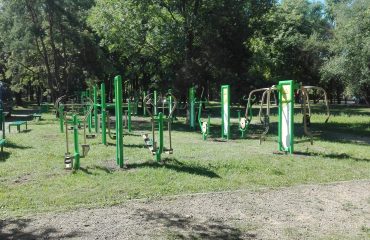
An outdoor fitness trail is not a single product but a set of permanently anchored exercise stations placed at intervals along a defined path. Users walk or jog between stations and stop at each one to perform a short exercise. The concept works because it removes every barrier to entry: no membership, no booking, no instructor and no equipment to bring. For the operator, it converts an under-used green space, a lakeside path, a campsite perimeter or a campus loop into a usable sports facility.
Two configurations dominate. The linear trail spreads stations along an existing route, typically one station every hundred or so paces, so that the walk between them becomes part of the session. The clustered configuration groups all stations in a single open-air area, which suits smaller sites, hotel grounds and residential schemes where there is no long route to follow. Both draw on the same fitness trail stations; only the spacing and the signage change.
Who specifies an outdoor fitness trail
| Site type | What the trail is expected to deliver | Dominant constraint |
|---|---|---|
| Municipality, public park | Free access sport for residents of all ages | Public procurement, vandalism, inclusive access |
| Campsite, holiday village | A visible activity in the brochure, usable without staff | Seasonal peaks, mixed adult and family use |
| Hotel, resort | An outdoor complement to a small indoor gym | Appearance, integration with landscaping |
| University, school campus | Circuit training and warm-up support for clubs | Intensive use by trained users |
| Social housing landlord | Activity in shared outdoor space | Noise, robustness, low maintenance |
| Rehabilitation centre, care setting | Supervised functional exercise outdoors | Controlled resistance, seated and accessible stations |
| Armed forces, emergency services | Conditioning at unit level | High load, continuous use |
The same catalogue serves all of them, but the station mix differs sharply. A campsite buys for breadth and family appeal; a barracks buys for load and durability; a care setting buys for controlled, low-impact movement.
The four families of stations
Cardiovascular stations
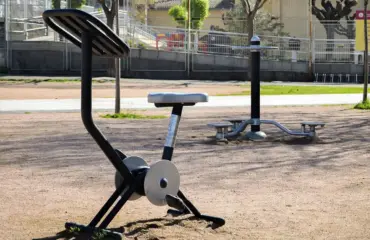
Outdoor cross trainers, air walkers, static bikes and stepper units build endurance and cardiovascular capacity. They are the stations users recognise instantly, which makes them the natural entry point on a trail. Because they carry moving parts exposed to weather, the bearing and pivot specification matters more here than anywhere else on the route.
Strength stations
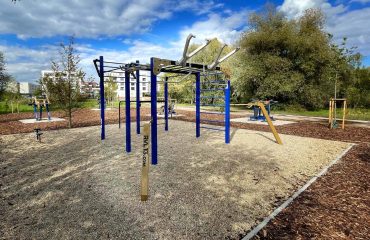
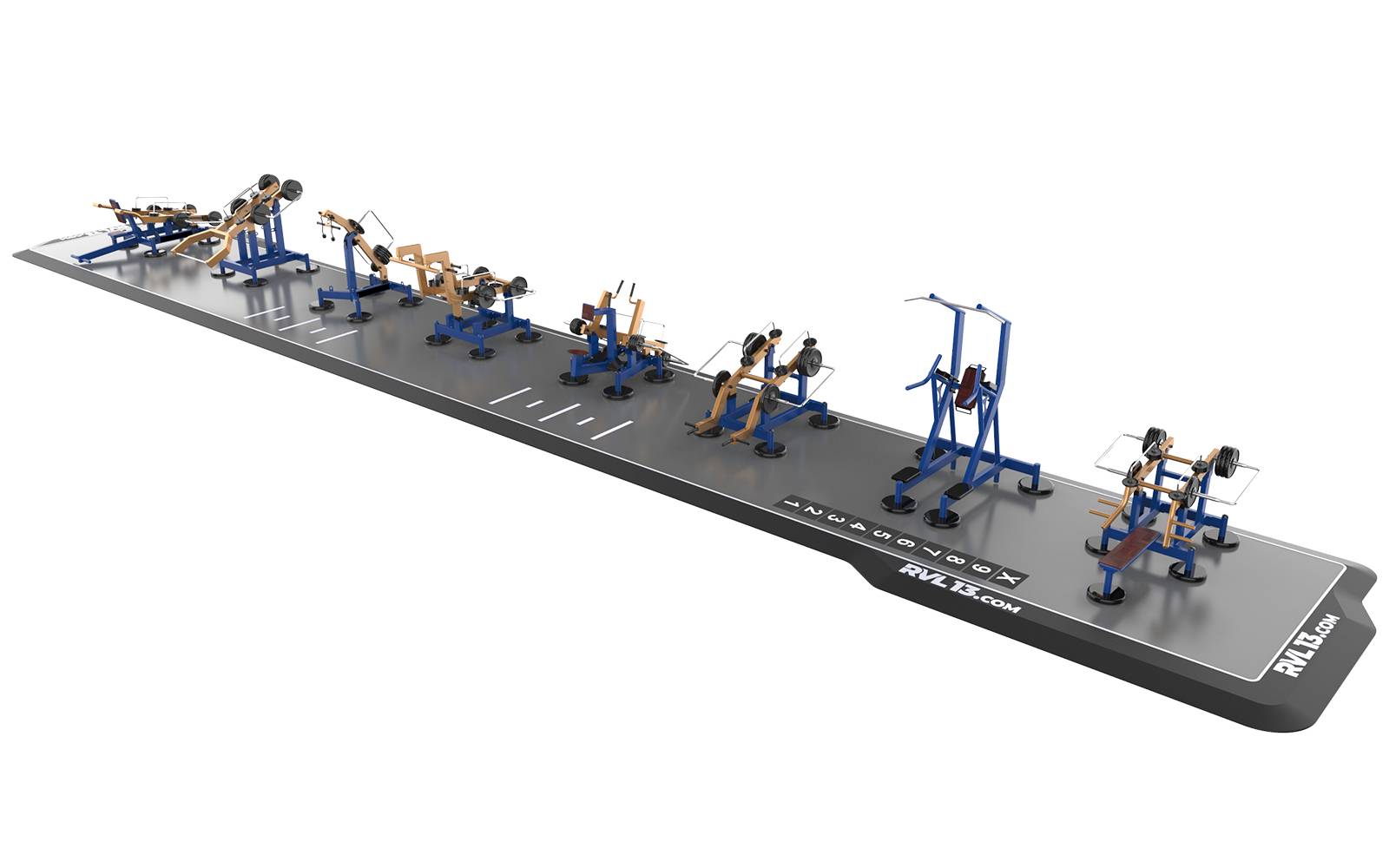
Chest press, lat pull, leg press, dip bars, pull-up bars and body-weight benches target the main muscle groups. Two mechanical principles coexist: body-weight stations, where the user’s own mass provides the resistance, and hydraulic or lever stations, where resistance is fixed at manufacture. Body-weight stations self-regulate across a wide range of users and are the safer default for unsupervised public sites.
Mobility and stretching stations
Stretching frames, calf and hamstring boards, shoulder wheels and Tai Chi discs support warm-up and cool-down. They are inexpensive relative to the cardiovascular units and disproportionately used, particularly by older visitors, so under-specifying them is a common mistake.
Balance and coordination stations
Beams, stepping posts, ladders and unstable platforms train stabilising muscles, proprioception and posture. On trails serving seniors these stations do more for fall prevention than any other family, and they are the ones most often omitted from a first specification.
Materials and exposure
| Material | Where it belongs | What to watch |
|---|---|---|
| Hot-dip galvanised steel | Inland parks, campuses, residential schemes, most campsites | Coating integrity at drilled and welded points; touch-up after installation damage |
| 316L stainless steel | Coastal and saline atmospheres, pool surrounds, de-icing salt exposure | Higher cost; specify the grade explicitly, not simply stainless |
| Treated timber and steel hybrid | Sites where visual integration into a landscape governs | Timber movement and periodic surface maintenance |
The material decision is made by the site, not by the budget. Specifying galvanised steel within reach of sea spray is the single most expensive mistake on an outdoor trail, because the replacement cost arrives years before the end of the expected service life. Conversely, specifying 316L for an inland park spends money that would have bought two more stations. Where the site is genuinely borderline, split the specification: stainless for the fixings and the parts users touch, galvanised for the buried and structural sections.
Standards that apply
Permanently installed outdoor fitness equipment for adults falls under EN 16630. It governs the safety requirements and test methods for the equipment and its installation, including entrapment, fall zones and structural integrity. Any station intended for adult public use outdoors should be supplied with a declaration referencing it.
Children’s equipment is a separate regime and the two must never be merged. Play equipment is covered by EN 1176-1, and impact-attenuating surfacing beneath it by EN 1177. EN 16630 is not applicable to children’s equipment, and a supplier who cites it for a play structure has misread the scope. Where a fitness trail runs alongside a play area, the two zones keep their own standards, their own fall zones and their own inspection regimes.
If the project also includes an indoor room, the reference there is EN ISO 20957-1 class S, the studio class for equipment in supervised or professional use. Class I is the professional class for inclusive access rather than a step above class S, so the two are chosen by user profile, not by intensity.
Laying out the route
The layout decides whether the trail is used. Four points settle it.
- Sequence. Open with mobility and light cardiovascular work, place the strength stations in the middle third, close with stretching. Users follow the order they are given.
- Sightlines. Stations that cannot be seen from a path or a building are the ones that get vandalised and avoided after dark.
- Ground. Each station needs a level, free-draining surface and a clear fall zone. Where the ground is soft or the trail crosses a slope, the surfacing cost can exceed the equipment cost.
- Signage. A pictogram panel at every station, showing the movement and the muscle group, converts a passer-by into a user. Trails without signage lose most of their non-expert audience.
Accessibility and inclusive stations
An outdoor trail is one of the few sports facilities that can be genuinely inclusive at reasonable cost. Wheelchair-accessible stations, seated upper-body units and stations reachable from a firm, level approach let users with reduced mobility train on the same route as everyone else rather than on a separate installation. Our adapted and rehabilitation stations are built for that purpose and are increasingly written into public specifications as a requirement rather than an option. Accessibility obligations for outdoor public facilities are set nationally, so confirm the applicable national rules for your country at design stage.
Specification checklist before tender
- Primary user group and secondary user groups, stated explicitly.
- Linear route or clustered area, with the available length or footprint.
- Number of stations by family: cardiovascular, strength, mobility, balance.
- Material grade tied to site exposure, with 316L named where saline exposure exists.
- Anchoring method and ground conditions, including any surfacing works.
- EN 16630 declaration for adult stations; EN 1176-1 and EN 1177 handled separately for any adjoining play area.
- Accessible stations and the approach to them.
- Signage, pictograms and any operator branding.
- Inspection and maintenance regime after handover, and spare parts availability.
Frequently asked questions
How many stations does a fitness trail need?
There is no universal figure. The number follows the length of the route, the expected number of simultaneous users and the budget. A short clustered area covering the four station families is more useful than a long route with a single family repeated. Start from the mix, then extend it.
Is outdoor fitness equipment suitable for beginners?
Yes. Most stations are body-weight or self-limiting, and the movement is guided by the frame. That is precisely why signage matters: a clear pictogram is the only instruction most users will ever receive. For supervised settings such as rehabilitation, station selection should be made with the clinical team.
Galvanised steel or stainless steel?
Hot-dip galvanised steel is the standard specification inland. 316L stainless steel is required in saline atmospheres, near pools and where de-icing salt is used. The decision is driven by the site survey, not by preference.
Can the same trail serve children and adults?
They can share a site but not a standard. Adult stations follow EN 16630; children’s equipment follows EN 1176-1 with EN 1177 surfacing. Keep the zones, the fall areas and the inspection records separate.
What maintenance does a trail require?
Routine visual inspection for damage and missing fixings, periodic operational inspection of moving parts and fixings, and an annual main inspection of structure and anchoring. Coating damage should be made good as soon as it appears, since corrosion starts at the breach.
How do we handle a coastal site?
Specify 316L stainless steel for exposed elements from the outset and state the grade in the tender documents. Retro-fitting corrosion resistance is not possible, and a galvanised installation in a saline atmosphere will need replacing rather than repairing.
Specifying your project
An outdoor fitness trail is a long-life asset: the specification made at tender stage determines its cost of ownership for its entire service life. Getting the station mix, the material grade and the accessibility provision right at the start costs nothing extra; correcting them later means replacing equipment. Browse the full outdoor fitness trail range to see how the families combine, then request a quotation with your site dimensions, exposure and user profile so the proposal is built around your project rather than around a catalogue page.
Réalisations documentées
- Parcours ninja sur mesure, Rennes – îlot des Hautes-Ourmes
- Double mur ninja extérieur, Sallanches – Haute-Savoie
- Functional Rig inox – installations sur trois continents
- iGreenMill, tapis de course extérieur – installations sur trois continents