Outdoor Fitness Trail Equipment: Strength and Cardio Stations
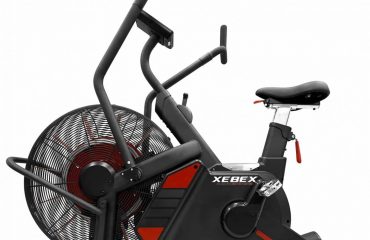
Un parcours santé extérieur peut intégrer des postes cardio sans moteur, vélo autonome ou tapis incurvé, en complément des agrès de musculation. L'absence de raccordement électrique permet l'implantation en accès libre. L'ensemble relève de la norme EN 16630 et suppose un sol de réception adapté.
In brief: An outdoor fitness trail can carry cardio stations alongside its strength stations, using self-powered equipment such as a chain-free bike or a curved treadmill. Because no electrical connection is required, these stations can be installed in open-access locations. The whole installation falls under EN 16630 and requires suitable impact-attenuating surfacing.
Outdoor fitness trails have moved a long way from the wooden posts of the 1980s. A municipality, a campsite operator, a social housing landlord, a school or a hotel now specifies a trail the way it would specify a playground: as a piece of public infrastructure with a defined standard, a defined surfacing, a defined maintenance cycle and a defined accessibility level. This article covers what a professional buyer needs to settle before ordering.
What an outdoor fitness trail actually is
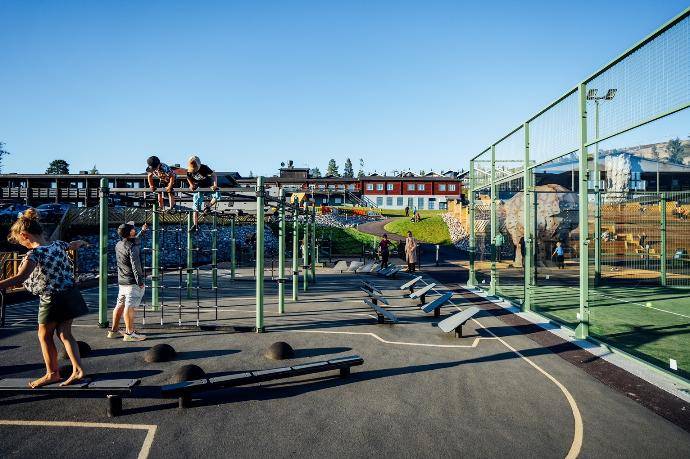
An outdoor fitness trail is a set of fixed stations installed in a park, along a running route or in any other publicly accessible space, allowing users to train without supervision and without membership. Each station covers a movement pattern: pushing, pulling, leg work, core, coordination or cardio. Together they are meant to give a balanced session to a user who arrives alone and reads the instruction plate.
The commercial logic is different from a gym. Nobody is at the door, nobody demonstrates the movement, and the equipment is exposed to weather, to misuse and to users of every level. Everything that follows derives from those three facts.
Cardio outdoors, without a power supply
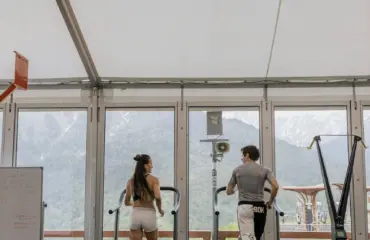
The point that most often surprises buyers is that a trail is not limited to strength stations. Cardio posts exist in self-powered versions: bikes that generate their own resistance and curved treadmills driven by the runner rather than by a motor.
The absence of any electrical connection is the decisive property. It removes the trenching, the supply point, the meter and the electrical safety inspection, and it is what makes open-access siting possible at all. A cardio station that needed mains power would have to be placed inside a controlled enclosure, which defeats the purpose of a trail.
EN 16630, and exactly where it stops
Permanently installed outdoor fitness equipment for adults is covered by EN 16630. That single reference governs the structural requirements, the entrapment and crush hazards, the free space around each station and the way the installation is inspected once it is in the ground. It is the line that belongs in the tender document, and it is what separates equipment engineered for unsupervised public use from equipment that merely looks robust.
What EN 16630 does not do is cover children. Children’s outdoor play equipment falls under EN 1176-1, with EN 1177 applying to the impact-attenuating surfacing beneath it. These are separate frameworks with separate test regimes, and EN 16630 never applies to equipment intended for children. Any trail that is expected to attract families should therefore be specified as two distinct zones, each to its own standard, rather than as one range described loosely as suitable for everyone.
Surfacing deserves the same discipline. The ground beneath and around a station is part of the installation, not a landscaping detail added afterwards, and it has to be specified against the free height of fall of the equipment actually chosen.
What decides service life outdoors
Indoors, equipment wears out through use. Outdoors, it wears out through use, weather, ultraviolet exposure and vandalism at the same time, with no staff present to notice the early signs. Three specification choices carry most of the outcome.
The base material and its protection. Hot dip galvanised steel and stainless steel behave very differently from painted steel in a coastal, urban or heavily salted environment. The relevant question at tender stage is not the colour of the finish but what happens to the structure once the finish is scratched, because it will be scratched.
The moving parts. Bearings, bushes and pivots are where an outdoor station fails first, and they are also where a station becomes dangerous rather than merely unusable. Sealed assemblies and replaceable wear parts decide whether year six is a maintenance visit or a replacement order.
The fixings and the foundation. Anchoring is what the annual inspection looks at hardest. It is worth settling the foundation type against the actual ground conditions at the survey stage rather than assuming a standard block.
Accessibility is a specification, not a gesture
An outdoor trail is public infrastructure, which makes inclusive access a design input rather than an optional extra. In practice that means stations a wheelchair user can approach and use from the chair, transfer space around them, controls within reach, and a continuous accessible route linking the stations to the path network.
This is a family of equipment in its own right, not a modified version of the standard range. Our accessible outdoor gym stations are built around seated access, and combined units such as the accessible outdoor press and lat pulldown station cover pushing and pulling from a single approach point. Coordination stations such as the Spinner BLH-1504 extend the trail to upper-limb mobility work, which matters when the same installation serves an older population.
Laying out the trail
The layout does more for usage figures than the individual station choice. A few principles hold across projects.
Sequence the stations. A user arriving alone follows the path. Ordering the stations so that the sequence forms a coherent session, rather than grouping them by supplier reference, is free and immediately visible in usage.
Keep the free space clear. The clearance required around each station under EN 16630 constrains spacing, and it also constrains benches, bins, planting and lighting columns. This is the point where a landscape drawing and an equipment drawing most often contradict each other.
Make the instructions readable. Nobody demonstrates the movement. The instruction plate is the entire user manual, and pictograms outperform text on a trail used by mixed-language populations.
Plan for maintenance access. Every station will eventually need a vehicle near it. Trails laid out without that in mind become expensive to maintain within a few years.
The full outdoor fitness trail range and the individual fitness trail stations can be combined freely, which is what allows a trail to be sized to the site rather than the site to the catalogue.
Frequently asked questions
Can an outdoor fitness trail include cardio stations?
Yes. Self-powered cardio posts exist, including chain-free bikes and curved treadmills driven by the user rather than by a motor. Because they need no electrical connection, they can be sited in open-access locations alongside the strength stations.
Which standard applies to outdoor fitness equipment?
EN 16630 covers permanently installed outdoor fitness equipment for adults. Children’s outdoor play equipment is a separate framework, EN 1176-1, with EN 1177 for the impact-attenuating surfacing beneath it.
Is a trail suitable for every user?
Adult stations are designed for adults, and a trail intended to serve children needs a separate zone specified to the children’s standards. Inclusive use is handled differently again, through stations designed for seated access rather than through general-purpose equipment.
How long should a session on a trail last?
The usual guidance for public installations is around thirty minutes per session, three to five times a week, adjusted to the individual. Signage that states this plainly measurably improves how a trail is used.
Does a trail replace a gym?
It complements one. A trail offers free access, daylight and no booking; an indoor facility offers a wider equipment range and supervision. Operators who install trails alongside an indoor offer generally see them recruit users rather than divert them.
Specifying your trail
An outdoor fitness trail is a long-lived asset in a hostile environment, bought once and inspected every year afterwards. Settle the standard, the surfacing, the accessibility level and the maintenance access before the station list, and the station list becomes straightforward.
Send us the site plan, the intended user profile and the ground conditions and we will return a laid-out trail with the matching surfacing. Request a quote and our team will work through the project with you.
Réalisations documentées
- Parcours ninja sur mesure, Rennes – îlot des Hautes-Ourmes
- Double mur ninja extérieur, Sallanches – Haute-Savoie