How to Build an Obstacle Course Gym: A Practical Guide
Building an obstacle course facility is a capital project before it is a sporting one. Whether you are converting an industrial unit into an indoor ninja gym, adding an OCR circuit to a holiday village or extending a municipal sports park, the sequence is the same: secure the right site, choose structures certified for the audience you will actually welcome, then build an operating model around them. Here is how professional operators work through it.
Start with the site, not the equipment
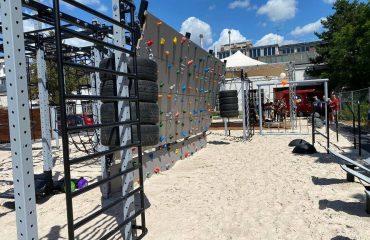
The decision that constrains everything else is the plot or building you start from. An indoor circuit needs clear height above the highest hold and a run-off zone around every module, so usable volume matters more than floor area alone. An outdoor circuit needs level, well-drained ground and a boundary that lets you control access outside opening hours. An existing playground or sports field is often the cheapest starting point, because groundworks, parking and utilities are already there. Do not freeze a layout before the ground survey: the fall height of the tallest obstacle drives the surfacing budget, and surfacing is the line item that surprises first-time operators most often.
Choose the core modules
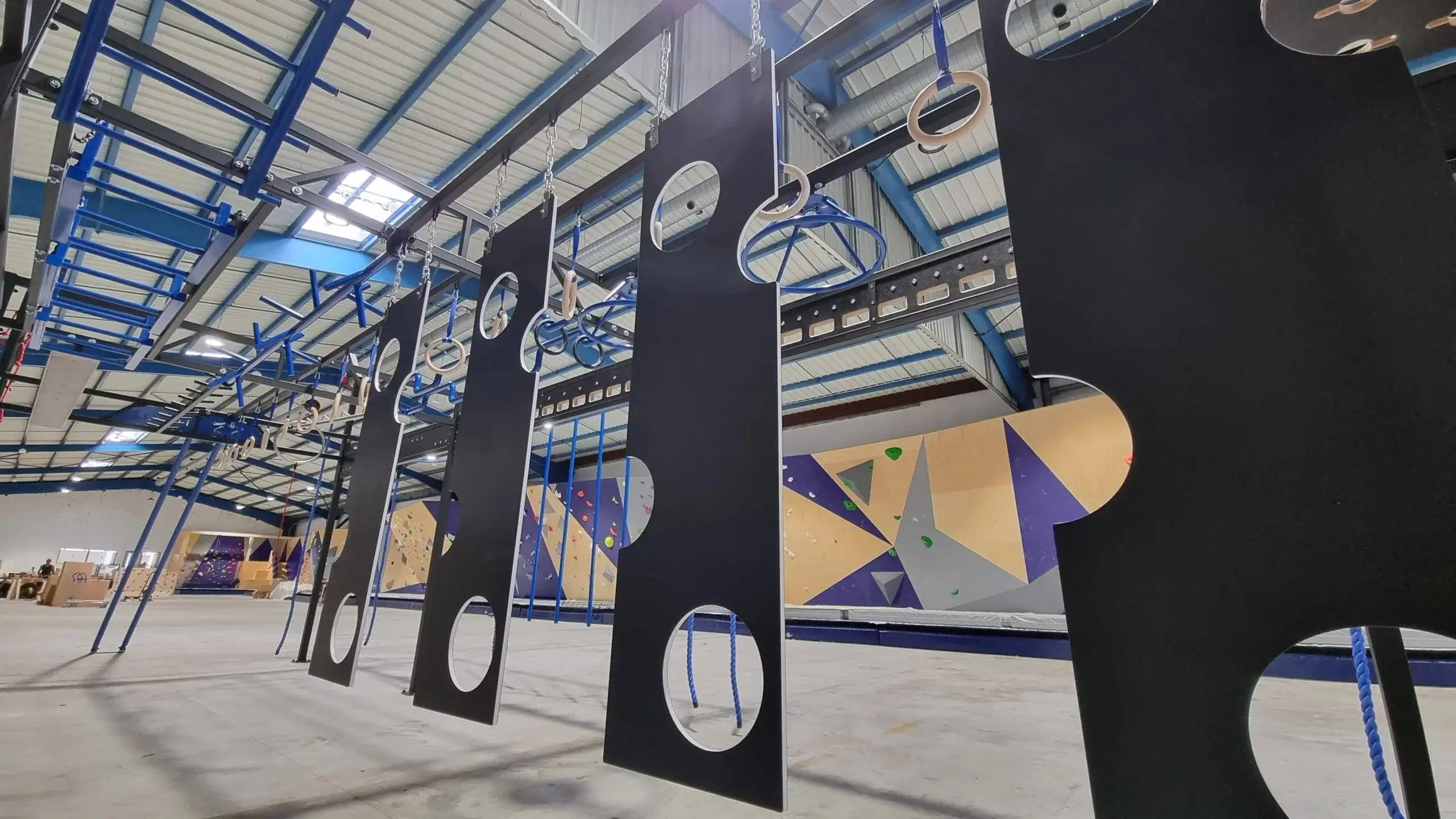
A credible circuit is built from a small number of well-made structures rather than a long list of novelty items. Climbing walls, hanging nets, monkey bars, rings, warped walls and slides form the backbone; free-standing rigs let you reconfigure the route between seasons without touching the foundations. Our obstacle trail modules and ninja warrior rigs are built for continuous public use, and a structure such as the ninja multi-rig cage concentrates a dozen movements into a single footprint, which helps when space rather than budget is the binding constraint.
Compliance is designed in, not added afterwards
The applicable standard depends on who uses the circuit and where. Indoor training equipment for professional and public use must meet EN ISO 20957-1 class S. Outdoor adult fitness and obstacle equipment falls under EN 16630. Anything aimed at children is covered by EN 1176-1 for the structures and EN 1177 for the impact-attenuating surface: the two are never interchangeable, and children’s equipment is never certified to EN 16630. Warning signage, fall zones, inspection intervals and a written maintenance log are part of that framework, not optional extras. Ask every supplier for the declaration of conformity covering the exact reference you are buying, and check what your own national regulations add on top for a facility open to the public.
Build the programme around the circuit
An obstacle circuit on its own fills a weekend. Operators who reach a viable occupancy rate wrap other disciplines around it: court sports, archery, strength and conditioning areas, swimming where the site allows it, team races and multi-sport sessions, each staffed by qualified instructors. Water sections and inflatable play areas widen the audience to families, but every one of them brings its own supervision requirement and its own insurance conversation. Group formats are what turn a one-off visit into a membership, and relays, timed heats and corporate days all run on hardware you have already paid for.
Do not underestimate the support areas
Changing rooms, secure storage, first aid provision, shaded rest areas and a picnic or catering zone are what visitors judge you on once the adrenaline has worn off. A conditioning room, squash or badminton courts and quieter lawn games extend dwell time for the part of the group that is not running the circuit. Train all front-of-house staff in first aid, not only the instructors, and write the daily inspection into the opening routine rather than leaving it to goodwill.
FAQ
Indoor or outdoor: which should I build first?
Indoor circuits trade higher fit-out cost for year-round revenue and predictable supervision. Outdoor circuits cost less per square metre and scale more easily, but income follows the weather. Sites that can do both usually start outdoors and add a covered core once attendance is proven.
What surfacing does an obstacle circuit need?
Surfacing is dictated by the fall height of the equipment above it, and the certificate for the surface must cover that height. Loose fill, rubber tiles and cast-in-place systems all qualify when correctly specified and installed to the depth stated by the manufacturer.
Can one circuit serve adults and children?
Only as separate zones. Adult obstacle equipment and children’s play equipment are certified under different standards and sized for different bodies, so they are laid out as distinct areas with their own access control, even when they share a site.
Planning your project
A successful obstacle course facility comes down to three things: a site that suits the format, certified structures matched to your real audience, and staff trained to run and inspect them. Tell us the surface area, the ceiling height if you are working indoors and the age groups you want to welcome, and we will come back with a layout and a costed proposal. Request a quote and our team will work through the specification with you.
Réalisations documentées
- Parcours ninja sur mesure, Rennes – îlot des Hautes-Ourmes
- Double mur ninja extérieur, Sallanches – Haute-Savoie
Sources et références
- Décret n° 96-1136 du 18 décembre 1996 – prescriptions de sécurité relatives aux aires collectives de jeux (Légifrance)
- NF EN 1176-1 – Équipements et sols d’aires de jeux, partie 1 : exigences de sécurité et méthodes d’essai générales (AFNOR)
- NF EN 1177 – revêtements de surface amortissants : détermination de la hauteur de chute critique (AFNOR)