OG Outdoor Strength Machine: Loaded Training on a Fitness Trail
Une machine de musculation outdoor est conçue pour rester installée à demeure, sans encadrement ni surveillance. Elle relève de la norme EN 16630 et impose un traitement anticorrosion adapté à l'exposition du site. Elle complète un parcours santé en apportant un travail en charge que les agrès au poids du corps ne permettent pas.
An outdoor strength machine is built to stay permanently installed, with no supervision and no instructor on site. It falls under EN 16630 and requires corrosion protection matched to the exposure of the location. On a fitness trail it adds what bodyweight apparatus cannot provide: progressive loaded resistance work.
The OG outdoor strength range was designed for exactly that gap. Most public fitness trails are built from bars, rings and step modules, all of which train the body against its own weight. That is useful, but it plateaus quickly and it excludes anyone who cannot yet move their own bodyweight through a full range. A loaded machine, sited outdoors and free to use, opens the trail to a much wider population.
What an outdoor strength machine actually is
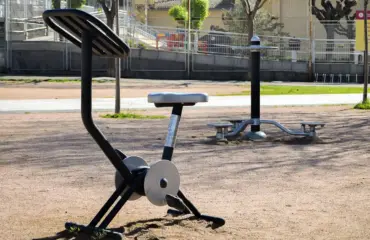
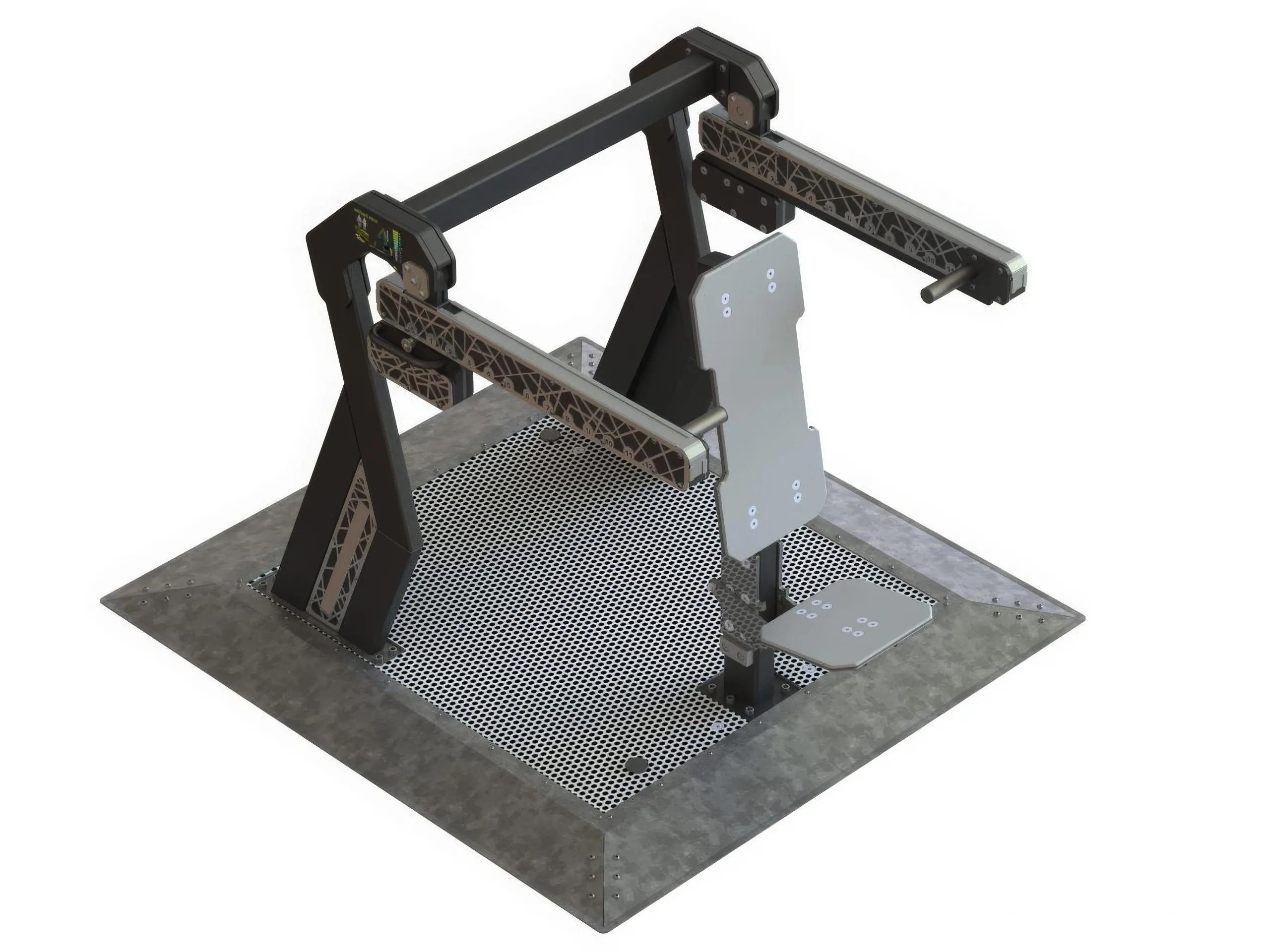
It is a fixed multi-station structure, anchored into a foundation, on which each station reproduces a guided gym movement using either the user own bodyweight as adjustable resistance or a hydraulic or friction mechanism. There is no stack of removable plates, nothing to lose, nothing to steal and no setting for a member of the public to get wrong.
Because the resistance mechanism is sealed, the machine tolerates rain, frost, sun and dust without any daily intervention. This is the fundamental difference with a gym machine: indoor equipment assumes a heated, dry room and a technician on site.
Why loaded work belongs on a fitness trail
A trail built only from pull-up bars and parallel bars serves the population already able to use them. Adding outdoor strength machines changes who the installation is for:
- beginners and returning users get a guided movement path with a manageable starting resistance;
- older users get joint friendly resistance work, which is what actually preserves muscle mass and bone density;
- trained users get a pushing and pulling load they cannot obtain from bodyweight apparatus alone;
- rehabilitation users get a repeatable, controlled movement that a physiotherapist can prescribe.
In practice a balanced installation combines both families: a set of bodyweight fitness trail stations and two to four loaded stations covering the main movement patterns, push, pull, legs and core.
Construction for permanent outdoor exposure
Everything that fails on outdoor equipment fails for one of three reasons: water, ultraviolet light or salt. The specification points that matter are therefore:
- Structure. Closed tubular sections that do not retain water, galvanised then powder coated, or stainless steel where the site is coastal or heavily salted in winter.
- Fasteners. Stainless steel throughout, with anti-vandal or tamper resistant heads on anything reachable.
- Bearings and pivots. Sealed, self-lubricating bushings rather than open greased bearings, which wash out within a season.
- Contact surfaces. Anti-slip grips and seats that stay usable when wet, and UV stable plastics that do not chalk or crack.
- Foundations. Concrete footings sized for the structure and the ground conditions, with the anchoring detail supplied by the manufacturer.
Ask for the surface treatment in writing rather than the material alone. Two machines described as steel can behave very differently after three winters depending on how they were prepared, coated and assembled.
The stations and what they train
A multi-station outdoor unit typically covers a chest press or shoulder press for the pushing chain, a lat pulldown or seated row for the pulling chain, a leg press or seated leg extension for the lower body, and a twist or abdominal station for the trunk. Each station uses a smooth guided path, which is what allows unsupervised use: the movement cannot easily be performed in a dangerous position.
Sizing the mix is a design decision, not a catalogue decision. A seafront promenade used mostly by walkers needs a different balance from a military training area or a residential courtyard.
EN 16630 and the safety zone
Permanently installed outdoor fitness equipment for adults is covered by EN 16630. The standard addresses structural strength, entrapment of fingers, head and body, protection against falls and, crucially for the layout, the free space that must be kept clear around each station.
Two points are regularly missed at design stage. First, EN 16630 is a standard for adult equipment: it is not the standard that applies to children playground equipment, and an adult machine must never be specified as children equipment or installed inside a children play area. Second, the free space of adjacent stations must not overlap, which is what determines the real footprint of the installation on the ground.
Siting and installation
Choose a level, well drained area with natural surveillance from paths or housing, ideally partly shaded. Keep the machines together as a coherent zone rather than scattering them, so users move from station to station without crossing a footpath. Check the access for the delivery vehicle and for the concrete before committing to a location. The whole scheme usually sits inside a wider outdoor fitness trail layout with signage explaining each movement.
Maintenance in service
Outdoor strength machines need very little, but not nothing. Wash the contact surfaces periodically with mild soapy water and a soft cloth, never with a solvent or an abrasive. Inspect moving parts, fastener tightness and coating condition on a fixed schedule, and record each inspection: for a public installation, that written record is both the maintenance tool and the liability document. Any sign of wear, play or mechanical noise should be referred to the manufacturer rather than fixed with a workshop improvisation.
Frequently asked questions
How is resistance adjusted?
By the mechanism built into the station rather than by adding plates. The adjustment method varies by model and is described in each product technical sheet.
Can these machines replace an indoor gym?
They serve a different purpose. An outdoor installation is free, unsupervised and permanently open; an indoor gym offers a far wider load range and controlled conditions. On a public site the two are complementary, not interchangeable.
Are outdoor strength machines suitable for children?
No. Equipment designed to EN 16630 is adult equipment. Children areas use a different standard for the equipment and another one again for the impact absorbing surface, and the two families must not be mixed.
What surface should be laid underneath?
A stable, well drained surface across the whole free space. The choice depends on the site and on how the area is used, and should be specified together with the layout.
Planning your installation
Whether the project is a municipal park, a campsite, a residential development, a school or a military site, the useful starting point is the same: the site plan, the exposure, and the profile of the people who will use it. Send us those three things and we will return a station mix, a layout respecting the free spaces and a full costing: request a quote.
Réalisations documentées
- Parcours ninja sur mesure, Rennes – îlot des Hautes-Ourmes
- Double mur ninja extérieur, Sallanches – Haute-Savoie
Sources et références
- NF EN 16630 – modules fixes d’entraînement physique de plein air : exigences de sécurité et méthodes d’essai (AFNOR)
- Code du sport, article L322-2 – garanties d’hygiène et de sécurité des établissements d’activités physiques et sportives (Légifrance)