Pump track cost: what drives the price and how to budget
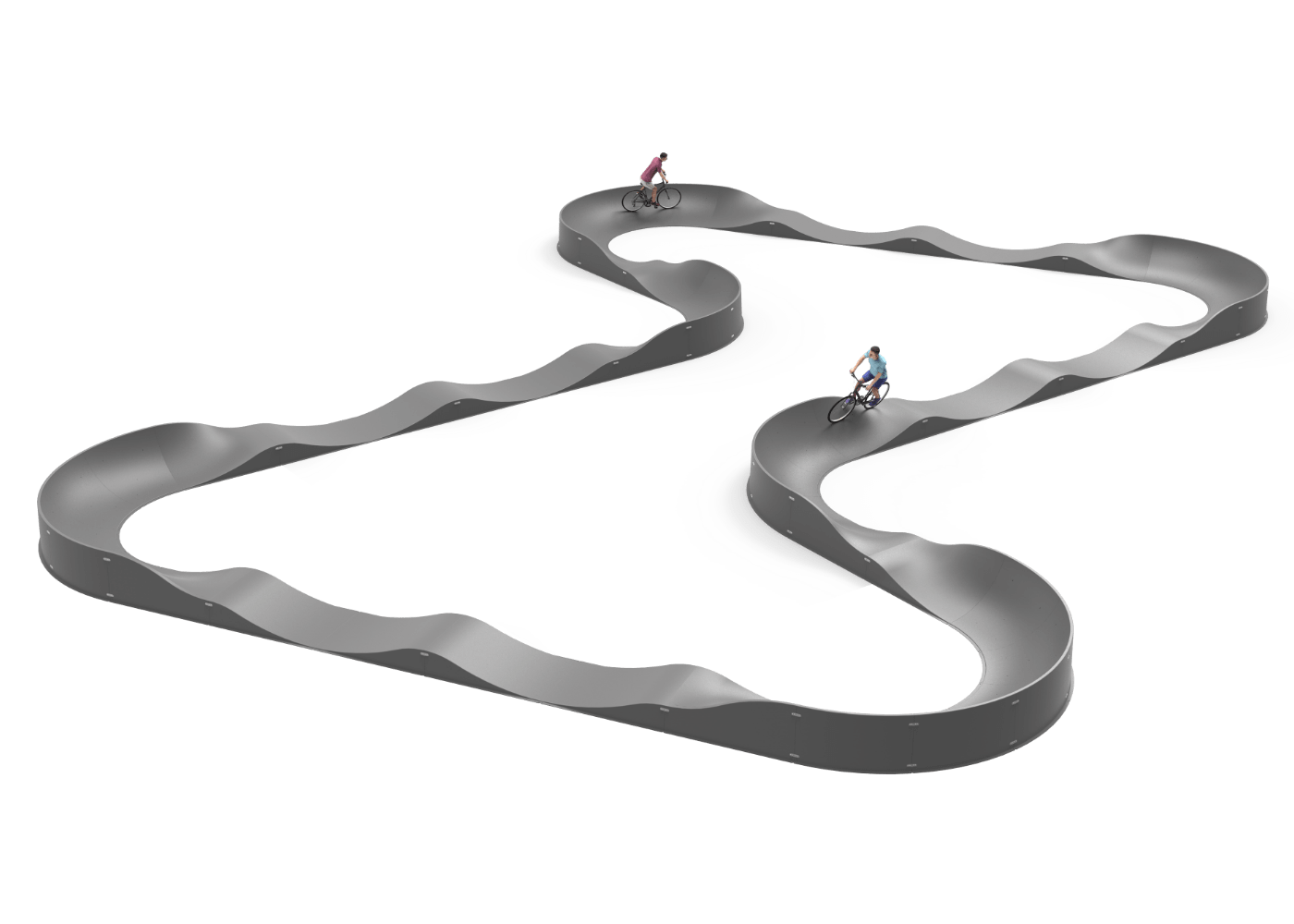
A pump track is a closed circuit of rollers and banked turns ridden without pedalling or pushing: riders generate speed by pumping the terrain with their body weight. It works for bikes, skateboards, scooters and inline skates, it needs no power supply, and it draws users from about the age of five to well into adulthood. For a local authority, a school, a campsite, a resort or a sports club, that combination is unusually attractive. The question that follows is always the same one: what does it cost, and what actually drives the figure?
What a pump track is, and why the format works
The circuit is built from a repeating sequence of rollers and berms. Riders keep momentum by extending and compressing their body over the terrain rather than by pedalling, which is where the name comes from. Three consequences matter for the organisation buying one.
- It is genuinely multi-age and multi-level. A child on a first scooter and an experienced mountain biker use the same circuit at different speeds and lines, without separate zones.
- It needs no motor and no electricity. There is no power connection to install, no consumption to budget and no plant to maintain.
- It is multi-discipline. Bikes, skateboards, scooters and skates all use the same asset, which spreads the cost of the installation across several user groups instead of one.
Compared with a single-sport facility, a pump track occupies one footprint and serves a much broader population, which is what makes it a recurring choice in public-space and leisure projects. Browse the pump track range to see the configurations available.
Who these installations are specified for
Pump tracks are specified by local authorities upgrading public open space, by schools and campuses, by campsites and holiday resorts looking for an activity that runs without staffing, by BMX and skateboard clubs, by property developers fitting out shared amenity space, and by sports complexes adding an outdoor draw alongside indoor facilities.
Those buyers rarely install a track in isolation. It is often specified alongside other outdoor equipment for the same site – outdoor parkour and calisthenics parks for teenagers and adults, or children outdoor fitness equipment for younger users – so that one visit serves several age groups.
What drives the price
There is no single list price for a pump track, and any supplier quoting one without seeing the site is guessing. The figure is built from a small number of variables:
- The size of the circuit. This is the dominant factor. A compact track sized for children and beginners costs substantially less than a full circuit intended to host events, because both the material quantity and the groundworks scale with the footprint.
- The surfacing and construction method. Modular systems, asphalt and timber-based construction differ in price, in lead time and in the finish they give. They also differ in how they behave over years of use, which is why the cheapest surface is not automatically the cheapest asset.
- Customisation. A standard configuration costs less than a bespoke layout with specific obstacles, a particular line design or a defined visual identity. Where a site has an irregular shape or a level difference to absorb, custom design stops being optional.
- Site preparation and installation. Ground conditions, drainage, access for machinery and the state of the existing surface all feed into the works package. This is the line item most often underestimated in a first budget.
Because these variables interact, a pump track is quoted per project rather than sold from a price list. What we can commit to at the enquiry stage is a costed proposal against your actual site rather than an indicative figure that changes once the survey is done.
Modular or built in situ
Modular tracks are assembled from prefabricated elements. Their advantages are a short and predictable installation, a layout that can be extended or reconfigured later, and the possibility of relocating the installation if the site changes use. In-situ construction, typically asphalt, gives a seamless riding surface and a permanent installation, at the cost of a longer works programme and a fixed layout.
The choice usually comes down to two questions: how permanent the site is, and whether the layout may need to grow. A campsite or a school that expects to extend the offer later is generally better served by a modular system; a municipal park intended as a long-term destination often justifies in-situ construction.
Safety, layout and the surrounding area
A pump track is used without supervision most of the time, so the design of what surrounds it matters as much as the circuit. Plan the run-off areas, the entry and exit points, the separation from pedestrian routes and, where the site is shared with a play area, the boundary between the two.
One point deserves care in mixed installations. Playground equipment and its impact-attenuating playground surfacing are governed by their own dedicated standards, which apply to that equipment and its surfacing – not to the riding circuit. Where a project combines a pump track with a play area, keep the two sets of requirements distinct in the specification rather than applying one to the other. For the circuit itself, the applicable requirements depend on the installation and its context, and should be confirmed against the national regulations that apply where the site is located.
The long-term case
Three arguments carry most of the weight in a business case. Durability: a well-built track has no moving parts, no electronics and no consumables, so routine maintenance is limited compared with equipment of similar cost. Attractiveness: the format draws riders, spectators and events, and it animates a space that might otherwise be used only in passing. Public health: it encourages regular physical activity and develops balance and coordination in a form that people choose voluntarily, which is the hardest part of any activity programme to achieve.
Set against a capital cost spread over many years of use, those three points are usually what turns a pump track from a nice idea into an approved project.
Frequently asked questions
How much does a pump track cost?
It depends on size, surfacing, level of customisation and site preparation, so a meaningful figure requires the site details. We do not publish a fixed price, because any number given before the site is assessed would be misleading. Send us the dimensions and the ground conditions and we will return a costed proposal.
How much space is needed?
The footprint follows the configuration chosen and the shape of the available land. Rather than working from a standard area, send us the plot dimensions and we will propose the layouts that fit it.
Can several disciplines use the same track?
Yes. Bikes, skateboards, scooters and inline skates all ride the same circuit. Busy sites usually manage this through posted usage rules or time slots rather than through separate infrastructure.
What maintenance does it need?
Routine maintenance is mainly inspection, keeping the surface clean and free of debris, and attending to the surfacing and the edges. There is no motor, no electrical system and no wearing consumable, which is why the running cost is low relative to the initial investment.
How long does installation take?
It depends on the construction method and on the site preparation required. Modular installations are the faster option; in-situ construction takes longer. The programme is confirmed with the quotation once the site is known.
Getting a figure for your project
A pump track is one of the few outdoor installations that serves children, teenagers and adults from a single footprint, without power and with limited upkeep. The price depends on your site, not on a catalogue, and the only honest way to get a number is to look at the plot.
Light In Fitness has supplied sports and leisure equipment since 2013 to local authorities, schools, clubs, campsites, resorts and developers, and handles design, supply and installation. Tell us the dimensions of your site, the ground conditions and the user groups you want to serve, and we will come back with a configuration and a costed proposal. Request a quote.
À lire aussi sur le même thème
- The Essential Machines for a Gym: A Complete Equipment Checklist
- Chest press : Les muscles sollicités et pourquoi cet exercice est incontournable (Spoiler : c’est votre meilleur allié pour un torse en béton)
- How to Choose a Massage Chair for a Professional Setting
- How much does a street workout structure cost? The full budget breakdown