What Is Pilates and How Many Types Are There?
For a small minority the gym is a passion. For most people it is a genuine sacrifice made to stay in shape, in money, in time and in physical effort. Not everyone is suited to lifting weights or to intense aerobic classes.
For anyone who wants to build tone in a gentler way, there has been an alternative for some years now: Pilates, a discipline that does not subject the muscles to excessive load and that suits everybody. And there is more than one kind of it.
Pilates, an intelligent way to train
At the root of the method lies a conviction, supported by both theory and practice, that a small movement, programmed into a coherent sequence and executed precisely, is worth more than three hours of weight training.
Pilates is not simple gymnastics. It is a discipline that teaches correct posture and produces harmony and fluidity in the movements of the body.
By learning to perform the exercises correctly, the practitioner learns to move correctly in every other circumstance: posture improves, stiffness and tension disappear, and so do the back problems that follow from them. That versatility is exactly why Pilates has also found a place in rehabilitation.
The Pilates method follows its philosophical and theoretical principles strictly, and combines the best aspects of Western sporting disciplines with those of Eastern holistic practices. The aim, in all its forms, is to make people aware of themselves, of their body and of their mind, which together become an integrated, dynamic and functional system.
A discipline that came out of practice
The Pilates method was invented by the German Joseph Hubertus Pilates who, from the early 1900s and while still a child, began teaching himself a form of gymnastics similar to body building, with the aim of improving his own physical condition. He was a boy of very fragile constitution, but by the age of fourteen, thanks to the method he had invented, he had built the body of a Greek athlete, to the point that he began working as a model for anatomical drawings.
At the start of the First World War he spent a long period in prison, and it was there that he began training the other prisoners with his sequence of free body exercises on a mat, which he called Muscle Control and which is known today as Matwork, the foundation of Pilates. Learning to build sequences and to teach them to others, if you intend to become a Pilates teacher, is not something to approach approximately: it requires a proper Pilates course.
The other pillar of the method invented by Joseph Pilates is called the Reformer. That technique was also born during his imprisonment. He observed that the springs attached to hospital beds could be used to let patients tone their muscles before getting back on their feet.
The principle of using springs as tools of resistance to movement is the basis of the Universal Reformer and Cadillac machines. A Pilates Reformer course teaches the foundations of that technique and how to use both machines correctly.
Pilates as a form of training began to gain ground in New York among classical dancers, until it was discovered by athletes, actors and the general public in the 2000s.
Today the method is widely practised and several variants have been created for particular conditions or problems: Pilates for posture, Pilates for athletes, Pilates for dancers, Pilates for osteoporosis, pre-natal and post-natal Pilates, Pilates for older adults, among others.
All of these forms share one aim, which is to teach the individual to move economically, according to seven fundamental principles.
The seven principles of the Pilates method
1. Concentration
You have to be aware of your posture while performing the exercise, and to free the mind from everyday worries.
2. Control and fluidity of movement
Concentration should also help reach the state in which total control over every gesture is possible. Beyond control there must be harmony in every movement. The body has to hold its balance so as not to fall, and movements must not be abrupt, to avoid injury.
With practice, these two principles begin to apply themselves spontaneously to the movements made during the day, such as lifting shopping bags.
3. Precision
Precision of movement produces correct balance between muscle groups, which gives movement its grace. Someone starting Pilates can see within a few sessions how much daily life improves, including posture at a computer.
4. Breathing
Every exercise in the Pilates method, when it is taught correctly, comes with breathing instructions that have to be coordinated with the movement. On the inhale, through the nose, the diaphragm moves downwards so that the lungs can expand.
The exhale is through the mouth. Pushing the air out should be done by releasing the intercostal muscles, so that the diaphragm returns automatically to its normal position.
5. The centre
Defined by Joseph Pilates as the powerhouse, this is the area between the base of the rib cage and the pelvis, and it is the control centre of the whole body. Strengthening the centre is what makes correct posture possible.
The method concentrates heavily on this area, and in every exercise it is necessary to control the centre. It is the synergy between the abdominal and lumbar areas that maintains the neutral position suited to any movement.
6. Isolation
The method makes it possible to recognise and isolate the different muscle groups, in order to understand where to act to restore balance. All muscles work together. When there is inflammation or poor posture in one particular area of the body, every other area is affected.
7. Repetition
The more an exercise is practised, the better the skill becomes. It is therefore good to train at least a few days a week, varying the exercises but performing them enough times for the muscle to feel the effort.
The types of Pilates and the equipment they use
Beyond the free body work of Pilates Matwork, there are different types of training that use machines, the Cadillac, the Reformer and the Wall Unit, or specific techniques for improving posture, known as postural Pilates.
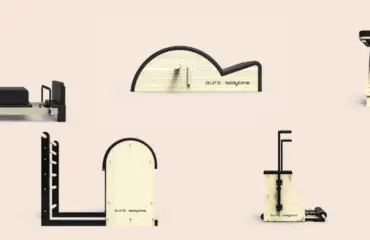
Alongside the best known tool, the Reformer, two others are very widely used today: the Cadillac, a table fitted with various attachments, and the Chair, a small unit that allows a large number of exercises. Others are the Tower, the Barrel and the Half Barrel, and the Circle.
Most Pilates exercises, aimed at strengthening or stimulating specific parts of the body, are performed without additional equipment. Some exercises, however, use small tools that either resist the force or accompany the movement:
- The ball forces you into the correct position in order to hold balance and not fall.
- The band, or rubber band, is used for stretching and resistance exercises.
- The circle is placed between the legs to build that muscle group.
- The foam tube, or roller, is used to work on balance.
Equipping a Pilates studio
The equipment list follows directly from which of those types a studio intends to teach, and the difference between them is a difference in capital spend per square metre.
A matwork-only room needs floor, mirrors and small props. That is the cheapest studio to open and the one with the highest number of participants per session, but it is also the one that competes with every other group class in town.
A reformer studio is a different proposition. Each machine occupies a fixed footprint and serves one client at a time, so the class size, the room dimensions and the revenue per hour are all decided by the number of machines you install. Our Pilates reformers range covers the studio machines themselves, with the individual reformer machines listed separately from the studio accessories: the circles, bands, balls and rollers described above.
The floor is the part that gets forgotten. Matwork, prop work and any rehabilitation-oriented programming all happen at floor level, and a hard surface undoes a good deal of what the method is trying to achieve. Purpose-made fitness, gym and Pilates mats solve that at a fraction of the cost of a machine.
Frequently asked questions
Who invented Pilates?
Joseph Hubertus Pilates, a German who began developing the method on himself from the early 1900s and refined it while imprisoned during the First World War.
What is the difference between Matwork and Reformer?
Matwork is the sequence of free body exercises performed on a mat, originally called Muscle Control. The Reformer uses springs as resistance, a principle Joseph Pilates derived from the springs on hospital beds.
Is Pilates suitable for rehabilitation?
Yes. The versatility of the method is precisely what has made its use possible in rehabilitation, and several variants exist for specific conditions such as osteoporosis and for pre-natal and post-natal work.
How often should Pilates be practised?
At least a few days a week, varying the exercises but performing them enough times for the muscle to feel the effort.
What equipment does a studio need to start?
That depends on the format. Matwork needs flooring, mirrors and small props; a reformer studio needs one machine per client per class, which is what sets the room size and the class capacity.
From method to floor plan
Pilates is a method before it is a piece of equipment, but the equipment decides what a studio can teach and how many people it can teach at once. If you are opening or extending a studio, send us the room dimensions and the class formats you intend to run, and we will propose a machine count, a layout and the accessories that go with them. Request a quote for a costed proposal.
À lire aussi sur le même thème
- Yoga Prénatal et Postnatal : Bienfaits Clés et Pratiques Essentielles pour les Futures et Nouvelles Mamans
- Yoga vs Pilates: the Main Differences for Studio Operators
- Yoga régénératif (qu’est-ce que c’est, comment le pratiquer, 13 bienfaits)
- Fitness Pilates : La Méthode Infaillible pour Une Silhouette Sculptée et un Bien-Être Optimisé