Pilates: Principles, Benefits, Types and Studio Equipment
Pilates strengthens muscle, eases back pain, refines posture and calms the nervous system, and it works for every level of fitness. For studios, clubs and rehabilitation centres it is also one of the few disciplines that fills off-peak hours with a broad audience. Here are the principles behind the method, the benefits of practising it regularly, the main variants and the equipment a facility needs to run it.
What is Pilates? Characteristics and core principles
Pilates is a training method developed by the German-born athlete Joseph Pilates in the 1920s. As a child he suffered from asthma and rickets. He trained persistently and devised his own stretching and strengthening exercises, which allowed him to overcome those health problems and to build an athletic physique, to the point that he posed for anatomical drawings.
Working as an orderly, he based his rehabilitation methods partly on exercises using springs from hospital beds, an idea that became the basis of the Pilates Reformer. His approach helped soldiers wounded in the First World War recover their physical condition more quickly. At that time he called his system contrology. After moving to the United States he opened his own studio in New York with his wife, worked closely with dancers, refined the method and developed equipment he called apparatus, such as the reformer and the cadillac.
The original system comprised 34 exercises. Over time it expanded to include movements using props such as ovoballs, rings and foam rollers.
Pilates rests on a small number of principles that determine whether the work produces results:
- Breathing – breathe slowly and deeply with the diaphragm working actively; inhale through the nose and exhale through the mouth.
- Concentration – each exercise is performed carefully and with full awareness of the movement.
- Centring – every movement starts from correct activation of the abdominal muscles, the area between the lower ribs and the anterior superior iliac spines.
- Control – the movement is executed with awareness of the body and under complete control.
- Flow – the movement is smooth and unhurried, seeking balance and harmony with the breath.
- Precision – what counts is not the number of repetitions but the accuracy of execution: a neutral pelvis, the natural curvature of the spine and a stable shoulder girdle.
- Regularity – the exercises should become a habit and part of a routine.
What Pilates delivers: benefits and health effects
Because the method engages the body, the breath and the mind together, regular sessions produce a wide range of physical and mental benefits:
- strengthens the deep muscles responsible for posture and for holding the internal organs in place, including the pelvic floor;
- teaches concentration and correct breathing;
- increases muscular endurance and strength;
- does not load the joints;
- improves flexibility and mobility and increases joint range of motion;
- helps reduce or eliminate back pain;
- improves balance;
- increases body awareness, which makes it a useful complement to other training;
- lowers stress levels;
- helps build a lean, athletic shape without adding bulk;
- releases tension and relieves the nervous system;
- reduces the risk of injury.
How long before the results show? Joseph Pilates himself put it this way:
After 10 sessions you will feel the difference, after 20 you will see the difference, and after 30 sessions everyone will notice it, because you will have a completely new body.
The key with this method is consistency. Two to three sessions a week of 45 to 60 minutes is the usual pattern, although shorter sessions of 20 to 30 minutes are a reasonable starting point. Pilates is not a high-impact discipline, but recovery between sessions still matters.
Who is Pilates for?
The system draws on ballet, yoga, gymnastics, isometrics and martial arts such as tai chi, which is why it fits so many different objectives: strengthening the postural muscles of the trunk, returning to activity after an injury, improving general condition, changing the appearance of the abdomen, back and glutes, establishing a regular training habit, or gaining flexibility and tone.
It suits almost everyone: older adults, pregnant women (with medical clearance), people carrying excess weight, competitive athletes, people recovering from injury or with reduced mobility, and strength and bodybuilding athletes. The breadth of the exercise catalogue and the range of difficulty mean the method can be adapted to individual needs and capacities, which is precisely what makes it viable as a class format in a commercial facility.
There are contraindications, including:
- active inflammation;
- recent fractures;
- post-traumatic conditions;
- thrombosis;
- spondylolisthesis;
- tumours;
- advanced osteoporosis;
- large fluctuations in blood pressure;
- disc or abdominal hernia;
- high-risk pregnancy.
Anyone unsure whether Pilates is appropriate for them should speak to their doctor first, and a facility should make that clear at sign-up.
The most popular types of Pilates
In more than a century, a method built on correct breathing and on strengthening, stretching and mobilising the abdominal, back and pelvic muscles has produced several variants. Two of them are found most often on a class timetable.
Power Pilates
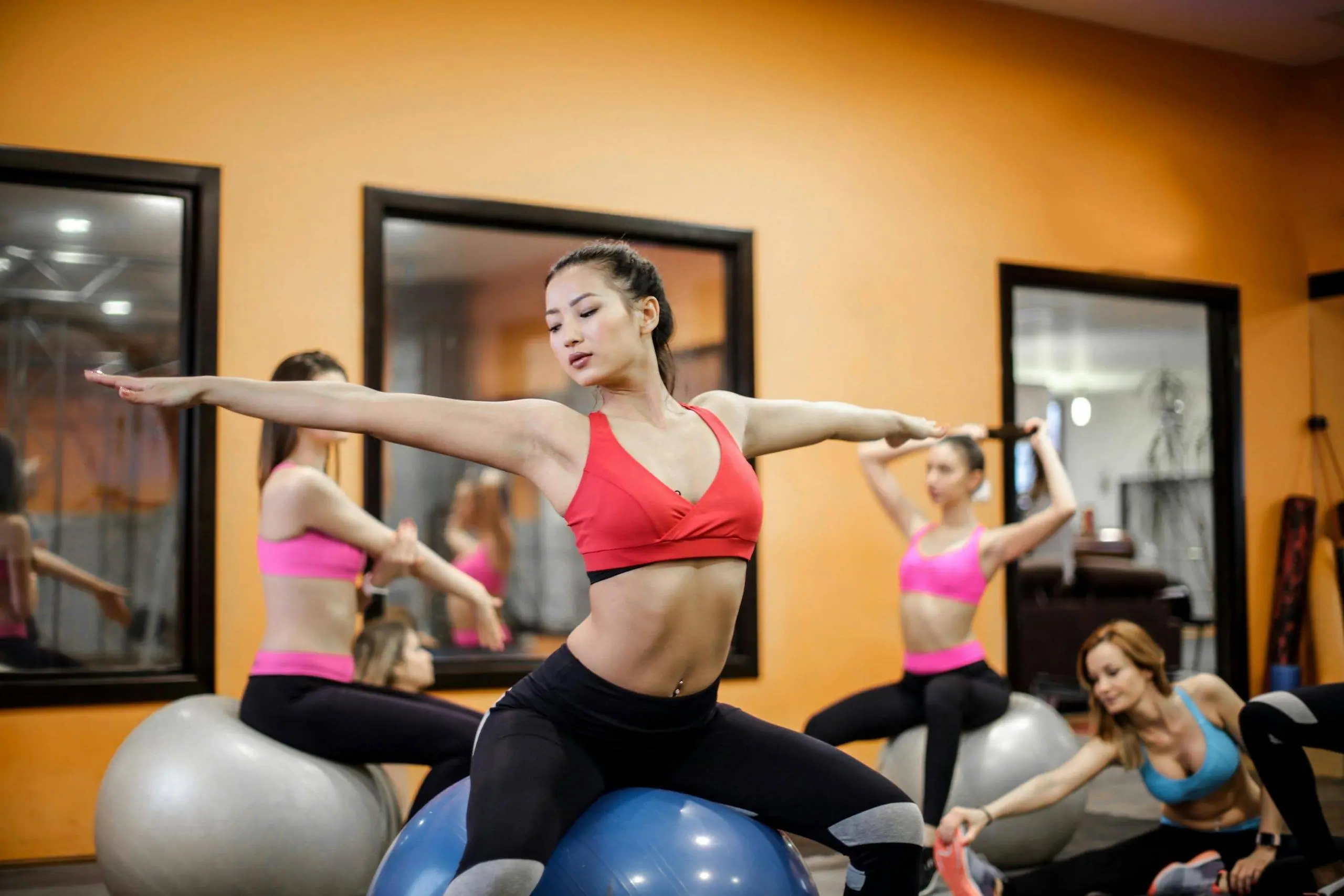
Power Pilates is distinguished by a higher exercise intensity, which supports metabolism and the burning of fat tissue. It is aimed at intermediate and advanced practitioners. It can be done with body weight alone or with supplementary training and rehabilitation props such as massage rollers, rings, resistance bands, large gym balls and ovoballs.
Stott Pilates
Developed by Moira Merrithew (Stott), this is a contemporary reading of the method that replaces the flat spine in the supine position with what is known as the neutral back. Stott Pilates is built on five key principles: breathing, pelvic placement, rib cage placement, scapular movement and stabilisation, and head and cervical placement. Its very calm character makes it broadly applicable. This modern approach includes more than 500 exercises performed on a mat or with specialised equipment.
Preparing for a Pilates session: clothing and equipment
Pilates can be practised with body weight alone, with supplementary props, or on the dedicated apparatus developed by Joseph Pilates. Whether the session takes place on a mat, in a Pilates studio or in a fitness club, it is worth knowing the main pieces of equipment and how to dress so that attention stays on muscular tension and breathing.
Pilates equipment
Alongside working to the principles of the method, the specialised apparatus developed by Joseph Pilates is what opens up the full exercise repertoire:
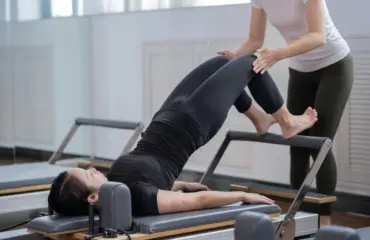
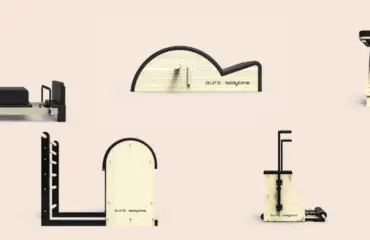
- Reformer – a bed-shaped machine consisting of a frame with a moving carriage, springs, ropes and straps for the hands or feet. Exercises of varying difficulty and springs of different resistance allow work in seated, lying, standing, kneeling and supported positions.
- Cadillac – also called the trapeze table, an apparatus resembling a hospital bed with a metal frame carrying springs, bars, handles and loops. It allows work in lying and semi-reclined positions and is used in one-to-one training and in rehabilitation.
- Wunda chair – a device with a seat and a moving footbar attached by springs of different resistance. It can be used standing, kneeling, seated or lying to strengthen, stretch and stabilise every muscle group.
- Barrel – an apparatus shaped like a barrel, available with a ladder for standing work or as a spine corrector for work in the lying position. It is used mainly for deep muscle strengthening, mobility and flexibility.
For a studio, the reformer is the anchor of the offer: it defines the class format, the number of places per session and therefore the revenue per hour. Our professional reformers are built for studio duty, and the Pilates studio accessories that go with them cover the props listed above. Mat classes need a floor that is stable and easy to clean; our fitness, gym and Pilates mats are made for that use.
Pilates clothing
Pilates requires no specialised clothing or footwear. It is best practised barefoot or in socks. Clothing should be neither loose enough to hinder movement nor tight enough to restrict it: a top, long sleeve, sports bra or technical t-shirt with leggings or fitted shorts is the usual choice. A well-fitted outfit makes it easier for both the participant and the instructor to observe a movement and judge whether it is correct and whether the right muscles have been activated. Light, breathable fabrics that wick moisture keep the session comfortable.
Frequently asked questions
How often should Pilates be practised?
Two to three sessions a week of 45 to 60 minutes is the usual recommendation. Shorter sessions of 20 to 30 minutes are a valid way to start, and consistency matters more than duration.
Is Pilates suitable for beginners?
Yes. The exercise catalogue covers a wide range of difficulty, so a class can be built for complete beginners and progressed from there. Beginners generally start on the mat before moving to the reformer.
What is the difference between mat Pilates and reformer Pilates?
Mat work uses body weight and small props. The reformer adds spring resistance and a moving carriage, which allows assisted and resisted versions of the same movements and opens the method to users who cannot yet control their own body weight.
How many reformers does a studio need?
That depends on the room, the class format and the price point. The usable surface and the circulation space around each machine set the ceiling, so we work from the floor plan rather than from a fixed number.
Equipping a Pilates studio
Pilates is a method with more than a century of practice behind it, a broad audience and modest space requirements, which makes it one of the most reliable additions to a timetable. What determines whether it works commercially is the quality of the apparatus, the layout of the room and the training of the instructors.
Tell us the surface you have and the format you want to run, and we will propose a studio layout and an equipment list. Browse the full Pilates range or request a quote.