Equipping a facility for Hyrox training: rig, ergometers and floor
Hyrox is a timed fitness race that alternates running with functional stations, and a facility that wants to host that training needs three things: ergometers that survive continuous use, a lane where loads can be pushed and carried, and a rig that turns one footprint into a dozen work stations. This guide sets out how an operator specifies each block, what the floor has to do underneath, and how many members a given configuration can actually serve at once.
What the format asks of a facility
The demand profile is unusual for a commercial gym. Athletes arrive on a running effort and go straight onto a station, so the equipment is used with an elevated heart rate, poor technique tolerance and no rest between entries. Two consequences follow for the buyer.
The first is duty cycle. Equipment in a Hyrox training area runs closer to continuous than intermittent use, which is exactly the distinction that separates professional equipment from lighter builds. Specify to EN ISO 20957-1 class S, the classification for stationary training equipment intended for professional and commercial installations. Class I in the same family is a professional class with inclusive access, not a step above class S, and the two are often confused in tenders.
The second is throughput. A class of twenty people cannot queue for two rowers. The station count, not the brand of the machines, is what decides whether a session runs on time.
The three equipment blocks
| Training requirement | Equipment | Facility constraint |
|---|---|---|
| Sustained aerobic output, upper body pulling under fatigue | Rowing machines, ski ergometers | Length behind each machine for the recovery stroke, storage or rail if machines are moved between sessions |
| Horizontal loaded work, carries | Sleds, loadable accessories, storage racking | A clear lane with a surface that lets a loaded sled move without tearing, plus space to turn at each end |
| Bodyweight pulling, hanging work, station rotation | Rig with pull up bars, rings, suspension anchors, storage | Anchoring into slab or wall, clear height, safety distance around each station |
Our ski ergometers and rowing machines cover the ergometer block, power sleds cover the loaded lane, and CrossFit and Hyrox cages cover the rig.
The rig is the backbone, not an accessory
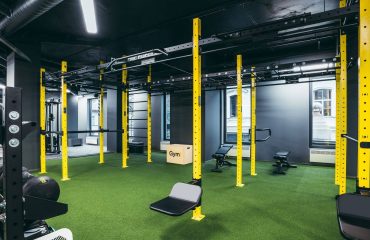
A rig is what allows one area to serve a class rather than an individual. Because the uprights are perforated along their length, accessories are added and removed without tools and without changing the structure: pull up bars, rings, suspension trainer anchors, storage for plates, kettlebells and balls, and platforms at the ends of the frame.
That modularity is what protects the investment. A club that starts with a section of ten people and grows to sixty adds modules to the same frame instead of replacing it. It also solves the storage problem that Hyrox training creates: loose accessories on the floor of a running lane are the most common cause of injury in this format, and rig integrated storage is the cheapest way to remove them.
Two design decisions matter at specification stage. The first is whether the rig is wall mounted or freestanding, which depends entirely on what the wall can take. The second is the upright section, because a heavier section allows longer unsupported spans and more accessories per bay.
The floor decides whether the format works
Running, jumping, sled work and dropped loads happen on the same surface, and no single thickness handles all four well. In practice the area is zoned: a resilient surface where impact is repeated, a heavier tile where loads are dropped, and a smooth, tightly jointed surface in the sled lane so that the sled slides rather than catches on a tile edge.
Get this wrong and the symptoms appear within a season: lifted tile edges in the lane, noise complaints from the floor above, and a maintenance line nobody budgeted for. Get it right and the floor outlasts two generations of machines.
Sizing the area for the number of people you actually train
Start from the class size and the session format, not from the catalogue. Count the stations you need running simultaneously, allow the safety distance each one requires, and add the circulation between them. The result is a footprint. Only then does the equipment list get written.
Two configurations cover most commercial cases. A compact configuration serves small group sessions: one rig bay per small group, a pair of ergometers, one sled lane, and accessory storage on the frame. A full configuration serves a dedicated Hyrox area with parallel station lines, so a class rotates without waiting.
Frequently asked questions
Does a Hyrox area need its own room?
Not necessarily. It needs a defined zone with a lane long enough for loaded work and a floor specified for it. Many operators carve it out of an underused free weight area rather than building a new room.
Can existing cardio machines be reused?
If they are professional class S machines in good condition, yes for the ergometer block. What usually has to be added is the sled lane and the rig, because those are what a conventional gym does not have.
Is the same equipment usable outside Hyrox sessions?
Yes, and that is what makes the business case. A rig, ergometers and sleds serve small group training, personal training and general member use throughout the day. The Hyrox format concentrates the demand; it does not monopolise the equipment.
Getting a configuration for your site
The right answer depends on your clear height, your slab, your class size and the space you can commit. Send us your floor plan and the number of people you need to train at once, and we will return a station layout, an equipment list and a costed proposal. Request a quote and our technical team will come back to you with a configuration.