How to Choose a Professional Spin Bike for Your Studio
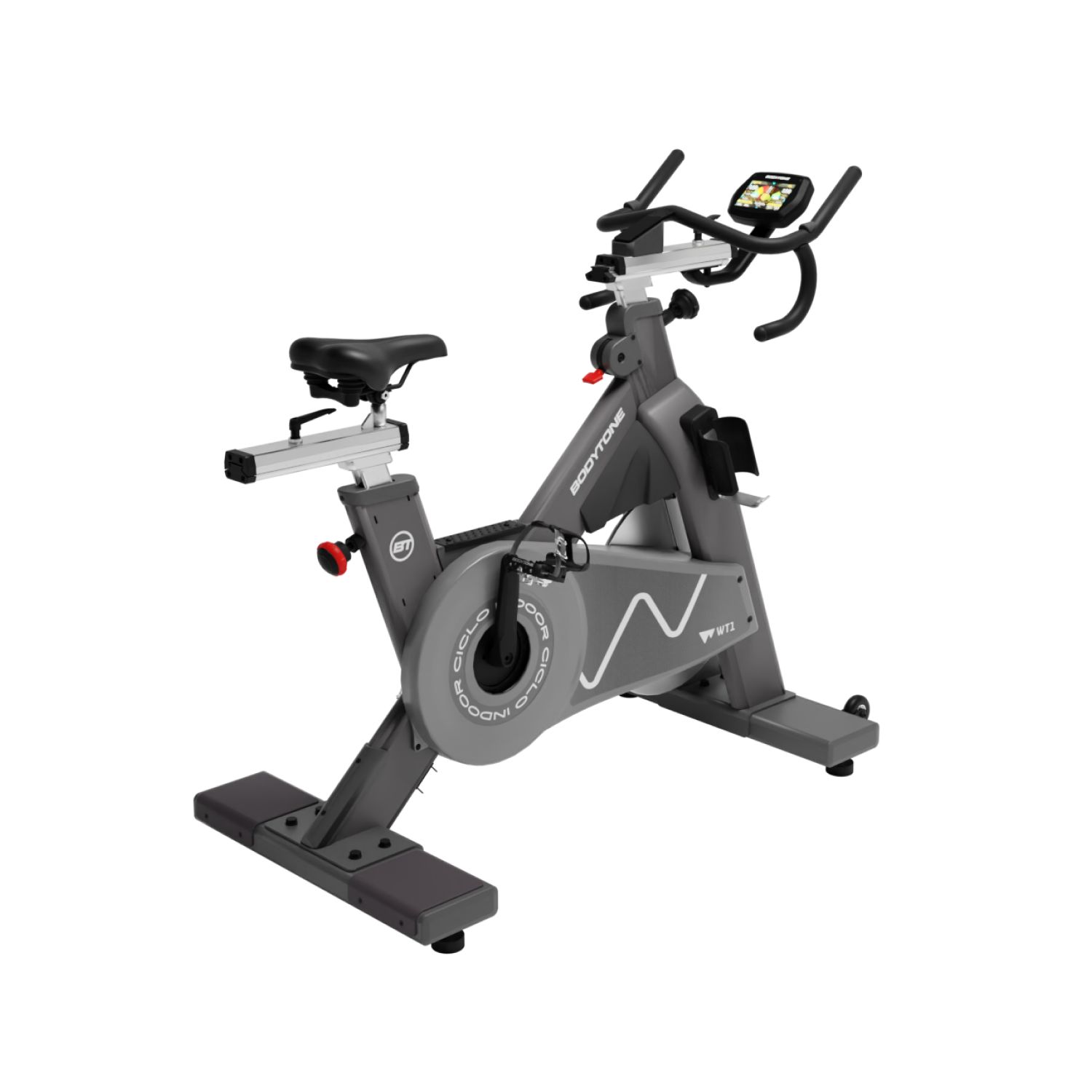
A professional spin bike is a piece of performance equipment, not a lighter machine with a heavier frame. It is designed to survive daily intensive use in a studio, to hold its calibration through hundreds of classes, and to keep its adjustment settings repeatable for riders of very different builds. Whether you run a club, coach individually or specify equipment for a public facility, the model you choose decides both how your riders experience the class and how the investment behaves over five years.
What defines a professional indoor cycling bike
Equipment built for a supervised commercial floor differs from lighter machines on five points:
- A reinforced steel frame rated for high loads, up to 150 kg of user weight.
- A precise resistance system, magnetic or friction-based.
- A robust drivetrain, either a Poly-V belt or a reinforced chain.
- Multi-axis adjustment, so the same bike fits every rider in the class.
- Certified components to EN ISO 20957-1, the standard for stationary training equipment.
Standards and certification
For commercial use, check two things. EN ISO 20957-1 governs frame robustness and the accuracy of the displayed measurements. Class S is the classification for equipment used in a supervised commercial facility – it is the class to specify, and it should appear on the certification for each individual reference rather than as a general claim about the range. Warranty periods differ by component and by market, so confirm them in writing for your own order.
The technical criteria that matter
1. Resistance system
Magnetic resistance is quiet, smooth and needs little maintenance. Friction resistance costs less to buy but requires regular attention, since the pad is a wear part that changes the feel of the bike as it ages. In a studio running several classes a day, the maintenance difference usually outweighs the purchase price difference.
2. Flywheel
A minimum of 18 kg gives a smooth pedal stroke. For intensive use, specify 20 kg or more. Flywheel mass is what makes the transition between seated and standing work feel controlled rather than jerky, which is why riders notice it immediately even when they cannot name it.
3. Drivetrain
A belt is quiet and needs little maintenance. A chain gives a feel closer to a road bike, which some coaching programmes prefer. Both are valid choices; the decision usually comes down to how noise-sensitive the room is.
4. Display and tracking
The basic set is speed, cadence in RPM, distance and calories. Power measurement in watts is the addition that matters for coaching: it turns a class into measurable progression instead of perceived effort. If a bike does not measure watts natively, check whether a console can be added rather than assuming it cannot.
5. Adjustment
Saddle and handlebars should adjust both horizontally and vertically. Dual-function pedals, taking SPD cleats on one side and flat shoes on the other, keep the bike usable for drop-in riders and committed cyclists in the same class.
Two bikes compared
The Bodytone MT10 and the Bodytone MT6 cover the two most common briefs: precision coaching on one side, reliable everyday class use on the other.
| Specification | Bodytone MT10 | Bodytone MT6 |
|---|---|---|
| Power display | Yes | Available as an option |
| Resistance | Magnetic | Magnetic |
| Flywheel | 20 kg | 20 kg |
| Drivetrain | Belt | Belt |
| Recommended use | Coaching and intensive tracking | Regular class training |
| Noise level | Very low | Low |
| Maintenance | Very low | Low |
Where an MT6 fleet needs power data later, the Bodytone M20X wireless console adds watts, heart rate and cadence to bikes already on the floor, which is often cheaper than replacing them.
How to choose without wasting a study
- Define the use: group classes, individual coaching or athletic preparation. They lead to different specifications.
- Set a budget that includes durability and maintenance, not just the purchase line.
- Compare models on resistance, display, adjustment range, flywheel mass and warranty.
- Plan the accessories: sports flooring tiles, bottle holders, connected consoles.
- Confirm delivery and installation arrangements before the order, not after.
The full range is in the indoor cycling bikes category.
Frequently asked questions
What is the difference between a spin bike and a general exercise bike?
A spin bike is designed for intensive use with finely adjustable resistance and a riding position closer to a road bike, which is what makes it suited to cardio and HIIT class formats.
Why choose a bike with watt measurement?
Because power is an objective figure. It gives a coach precise output tracking and gives the rider measurable progression instead of a subjective sense of effort.
What flywheel weight should be specified?
At least 18 kg for a smooth pedal stroke, and 20 kg for professional use.
Are magnetic bikes quiet?
Yes. Magnetic resistance has no contact pad, which is why it is the usual choice for studios sharing a wall with another room.
How often does a professional bike need servicing?
A belt-driven bike needs little: an annual inspection is generally enough. Friction systems need their pads checked far more often.
Can the settings be adapted to each rider?
Yes. Saddle and handlebars adjust on two axes, which is what lets one bike serve a full class timetable.
Specifying your studio
The right bike depends on how you will use it: a coaching studio buys power data, a club floor buys reliability and low noise, and most facilities end up with a mix. Tell us your class timetable, the size of the room and the number of bikes you need, and we will come back with a specification. Request a quote to start.
Sources et références
- NF EN ISO 20957-1 – équipement d’entraînement fixe, partie 1 : exigences générales de sécurité et méthodes d’essai (AFNOR)
- AFNOR Normalisation – dossier thématique sur les appareils d’entraînement fixes et leurs classes d’usage
À lire aussi sur le même thème
- Comment dynamiser vos cours de RPM grâce au vélo de biking magnétique adaptés à tous ?
- Buying Magnetic Indoor Cycling Bikes: The Complete Guide
- Magnetic Resistance Indoor Cycling Bikes: How to Choose
- Pickleball Court Flooring: Where to Buy a Complete System at the Right Price
- What Is Calisthenics and Which Equipment Should You Buy?