Pickleball Court Flooring: Where to Buy a Complete System at the Right Price
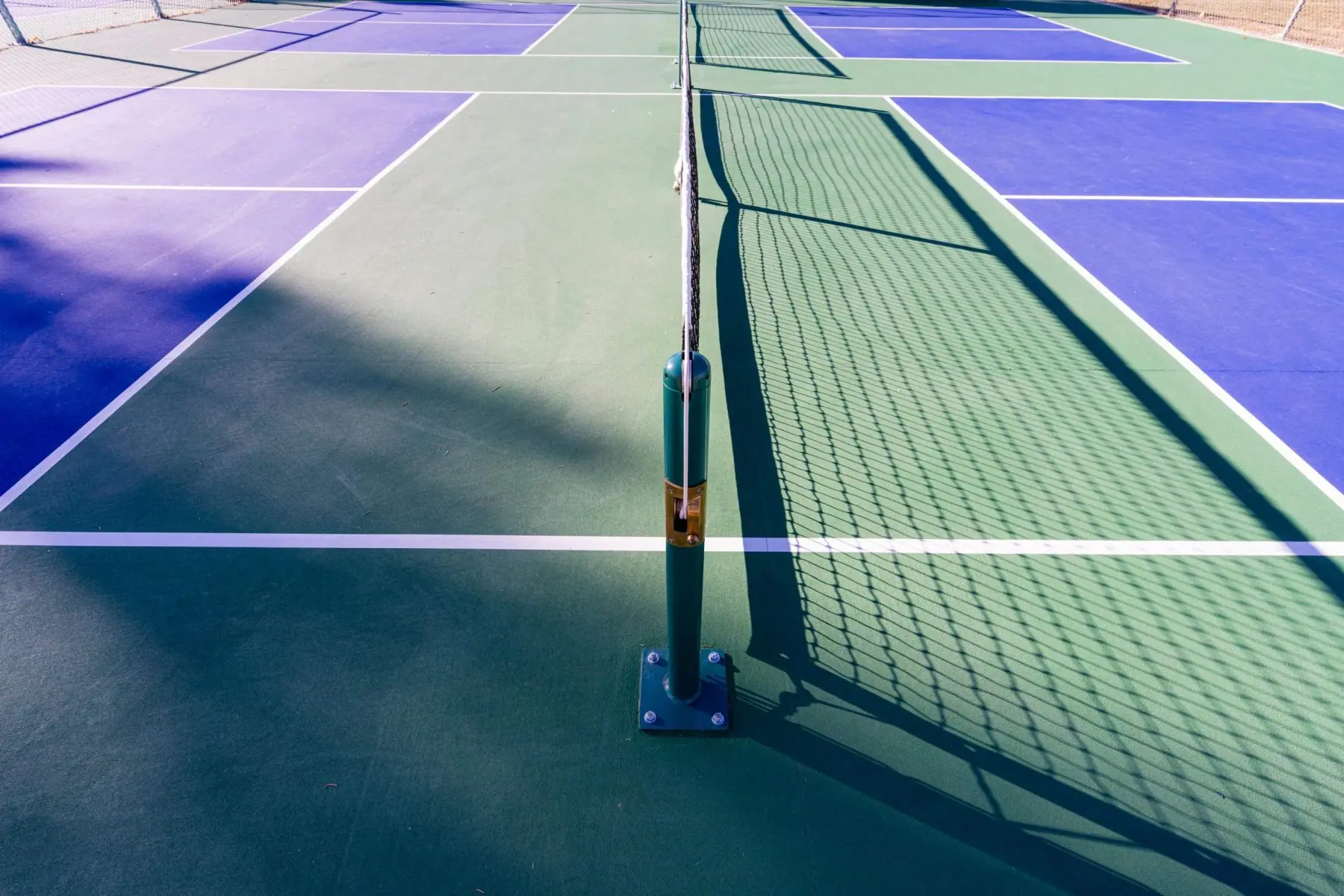
The cost per square metre of a pickleball court surface only means something once you know the substrate, the exposure and the number of playing hours it has to absorb. The same court can be built as interlocking polypropylene tiles, as a PVC sports roll, as a polyurethane resin system or as a rubber tile floor, and each of those answers a different brief. This guide sets out how to compare the options properly and what has to be on the quotation before price becomes a useful number.
Pickleball is one of the fastest growing racket sports, and courts are going in at clubs, sports halls, hotels, campsites, schools and local authority sites. The surface is not an afterthought: it decides ball bounce, footing, joint load, noise and how long the court lasts before it has to be redone.
The surface families, and what each one is for
Interlocking polypropylene tiles
Modular tiles that clip together over an existing hard surface. They drain, they tolerate outdoor exposure, they can be laid quickly and by a small team, and a damaged tile is replaced individually rather than by redoing a section. They are the usual answer for an outdoor court going onto an existing slab or an old tarmac area. Line markings are built up from tiles of a second colour, so the court layout is set at installation and can be changed later.
PVC sports rolls
Welded vinyl sheet with a defined wear layer. This is the indoor sports hall solution: consistent ball response, controlled slip resistance, good acoustic behaviour and a surface that cleans easily. It needs a sound, flat, dry substrate, which usually means a screed or a levelling compound over the existing slab.
Polyurethane resin systems
A seamless applied system, hard-wearing and uniform, built up in situ. It gives the most consistent playing surface and the longest service life on a well prepared base, at the cost of a longer installation and a full cure time before play.
Rubber tiles and rolls
Where shock absorption and noise control matter more than a fast ball, rubber is the answer. It is more often used for a multi-use area that includes pickleball than for a dedicated competition court.
Synthetic turf
Sand-dressed synthetic turf drains well and is forgiving underfoot. It changes the ball behaviour noticeably, so it suits recreational and holiday-site courts rather than club play.
Thickness, substrate and shock absorption
Thickness is not a quality ranking, it is a response to the substrate and the use. A thicker floor absorbs impact better and resists point loading from equipment and furniture; a thinner one is what you lay loose or bonded over an existing slab, tiling or an old covering when the level cannot be raised.
As a working range, PVC sports floors for this use sit between 4 mm and 10 mm, and shock-absorbing rubber floors go up to 20 mm. The right figure for your court depends on the base and on the playing hours, which is why it is settled on the quotation and not in advance.
Whatever the family, ask the supplier for the test reports covering slip resistance, wear layer thickness, shock absorption and, for an indoor hall, acoustic performance. A supplier who can produce those documents is telling you something a price per square metre cannot.
Comparing the options
| Surface | Indoor or outdoor | Installation | Best suited to | Watch out for |
|---|---|---|---|---|
| Interlocking polypropylene tiles | Mainly outdoor, also indoor | Clipped, dry laid, fast | Existing slab or tarmac, multi-sport use, phased budgets | Substrate flatness and falls for drainage |
| PVC sports roll | Indoor | Bonded and welded | Sports halls, schools, clubs | Requires a flat, dry, sound base |
| Polyurethane resin | Indoor and outdoor | Applied in situ, cure time | Dedicated club and competition courts | Longest works window, base preparation critical |
| Rubber tiles or rolls | Indoor and outdoor | Loose laid, interlocked or bonded | Multi-use areas, noise-sensitive sites | Ball response differs from a hard court |
| Synthetic turf | Outdoor | Rolled and seamed | Holiday sites, campsites, recreational play | Not a club-standard playing surface |
Our pickleball court surfacing covers the dedicated systems, with the polypropylene interlocking tiles for outdoor modular courts and the sports court rolls for indoor halls.
Six questions that settle the specification
- Where is the court? Indoor, outdoor, covered but open-sided. Exposure decides UV stability and drainage before anything else.
- What is underneath? Concrete slab, tarmac, existing sports floor, tiling. The substrate rules out more options than the budget does.
- How many playing hours? A club court and a hotel court that sees a few hours a week do not need the same wear layer.
- Single sport or multi-use? If the same area also hosts basketball or school PE, the markings and the surface both have to accommodate it.
- How much disruption is acceptable? Modular tiles are playable the same day; a resin system needs a works window and a cure period.
- What is the whole-life budget? Cost per square metre plus preparation, markings, delivery, installation and the expected service life. Comparing only the first of those is how projects go wrong.
Markings and finishing
Court markings can be produced in contrasting tiles on a modular court, or applied as sports line paint on rolls and resin. Where the same area serves several sports, agree the marking hierarchy and the colours at the design stage rather than after installation; overlapping line sets in similar tones are the most common complaint on a multi-use hall.
Maintenance
Most sports surfaces need far less than people expect: a damp mop with a neutral cleaner and quick drying, no aggressive detergents, and no abrasive pads on the wear layer. Modular outdoor tiles need their drainage channels kept clear of leaves and grit. Set a cleaning routine at handover and record it, particularly on a site open to the public.
Frequently asked questions
What thickness should a pickleball surface be?
Between 4 mm and 10 mm for PVC sports floors, and up to 20 mm for shock-absorbing rubber floors. The figure follows from the substrate and the playing hours.
Can interlocking PVC or polypropylene tiles go straight onto a concrete slab?
Yes, provided the slab is flat. A levelling compound is usually needed first, and outdoors the slab has to have enough fall to drain.
What is the difference between a resin floor and a PVC floor?
Polyurethane resin is applied in situ and gives a seamless, extremely hard-wearing and uniform finish. PVC comes as a manufactured sheet, offers a wider choice of colours and is quicker and simpler to install.
Are these surfaces suitable for humid environments?
Yes, subject to choosing the right system. Slip resistance and moisture behaviour are properties of the specific product, so ask for the test data for the reference being quoted.
Can markings be customised for a club?
Yes. Colours, line sets and logos are agreed as part of the layout, on modular courts and on rolled or resin surfaces alike.
Getting a price that means something
Send us the court dimensions, a photograph of the existing surface, whether the court is indoor or outdoor and the expected playing hours. You get back a recommended system, the preparation it needs and a costed proposal per square metre with everything included. Request a quote to start.
Réalisations documentées
- Dalles et sols sportifs : livraisons documentées – plusieurs chantiers
- Sol sportif extérieur, square Georges-Vallerey – Taverny (95)