Essential Gym Equipment: The Complete Buyer Guide for Facilities
L'équipement de base d'une progression en musculation tient en quatre éléments : une barre et des disques, un banc réglable, un rack et une barre de traction. Ces éléments couvrent l'ensemble des mouvements polyarticulaires. Les machines guidées et les accessoires viennent ensuite, selon le public et la surface disponible.

Specifying the right strength equipment is the foundation of a facility that performs. It protects users, it supports genuine progression, and it decides how many years a fit-out will last before it has to be replaced. This guide walks through the essential categories, the brands worth shortlisting, the machines to select by muscle group, the accessories that make a measurable difference, and the equipment now moving from niche to standard on commercial floors.
Why equipment quality genuinely matters
Under-specified equipment costs far more than it saves. On a commercial floor it:
- raises the risk of injury through instability, component failure and poor biomechanics;
- slows progression, because loading is insufficient and wear is fast;
- degrades the training experience, and with it member retention and reputation.
For any indoor installation open to the public, the reference is EN ISO 20957-1 class S, the professional class for equipment used in supervised and unsupervised commercial facilities. Class S is the baseline for gyms, clubs, hotels, municipal halls, schools and rehabilitation centres alike, and it is what separates a floor that survives a decade of continuous use from one that does not.
The essential equipment for any strength floor
Power racks and squat racks
The rack is the centrepiece of any serious strength area. It allows users to:
- squat, press and pull safely thanks to adjustable safety bars;
- perform pull-ups, dips and other bodyweight work on the same footprint;
- train heavy without a spotter, which matters in unsupervised opening hours.
A single rack concentrates a large share of the training value of a room into a few square metres. Browse the full range of racks and power cages to see the configurations available.
Barbells and dumbbells
These are the primary tools:
- Olympic barbells, EZ bars and hex bars, chosen according to the movements programmed;
- adjustable dumbbells or fixed sets for unilateral work and isolation.
On a commercial floor, fixed dumbbell sets usually win on throughput and durability; adjustable sets win where space is the binding constraint.
Weight benches
Indispensable for flat, incline and decline pressing and for a long list of isolation movements. Prioritise a stable frame, a genuine adjustment range and an upholstery specification that survives daily use. See the range of professional weight benches.
Weight plates
Olympic plates with a 50 mm bore, or standard plates depending on the bars in service. Plan a complete range of increments so users can load progressively rather than jumping between wide gaps.
Cardio machines
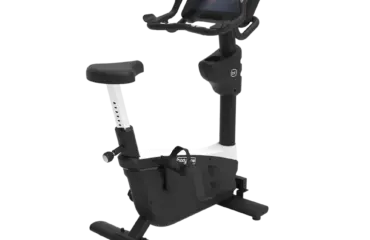
Treadmills, exercise bikes, rowers and air bikes serve warm-up, endurance work and energy expenditure. They also govern the perceived comfort of the space at peak hours. Explore the professional cardio range.
Pull-up bars
Essential for back and arm work. They can be wall-mounted, ceiling-mounted or integrated into the rack, which is usually the most efficient option when floor area is limited.
Leading strength equipment brands
| Brand | Speciality |
|---|---|
| Light In Fitness | Strength equipment, racks, cages, sports flooring |
| Bodytone | Strong value for money, complete catalogue |
| Ziva | Dumbbells, plates, durable accessories |
| Xebex | Cardio, air bikes, rowers |
| Ellipse | Versatile equipment, cross-training |
Each brand has its own centre of gravity. The right choice depends on budget, on the intended use, and on whether the priority is strength, cardio or versatility across a mixed membership.
Equipment by muscle group
Chest
- Chest press: guided, safe, well suited to heavy loading by less experienced users.
- Cable crossover: wide range of motion and full contraction, and a strong visual anchor for a functional zone.
Back
- Lat pulldown: targets the lats and improves shoulder mobility.
- Seated row: strengthens the mid and lower back.
Legs
- Leg press: heavy work for quadriceps, glutes and hamstrings.
- Leg curl: hamstring isolation.
Arms
- EZ bar: biceps work with less wrist stress.
- Triceps bar or rope attachment: triceps isolation on a cable station.
Core
- Ab wheel: dynamic bracing, very effective, easy to store.
- Incline ab bench: crunches and sit-ups.
Accessories that improve training
These smaller items make a real difference to how a floor is used:
- Lifting belt: lumbar support on heavy squats and deadlifts.
- Wrist wraps: stability on heavy pressing.
- Knee wraps: joint support on heavy squats.
- Lifting straps: grip retention when the hands fail before the target muscle.
- Resistance bands: warm-up, activation and variable-resistance work.
Emerging strength equipment
Several tools have moved into the mainstream of commercial programming:
- Suspension trainers: bodyweight work, highly versatile, usable in almost any space.
- Battle ropes: conditioning combined with upper-body strengthening.
- Steel maces and sledgehammers: functional work, stability and coordination.
- Skipping ropes: conditioning, coordination and agility, with a negligible footprint.
These complement a classical programme rather than replacing it, and they let a small group class run alongside a busy strength floor.
Key takeaways
Well-chosen strength equipment:
- makes training safer for every user profile;
- allows progression in both load and technique;
- lasts, provided the brands and the build specification are sound.
Match the selection to the membership, the objectives and the available floor area. And remember that execution quality counts as much as equipment quality: correct form first, load second.
Frequently asked questions
What is the minimum equipment for a functional strength area?
A barbell with a full set of plates, an adjustable bench, a rack and a pull-up bar. Those four items cover every major compound movement. Guided machines and accessories come afterwards, according to the user profile and the surface available.
Why insist on EN ISO 20957-1 class S?
Class S is the professional class for indoor equipment. It sets the requirements for machines used in commercial facilities, where the equipment is loaded many times a day by users of very different sizes and abilities. Equipment outside that class does not belong on a paying floor.
Should a facility standardise on one brand?
Not necessarily. Mixing brands is common and often sensible, because the strongest cardio supplier is rarely the strongest plate-loaded supplier. What matters is a coherent layout, consistent adjustment logic across machines and a single point of contact for spare parts.
How much space should be allowed per station?
The source figures depend on the specific machine and on circulation requirements, so they should be taken from the technical sheet of each product rather than estimated. Ask for the layout drawing before ordering.
Building your equipment list
Every project has its own constraints: ceiling height, floor loading, membership profile, opening hours and budget. The most efficient route is to share the floor plan and the intended use, then work back to a specification that fits. Request a quote and receive a costed equipment list built around your room rather than around a catalogue page.