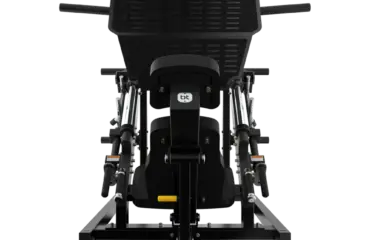
Hip thrust machine buying guide for commercial gyms
The hip thrust is the rare piece of gym equipment whose commercial effect an operator can actually measure, which is why the buying decision should start with utilisation hours per day rather than with the exercise itself. Practice has grown sharply since 2018, driven largely by women aged 25 to 45, and a dedicated glute training station has become a visible differentiator on a club floor.
This guide covers what the biomechanical evidence supports, the three machine formats and where each one belongs, the queue arithmetic that decides between them, a transparent payback calculation and the specification points that matter when you place the order.
What the evidence actually supports
Four points are worth separating from marketing. Electromyography work by Contreras and colleagues records gluteus maximus activation of around 86 per cent of maximum voluntary isometric contraction at only 40 per cent of one repetition maximum, which is higher than the squat, deadlift or leg press for isolating the gluteus maximus.
The loading profile is the reason: unlike the squat, which loads the glutes in a stretched position, the hip thrust loads them at full hip extension, the point of maximum contraction, and no other common exercise reproduces that resistance profile. Third, lumbar loading is essentially absent because the back is supported and the hip does the work, which makes it usable by the significant share of adults who cannot tolerate loaded spinal flexion.
Fourth, in the clubs we have equipped, adding a glute training zone with a dedicated machine has been followed by a 12 to 20 per cent rise in female sign ups over the following three months. That is our own observation across installed sites, not a controlled study, and your catchment matters.
Three formats, three different problems
| Format | How it works | Strength | Real limitation | Observed use |
|---|---|---|---|---|
| Free weight hip thrust bench | Dedicated bench with a 50 mm Olympic bar on plate holders, user loads and unloads | Highest maximum load, 200 to 360 kg, natural movement feel, moderate price | Loading takes 2 to 3 minutes per change, the bar rolls if the pad is misplaced, intimidating for beginners | 4 to 6 hours per day |
| Selectorised hip thrust machine | Weight stack with a pin, guided path, like a leg extension | Load change in about three seconds, accessible to beginners, easy drop sets, short queues | Maximum load usually capped at 80 to 120 kg, which advanced users outgrow within 12 to 18 months | 6 to 10 hours per day, the highest of the three |
| Hip thrust on a Smith machine | Bench positioned inside an existing Smith machine | No additional capital cost where a Smith machine already exists | Occupies the Smith machine for 15 to 20 minutes per user, strictly vertical path, complex set up per user | Not applicable |
The observed use figures are averages recorded across the clubs we have equipped, over a 06:00 to 22:00 operating window.
The queue arithmetic that settles the choice
The selectorised machine records the highest utilisation because it removes the main friction of the hip thrust on a busy floor: plate handling. At peak hours, a plate change between two users costs 3 to 5 minutes, and eight rotations an hour turn that into 24 to 40 minutes of dead time per hour on that station.
With a weight stack it is three seconds. The offsetting problem is the 80 to 120 kg ceiling, which is genuinely frustrating for members who reach 100 to 150 kg after a year of training.
Our recommendation follows from that. Below 200 members, one free weight bench is enough. Above 200 members, and as soon as peak hour queues exceed ten minutes, add a selectorised machine to smooth rotation. The two coexist well: the stack for beginners, the bar for advanced users. Where a Smith machine is the only option, treat it as a temporary answer, because monopolising your Smith machine for twenty minutes at peak time simply moves the queue rather than removing it.
Machine or barbell on a flat bench
| Criterion | Dedicated hip thrust machine | Barbell on a flat bench | Practical verdict |
|---|---|---|---|
| Gluteus maximus activation | 85 to 90 per cent MVIC, path optimised at the point of peak contraction | 80 to 86 per cent MVIC, the bar can shift and redistribute load | A 5 to 10 per cent difference, meaningful for competitors, marginal for general membership |
| Safety | No bar to roll or drop, integrated pad, mechanical stops | Risk if the bar rolls, the pad slips or the bench moves under heavy load | On an unsupervised floor the machine removes the set up related injury scenarios |
| Set up time per user | 30 seconds to 2 minutes | 3 to 8 minutes | At eight rotations per hour this is the difference between a usable station and a bottleneck |
| Accessibility for beginners | High, load selection is obvious | Low, users do not know what to load | Decisive if you are targeting new members |
What it costs and when it pays back
Two figures need separating, because our French source and our catalogue do not agree. Market bands cited there are 1,800 to 3,500 EUR excluding VAT for a free weight hip thrust bench and 2,500 to 4,500 EUR for a selectorised machine. Our own verified list price for the Lexco LPS-124 hip thrust machine is 5,500 EUR excluding VAT, and a complete pre configured lower body zone is listed at 40,340 EUR excluding VAT.
We quote our own price rather than the market band, and that changes the payback arithmetic, so here it is transparently.
| Scenario | Capital cost excluding VAT | Additional monthly revenue | Payback |
|---|---|---|---|
| Selectorised machine, 5 extra memberships at 40 EUR | 5,500 EUR | 200 EUR | About 27 months |
| Selectorised machine, 10 extra memberships at 40 EUR | 5,500 EUR | 400 EUR | About 14 months |
| Free weight bench, 5 extra memberships at 40 EUR | 3,000 EUR | 200 EUR | About 15 months |
Claims of a two to four month payback circulate in this category. They only hold at the bottom of the market price band and with an optimistic retention assumption, so we do not repeat them. A twelve to twenty four month payback on a machine with a ten to fifteen year service life is a perfectly sound investment without needing to be overstated.
Specification points to settle before ordering
Ask for the ISO 20957-1:2024 use class in writing: class S is professional and commercial, class H is domestic, and nothing sold as semi professional belongs on a club floor. Check pad width and the padding density, because this is the contact point that generates complaints. Confirm the maximum stack weight against the profile of your membership, not against the catalogue photograph.
Verify the footprint including the user’s leg extension, which is routinely underestimated in layout drawings. Specify 15 to 20 mm rubber flooring under a free weight version, since plates are set down hard on this station. And confirm spare parts availability in years, particularly for the pad and the cable if the machine is selectorised.
Frequently asked questions
Selectorised or free weight if we can only buy one?
Selectorised below 200 members if your priority is new and beginner users, free weight if your membership is already trained and lifting heavy. The stack version records higher daily utilisation in every club we have measured.
How much floor space does it need?
Allow for the machine footprint plus the user’s extended legs and a circulation lane behind, and place it where a queue will not block a main route. Cramming it against a wall in a corner is the most common layout error.
Is a hip thrust station worth it in a hotel or corporate gym?
Rarely as a dedicated machine, given the low user count. A rack with a bench and a pad covers the need at a fraction of the cost in those settings.
Does it replace squats and leg press?
No. It loads the glutes at full hip extension, which the squat does not, and the squat loads them under stretch, which the hip thrust does not. They are complementary, and a strength floor needs both.
What maintenance does it need?
Weekly checks of pad fixings and, on a selectorised version, cable and pulley condition. Pads wear fastest and should be a stocked spare part rather than a special order.
Specify your glute training zone
Light In Fitness has equipped more than 2,500 customers since 2013 from Tours, France, and quotes hip thrust stations individually or as part of a complete lower body zone. Send us your floor plan and membership profile and you will have a costed proposal within 24 working hours. Stock items ship in 5 to 10 working days across France, Belgium, Switzerland and Luxembourg, with export quoted per project. See strength training machines and the Bodytone booty area, or request a quote.
Sources et références
- Code du sport, articles R322-4 à R322-43 – garanties d’hygiène et de sécurité applicables aux établissements d’activités physiques et sportives (Légifrance)