Buying Shock-Absorbing Rubber Tiles: The Essential Guide to Choosing Well and Avoiding Mistakes
Introduction
Shock-absorbing rubber tiles have become unavoidable for gyms, playgrounds, outdoor terraces and public facilities. They deliver safety, comfort and long service life. But the moment you come to buy, the questions pile up: what thickness should you choose? Which standards do you need to check? Which installation method is right? And how do you avoid unpleasant surprises three years in?
This guide works through every question and every difficulty faced by buyers investing in a shock-absorbing rubber floor, with concrete answers drawn from the experience of Light In Fitness, a specialist supplier of professional sports equipment and of certified tiles for every kind of space.
1. Safety and standards: not optional
Why safety comes first
A shock-absorbing rubber tile is not only a comfort question. It has to protect against injury and to keep the installation compliant with the regulations that apply to the site.
The main standards to know
- EN 1177: the European standard for impact-attenuating playground surfacing, which defines the critical fall height (HIC). It is the standard that governs the surfacing under children’s play equipment; the play equipment itself falls under EN 1176-1.
- Fire classification Bfl-s1: required in many public buildings to limit the spread of flames and toxic smoke. Requirements vary by country and by building type, so confirm the class demanded by the national fire regulations applicable to your project before ordering.
- Slip resistance: essential to prevent slips, including when the floor is wet. Slip ratings such as R10 to DIN 51130 are the usual reference for specifying this.
The problem: many budget tiles do not meet these standards, which can lead to an insurance refusal or even to administrative closure if the site is inspected.
The Light In Fitness answer: our playground surfacing is tested to EN 1177 in laboratory conditions, and fire-rated versions are available, so the installation can be signed off in full compliance. Ask for the certificate covering the exact reference you are buying.
2. Thickness and density: match the tile to the use
Standard thicknesses and what they are for
- 20 to 25 mm: fitness, yoga, light loads.
- 30 to 40 mm: cross-training, heavy barbell work, intensive strength areas.
- 50 to 60 mm: playgrounds, zones with a high fall height, public parks.
Comparison table
| Use | Recommended thickness | Impact resistance | Average price per square metre |
|---|---|---|---|
| Fitness / yoga | 20 to 25 mm | Low | 20 to 35 EUR excluding VAT |
| Cross-training | 30 to 40 mm | Medium | 30 to 45 EUR excluding VAT |
| Heavy barbell work | 40 mm | High | 35 to 50 EUR excluding VAT |
| Playground | 50 to 60 mm | Very high | 40 to 65 EUR excluding VAT |
The problem: a tile that is too thin wears out quickly and does not absorb impact properly. A tile that is thicker than necessary costs more than it needs to and complicates the installation.
The Light In Fitness answer: every project gets an individual assessment based on the space and the intended use. Browse the full range of rubber gym flooring tiles and the playground surfacing for high fall heights.
3. Installation: puzzle tile or heavy square tile?
Tile formats
- Interlocking puzzle tiles: easy to install, removable, ideal for temporary or reconfigurable use.
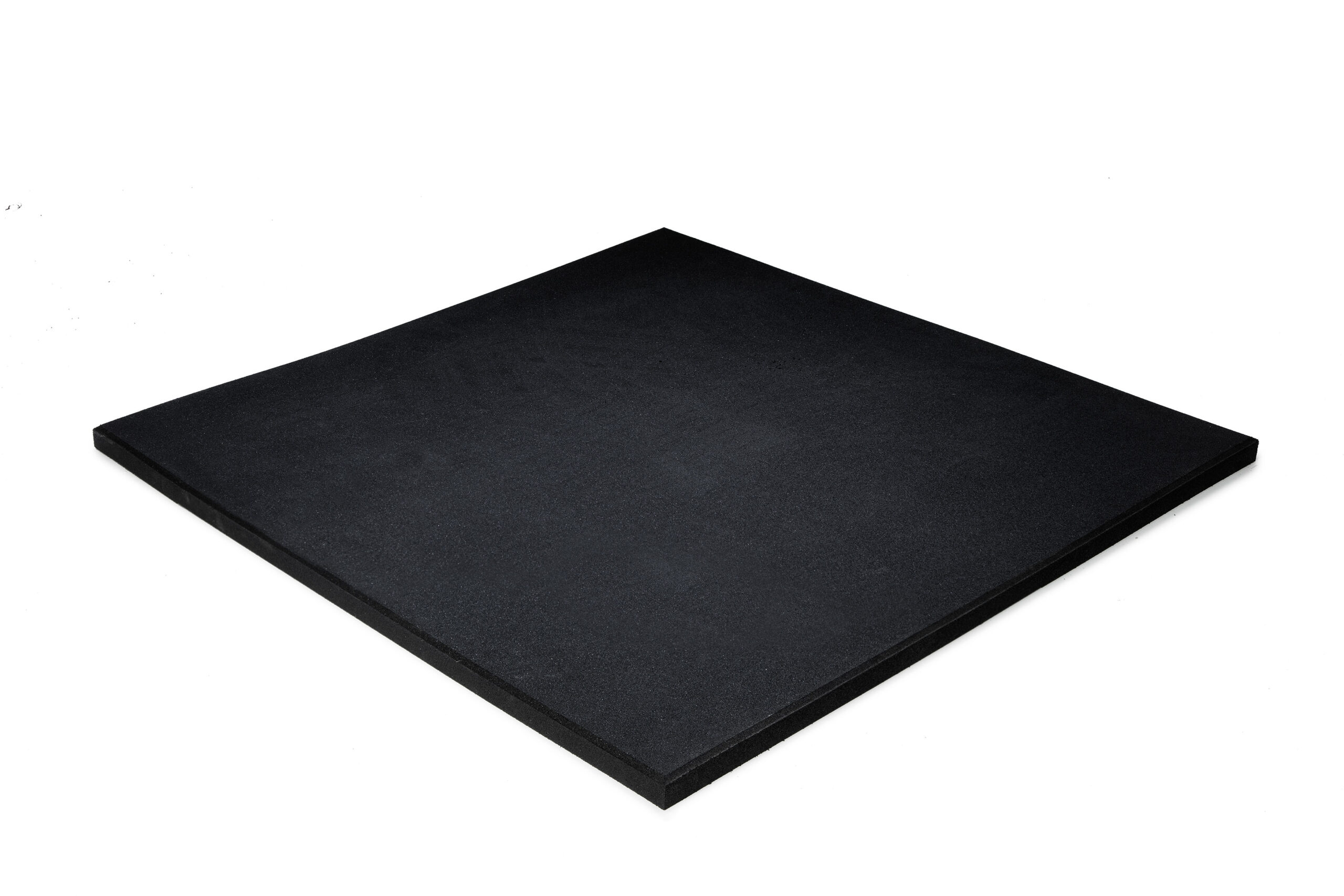
- Heavy square tiles (100 x 100 cm): stable, durable, the right choice for a permanent installation.
Fixing methods
- Loose lay: on a flat substrate, often sufficient indoors.
- Clipped or bonded: recommended outdoors or in high-traffic areas.
The problem: poor substrate preparation (unevenness, standing damp) leads to deformation and to water getting under the floor.
The Light In Fitness answer: technical advice on substrate preparation, plus fixing kits where a permanent installation calls for them.
4. Durability: avoiding premature wear
A good rubber floor should last 7 to 15 years, even under intensive use.
What determines resistance
- Rubber density: the more compact the material, the better it resists impact.
- UV and frost resistance: essential for any outdoor installation.
- Permanent slip resistance: safety maintained even when wet.
The problem: low-cost tiles lose their properties quickly, crumble at the edges or fade.
The Light In Fitness answer: our tiles are made from high-density recycled rubber, which combines robustness with a genuinely lower environmental footprint.
5. Budget and value for money
What drives the price
- Thickness: the thicker the tile, the higher the price.
- Certification: EN 1177 and fire classification.
- Finish: coloured granules, custom work.
- Order quantity: volume pricing per square metre for clubs and public buyers.
The problem: many buyers look only at the price per square metre, without considering certification or service life, and end up replacing the floor far sooner.
The Light In Fitness answer: professional volume pricing and a written quotation covering the whole project, floor and logistics included.
6. Appearance and customisation
Rubber flooring is no longer limited to classic black.
- Coloured granules for a contemporary finish.
- Logo customisation for sports clubs.
- Multiple colours for playgrounds.
The problem: the more decorative models cost more and are rarely held in stock.
The Light In Fitness answer: customisation on request, with made-to-order production.
7. Cleaning and hygiene: the point everyone forgets
What a quality tile gives you
- Simple cleaning (vacuum, mop, hose).
- Antibacterial treatment available.
- Resistance to odour build-up.
The problem: poor-quality tiles hold sweat and start to smell.
The Light In Fitness answer: premium tiles treated to limit odours and bacteria, which is what an enclosed training room needs.
8. Logistics and delivery: consistently underestimated
Rubber tiles are heavy: 15 to 30 kg per square metre.
Key points
- Transport becomes expensive when the supplier holds no stock near the site.
- Lead times vary widely and can run to six weeks with some suppliers.
- Handling on site is difficult if it has not been planned for.
The problem: buyers forget to cost the logistics, and the final budget inflates.
The Light In Fitness answer: a precise logistics quotation alongside the product quotation, so the delivered cost is known before the order is placed.
Conclusion
Buying shock-absorbing rubber tiles is not a decision to take lightly. Every one of these questions, safety, standards, thickness, installation, budget, durability, hygiene and logistics, has a direct impact on whether the project succeeds.
With Light In Fitness you get:
- certified products that comply with the applicable European standards,
- individual support in choosing the right thickness and the right fixing method,
- volume pricing for professional buyers,
- a clear logistics plan agreed before the order.
Ask for your quotation now and specify a floor that is durable, good-looking and safe: request a quote. For enclosed public buildings, start with the fire-rated rubber tiles.
FAQ on shock-absorbing rubber tiles
What thickness should I choose for a gym?
20 to 25 mm is enough for general fitness. For cross-training or heavy barbell work, go to 30 to 40 mm.
How do I know whether a rubber tile is certified?
Check the EN 1177 reference for playground fall safety and the declared fire classification. Light In Fitness supplies the official certificates for the reference you order.
Can rubber tiles be installed outdoors?
Yes, provided you choose UV-resistant, slip-resistant models.
Do the tiles have to be bonded?
Not necessarily. Puzzle tiles interlock without adhesive. Outdoors or in high-traffic areas, bonding is recommended.
What is the average price of a shock-absorbing rubber tile?
Between 20 and 65 EUR excluding VAT per square metre depending on thickness and certification, as set out in the comparison table above.
How do I clean a rubber floor?
A vacuum and a damp mop are enough. Outdoors, a hose does the job.
Do rubber tiles smell?
Low-cost models do. Certified Light In Fitness tiles are neutral and treated to limit odours.
What information should I have ready to get an accurate quotation?
The surface area in square metres, the intended use and the loads involved, whether the area is indoor or outdoor, the fall height if children’s equipment is present, the fire class required by the building, and the access conditions for delivery and handling.
Réalisations documentées
- Dalles et sols sportifs : livraisons documentées – plusieurs chantiers
- Sol sportif extérieur, square Georges-Vallerey – Taverny (95)
Sources et références
- Arrêté du 19 avril 2011 – étiquetage des produits de construction ou de revêtement de mur ou de sol sur leurs émissions de polluants volatils (Légifrance)
- Ministère de la Transition écologique – étiquetage des produits de construction : classes d’émission A+ à C
- Décret n° 96-1136 du 18 décembre 1996 – prescriptions de sécurité relatives aux aires collectives de jeux (Légifrance)
- NF EN 1176-1 – Équipements et sols d’aires de jeux, partie 1 : exigences de sécurité et méthodes d’essai générales (AFNOR)