Buying Magnetic Indoor Cycling Bikes: The Complete Guide
Magnetic indoor cycling bikes have become the default specification for studios, hotel fitness suites, clubs and corporate facilities, and the reason is straightforward: they are quiet, they are smooth, and they have almost nothing that wears out. Where a friction pad presses directly onto the flywheel, a magnetic brake never touches it, which removes the single largest consumable in a cycling studio and makes resistance progression genuinely repeatable from one class to the next.
Before you order a fleet, though, several questions decide whether the bikes will still be in service in year eight: what flywheel and drivetrain to specify, how much adjustment the frames offer, what the connectivity actually does, what certification to insist on, and what a professional bike really costs. This guide takes them in order.
1. How magnetic resistance works, and why it matters commercially
A friction system slows the flywheel with a pad in direct contact. A magnetic system uses magnets whose distance from the flywheel is varied: the closer they sit, the greater the braking force. Nothing touches, so nothing abrades.
Three consequences follow for an operator. The bike is quiet, which matters in a studio with an instructor microphone and in hotels where the fitness room sits near guest rooms. There is no wearing brake component to replace, which removes a recurring maintenance line. And the resistance progression is fine and repeatable, which is what makes structured class programming possible at all.
The caveat is real: not every bike sold as magnetic offers genuinely fine progression. Some low-cost designs give a small number of coarse steps. On the professional side of the range, the Etenon ION8 uses 100 digital resistance levels, which is what allows an instructor to call an exact effort and every rider in the room to reproduce it.
2. Flywheel weight and pedalling feel
The flywheel is the heart of the bike, and it is also the specification most often misread. Heavier flywheels smooth the pedal stroke, but raw flywheel mass is not the whole story: gear ratio and drivetrain design determine how much inertia the rider actually feels. The Etenon ION8, for example, documents a 12 kg flywheel producing a felt inertia of 24 kg. A number on a spec sheet only means something once you know which of the two it refers to.
What matters in practice for a commercial installation is that the pedal stroke stays smooth under a standing sprint by a heavy rider, that the same bike still feels smooth after two years of classes, and that every bike in the room feels identical, because a fleet that does not is a fleet that gets complained about. Ask the supplier for both the flywheel mass and the felt inertia rather than accepting one figure without context.
3. Fit and adjustment
A studio bike is used by a different body every 45 minutes, so adjustment range is a throughput issue, not a comfort feature. Check four things:
- Saddle adjustment in both height and fore-aft, with markings so a rider can return to their own setting quickly.
- Handlebar adjustment, ideally on both axes, with multiple grip positions for seated, standing and sprint work.
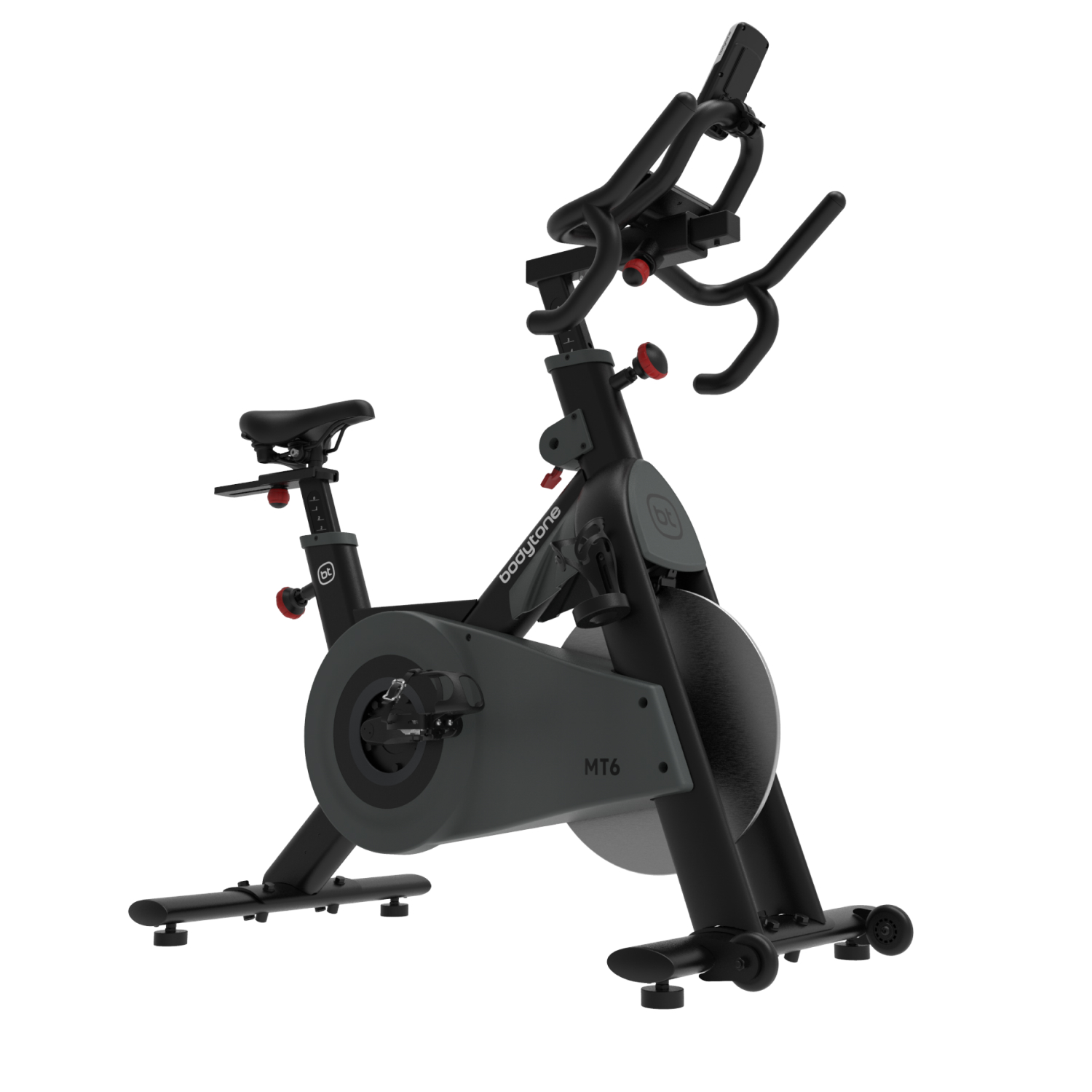
- Q-factor, the lateral distance between the pedals. A narrower Q-factor puts the knee in a more natural line; the Bodytone MT6 documents 213 mm.
- Pedals. Dual SPD and cage pedals let a class run with both clipped-in regulars and drop-in guests, which matters in hotels more than anywhere else.
Bikes with coarse adjustment produce bad postures, and bad postures produce complaints and, eventually, claims. Specify four-axis adjustment on any bike that will carry class traffic.
4. Build quality and duty rating
Indoor cycling is a high-load discipline: standing sprints, simulated climbs, maximum resistance. The frame has to take that daily.
- Reinforced steel frame for stability under a standing rider.
- Poly-V belt drive rather than a chain: quieter, no lubrication, no tensioning schedule. The MT6 uses a 20 mm Poly-V belt.
- Documented maximum user weight. The professional models in the Light In Fitness catalogue are rated to 150 kg. Take the manufacturer figure from the specification sheet rather than from a sales claim.
On certification, specify equipment built and certified to EN ISO 20957-1 class S, the classification for equipment intended for supervised commercial use. A general reference to a standard family without the part number and the class tells you nothing about whether the bike is rated for a public facility.
5. Console and connectivity
A studio bike is now a data device as much as a bike. What a professional console should give you:
- Speed, cadence in RPM, distance, calories and, on the better models, power in watts.
- Heart rate, either from a built-in receiver or a paired belt.
- Bluetooth or ANT+ so riders can use third-party training apps.
- Structured programmes for interval, endurance and sprint work.
Watts are the specification worth paying for in a club setting, because power is the only metric that lets an instructor set a genuinely comparable target across a room of different riders. The Bodytone MT10 includes integrated power measurement, and the Etenon ION8 ships with a Bluetooth console compatible with Zwift and Kinomap.
One practical detail that is easy to miss: a battery-powered console needs no floor cabling, which changes what is possible in a rented studio or a room with a finished floor.
6. Budget
Rather than quote a market-wide price ladder, it is more useful to look at what professional bikes actually cost. Three current catalogue references, all excluding VAT:
| Model | Positioning | Price |
|---|---|---|
| Bodytone MT6 | Magnetic studio bike, Poly-V belt, 213 mm Q-factor | 1,425.40 EUR excluding VAT |
| Etenon ION8 (PRO80) | 100 digital resistance levels, watts, Zwift and Kinomap console included | 1,950.00 EUR excluding VAT |
| Bodytone MT10 | Magnetic with integrated power measurement | 2,731.80 EUR excluding VAT |
Fleet pricing is quoted separately, and the gap between a bike that survives four years of classes and one that does not is far larger than the gap between these figures. Judge the purchase over an eight-to-ten-year service life rather than on the unit price.
7. Maintenance
This is where magnetic resistance repays the specification decision. There are no brake pads to change and no chain to lubricate or tension. A belt-driven magnetic bike needs regular cleaning, because sweat is corrosive and a studio produces a great deal of it, plus periodic checks on the adjustment mechanisms, pedals and belt tension.
Build the cleaning into the class turnaround rather than into a weekly routine. Bikes wiped down after every session last markedly longer than bikes cleaned once a week, and it costs nothing.
8. Delivery and installation
A professional indoor cycling bike weighs in the region of 45 to 65 kg, which puts a fleet delivery well beyond a standard parcel service. Plan three things before ordering: specialist transport that will not damage the frames, access to the room including lifts, doorways and stairs, and assembly, which is straightforward but needs tools and time. Delivery lead times, transport arrangements and after-sales terms vary by country, so confirm them for your own location as part of the quote.
Frequently asked questions
What is the difference between a magnetic and a friction indoor cycling bike?
A magnetic bike brakes with magnets that never touch the flywheel, so it is quiet and has no wearing brake part. A friction bike uses a pad in direct contact, which wears and needs periodic replacement.
What flywheel weight should I specify?
Ask for both the flywheel mass and the felt inertia, because the drivetrain determines how much of that mass the rider experiences. The Etenon ION8 pairs a 12 kg flywheel with 24 kg of felt inertia, which shows why one figure alone is not a specification.
Are magnetic bikes genuinely quiet?
Yes, and it is their main operational advantage. With a Poly-V belt drive and no brake contact, the bike is quiet enough for a studio with a microphone and for a hotel fitness room near guest accommodation.
What does a professional magnetic bike cost?
Current catalogue references run from 1,425.40 EUR excluding VAT for the Bodytone MT6 to 2,731.80 EUR excluding VAT for the Bodytone MT10. Fleet configurations are quoted individually.
What maximum user weight do professional bikes take?
The professional models in the catalogue are rated to 150 kg. Always check the figure on the specification sheet for the exact model you are ordering.
Can riders use Zwift or Kinomap?
Yes on the connected models. The Etenon ION8 includes a Bluetooth console compatible with both.
How long does a magnetic bike last in a commercial setting?
With routine cleaning and periodic checks, a professional magnetic bike is a seven-to-ten-year asset. The limiting factors are usually the console and the bearings, not the brake.
Specifying your cycling studio
Buying magnetic indoor cycling bikes for a commercial room comes down to a small number of decisions: fine and repeatable resistance, a drivetrain and flywheel combination that stays smooth under load, four-axis adjustment so any rider fits, a console that gives you the metrics you will actually programme with, and EN ISO 20957-1 class S certification behind all of it.
Light In Fitness has equipped professional facilities since 2013 and supplies the full indoor cycling bike range along with the rest of the professional cardio equipment programme. Request a quote with your room dimensions and fleet size, and we will price the studio as a whole.
À lire aussi sur le même thème
- Magnetic Resistance Indoor Cycling Bikes: How to Choose
- Quel est le meilleur vélo spinning pour atteindre un RPM élevé ?
- RPM, Les Mills or Spinning: Indoor Cycling Formats
- Buying Outdoor Fitness Trail Equipment: The Complete Buyer Guide
- Buying a Pickleball Court: The Complete Guide for Clubs and Operators