RPM, Les Mills or Spinning: Indoor Cycling Formats
Indoor cycling is one of the most effective cardio formats a club can put on a timetable, and one of the most confusingly labelled. Between licensed Les Mills programmes, generic cycling classes and immersive boutique concepts, the same studio equipment ends up marketed under several different names. This guide separates the formats and sets out what each one actually asks of an operator in terms of licensing, bikes and room.
1. The formats, and how they differ
Les Mills RPM: the licensed programme
RPM, short for Raw Power in Motion, is a registered Les Mills trademark. The class is choreographed to a fixed structure over 45 minutes and simulates a road cycling route with flats, climbs and time trials. The music and the exercises change every three months with a new release, which keeps the format fresh for regular attendees and gives instructors a prepared, tested structure rather than a blank page.
The operator consideration is licensing. A club cannot simply put RPM on its timetable: running a Les Mills programme requires an agreement with Les Mills and instructors certified for that programme, with ongoing costs for releases and training. That is a business decision as much as a programming one, and it should be settled before the studio is fitted out.
Generic indoor cycling, biking or spinning classes
Many clubs use the word RPM loosely for ordinary indoor cycling classes. Here the instructor builds their own playlist and their own ride profile. The advantage is freedom and variety: the class takes on the personality of the coach, which suits members who want something less standardised, and there is no programme licence to fund.
It is worth noting that Spinning is itself a registered trademark rather than a generic word, so a club that has no licence for it is better off describing its classes as indoor cycling. The practical trade-off against a licensed programme is consistency, since class quality depends entirely on the individual instructor.
Immersive and boutique cycling
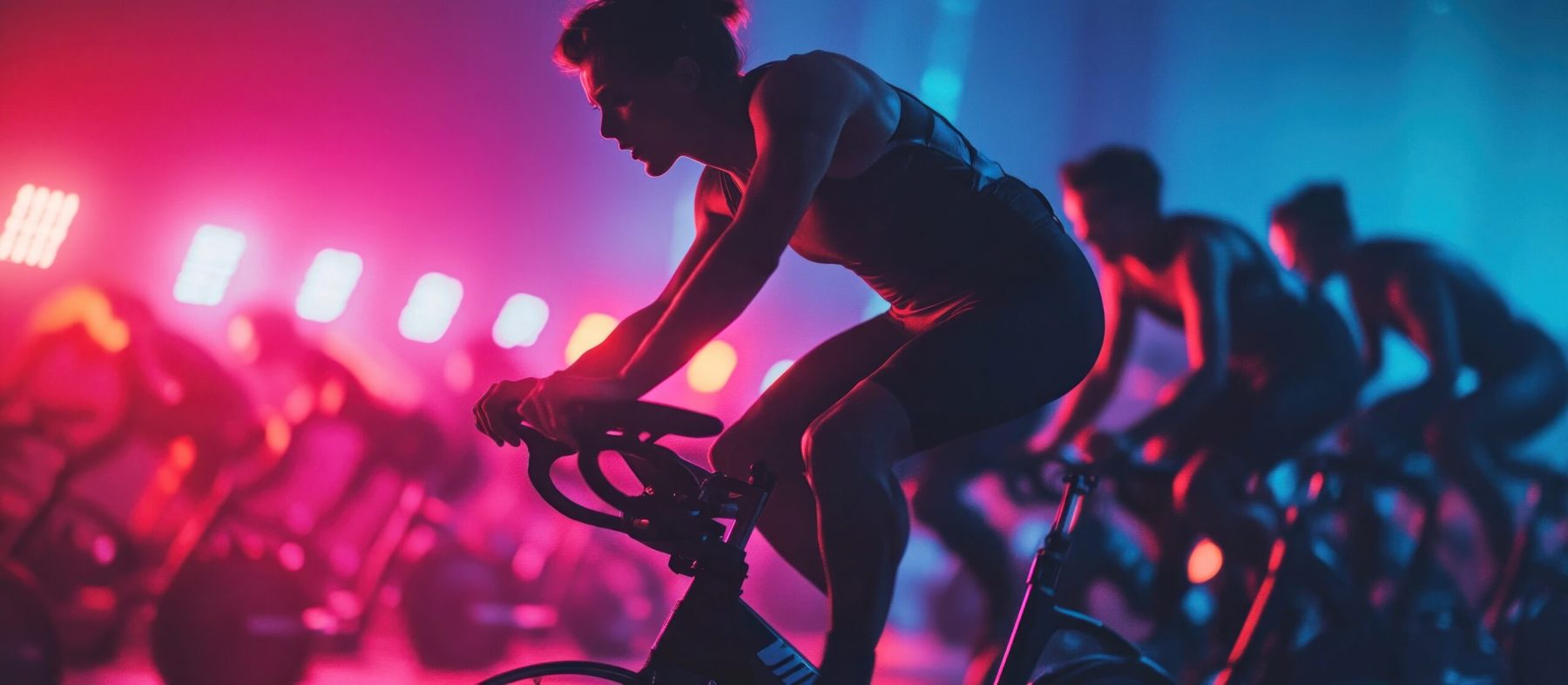
In large cities the format has evolved towards immersive indoor cycling: rides in near-darkness with atmospheric lighting, upper-body movements performed on the handlebars and a strong focus on the mental side of the session. The appeal is an intense communal experience.
For an operator this is the most demanding format to deliver. It depends on lighting, sound and room acoustics as much as on the bikes, the upper-body work needs bikes that stay planted when riders move on them, and the whole proposition rests on the studio feeling like a designed space rather than a room with bikes in it.
2. Why indoor cycling works for beginners
One of the great advantages of indoor cycling is how accessible it is, which is why it fills timetables across very different types of site.
- Low impact. Unlike running, cycling spares the joints, particularly the knees and ankles, which widens the range of members and ages who can take the class.
- Individual control. The rider sets their own resistance. Everyone can follow the rhythm of the music while working at their own intensity, so a mixed-ability group can share one class without anyone being left behind or held back.
- Visible progression. Aerobic capacity and muscular endurance respond well to regular cycling, and because the resistance setting and cadence are measurable, members can see that progress rather than having to take it on trust.
3. What riders need for a good session
A few items make a measurable difference to the experience, and they are worth communicating to members or stocking at reception.
- Cycling shoes. Ordinary trainers work, but shoes with cleats improve power transfer and make the pedal stroke more secure. If your bikes have dual pedals, say so in the class description.
- Padded shorts. For comfort on the saddle during sessions of 45 to 60 minutes, this is the single item that most affects whether a newcomer comes back.
- Hydration. A water bottle is essential, since a rider can lose up to a litre of fluid in a session. Studio layout should allow for bottle storage and easy refilling.
4. The bikes and the room
Bike quality is the decisive factor in the experience. A low-grade bike is noisy and unstable, and in a studio setting both problems are amplified by twenty of them in one room. Specify for:
- Smoothness. A heavy flywheel produces the road-like feel that riders associate with a good bike.
- Stability. A rigid frame that stays planted during high-intensity standing work, which is where weak frames announce themselves.
- Fine adjustment. Saddle and handlebar adjustment precise enough to fit every rider properly, which is a genuine injury-prevention measure in a class where nobody has time for a bike fit.
- Serviceability. In a studio all the bikes take the same load, so they wear together. Confirm that brake pads, bottom brackets, saddles and pedals are available as spares before committing to a range.
Ranges suited to studio timetables are grouped under indoor cycling bikes, with the broader cardio offer under cardio equipment. The floor deserves equal attention: cycling studios are noisy, they sit above or beside other rooms, and sweat reaches the surface constantly, so the covering has to damp vibration and tolerate cleaning. Suitable systems are grouped under rubber gym flooring tiles.
Which format should a club choose?
It depends on instructor availability and on positioning. A licensed programme buys consistency and a recognised name at a recurring cost. Freestyle classes cost nothing in licensing but depend on the strength of your instructors. Immersive formats command premium pricing but require investment in the room itself, not just the bikes.
How many bikes fit in a studio?
That comes from the room rather than a rule of thumb: each bike needs its own space plus circulation for entry, exit and instructor access. Send us the room dimensions and we will lay out a workable capacity.
Equipping your cycling studio
Whichever format you programme, the bikes and the room determine whether the class delivers on it. Tell us the studio size, the format you have in mind and the expected class size, and we will propose a bike specification, a layout and a floor build-up. Request a quote and we will come back with a full configuration.
À lire aussi sur le même thème
- Running a profitable spin studio: sizing, wear parts and operations
- Comparing professional indoor cycling bike brands for studios
- Aquabike fleet ROI: a three year model for aquatic centres
- Professional Sports Flooring: How to Choose the Right Surface Without Costly Mistakes
- Comparing professional gym equipment brands on specification