Magnetic Resistance Indoor Cycling Bikes: How to Choose
Un vélo de biking à résistance magnétique se distingue par l'absence de contact mécanique sur le volant : pas de patin à remplacer, pas de bruit de frottement, pas de déréglage. Cette conception réduit la maintenance et le niveau sonore, deux critères décisifs en studio de cycling et en hôtellerie. Light In Fitness distribue ces gammes en France avec livraison, montage et pièces détachées.

An indoor cycling bike with magnetic resistance is not simply a bike that makes people sweat. For a studio manager, a club operator, a hotel or a local authority it is an operating decision: how much noise the room will carry, how often a technician will have to come back, how long the frames will stay in service, and whether instructors can standardise an effort from one class to the next. This guide sets out what magnetic resistance changes, how to choose without regret, and what professional buyers should verify before ordering.
Why magnetic resistance changes the economics of a cycling room
The decisive point is mechanical. On a magnetic bike there is no contact between the resistance system and the flywheel: no pad to replace, no friction noise, no drift out of adjustment. That single design choice removes the two recurring costs of a friction bike, consumables and callouts, and it removes the background noise that makes a cycling room unusable next to a spa, a reception area or a treatment room.
The second effect is on the ride itself. Magnetic resistance is valued for its smoothness, and several of the models we distribute pair it with belt transmission, which further reduces maintenance and improves pedalling feel. Riders push harder when there is no parasitic noise and no dry, grabbing sensation under load, and a room where people ride harder is a room that retains members.
The third effect is on instruction. Structured cycling classes are built on cadence (RPM), intensity and progression. Some models add a power display in watts, which lets a coach set effort zones and repeat the same session with the same targets across a term rather than running it by feel.
Magnetic versus friction: the comparison that matters
| Criterion | Magnetic | Friction | What operators choose |
|---|---|---|---|
| Noise | Very low, no contact on the flywheel | Higher, contact noise under load | Magnetic, in every shared or acoustically sensitive space |
| Smoothness | Consistent over time | Varies as the pad wears | Magnetic |
| Maintenance | Reduced, especially with belt drive | Pad wear and repeated adjustment | Magnetic |
| Intensive use | Designed for continuous class schedules | Possible, highly model dependent | Professional magnetic ranges |
| Effort tracking | RPM, and watts on some models | Usually cadence only | Magnetic with a power console |
The five criteria that decide most of the choice
Most disappointments come from a mismatch rather than from a bad bike: a frame too light for the schedule it runs, a resistance system too noisy for the room, or a console that does not give instructors what they need. Five points cover almost the whole decision.
- The setting: hotel or residence fitness room, boutique studio, high volume club, rehabilitation centre or municipal facility. This sets the expected daily hours and the acoustic constraint.
- The objective: general conditioning, structured class programming, performance work or supervised reconditioning.
- The level of tracking: cadence alone, or power in watts for zone based coaching.
- The ride: flywheel, transmission and the resulting pedalling feel.
- Ergonomics: horizontal and vertical adjustment of saddle and handlebar, comfort, and pedal type, dual sided pedals being the usual answer where users arrive with or without cleats.
Selecting a model by need
| Model | Choose it if you want | Highlights | Typical operator |
|---|---|---|---|
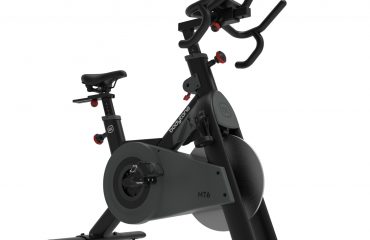
| Bodytone MT6 | A quiet professional magnetic bike for daily class use | Magnetic resistance, belt transmission, detailed technical sheet | Studio, club, hotel fitness room |
| Bodytone MT10 | Power measurement in watts alongside cadence | Magnetic resistance with watt based effort tracking | Coaching led studios, performance programming |
| Strong Bike Gold | A heavy duty frame built to absorb punishment | Reinforced steel, oval tubing, anti corrosion treatment, double paint and varnish | High frequency use, demanding sites |
| M-5811 magnetic | A contemporary design with a technology led build | Faired design, rear flywheel layout | Operators where the room has to look as good as it rides |
If cadence is enough today but power tracking may be needed later, check whether the console can be upgraded rather than replacing the whole bike. On several Bodytone frames a wireless watt, heart rate and cadence console can be fitted afterwards.
What professional buyers should verify
Four things separate a purchase that lasts from one that comes back. First, a genuine technical sheet: resistance type, transmission, flywheel, adjustment ranges, intended use. Buying from a photograph and a headline is how rooms end up with bikes that cannot hold a class schedule. Second, the declared standard. For indoor equipment in a supervised professional setting the reference is EN ISO 20957-1 class S; ask for the class in writing, because it is the line between equipment built for a club and equipment built for occasional use.
Third, after sales support: installation, maintenance, repairs and above all spare parts availability over the life of the fleet. A cycling room is only as reliable as the parts channel behind it. Fourth, the warranty, read separately for the frame and for wearing parts, since the two are rarely covered on the same terms.
Three situations, three answers
Hotel, spa or residence fitness room
The constraint is noise and adjacency. A magnetic bike with belt transmission, placed on a floor sized for the load, keeps the room usable next to guest areas. The frame matters less than the acoustic behaviour and the ease of unsupervised use.
Studio with coach led programming
The constraint is repeatability. Instructors need the same effort to mean the same thing from one class to the next, which means power in watts rather than perceived intensity, and consoles that are consistent across the whole row of bikes.
High volume club
The constraint is uptime. Frame strength, stability during out of the saddle sprints, reduced maintenance and a fast parts channel matter more than any single specification. This is where a reinforced frame and a proven service chain pay for themselves.
Twelve point checklist before ordering
- The room and its acoustic constraint
- The priority: silence, performance, comfort or coaching
- Resistance type: magnetic or other
- Transmission: belt for reduced maintenance, depending on the model
- Tracking: cadence only, or watts
- Flywheel and its effect on pedalling feel
- Saddle and handlebar adjustment, horizontal and vertical
- Pedals: clipless, flat or dual sided
- Stability under sprint and out of the saddle work
- Declared standard: EN ISO 20957-1 class S for professional indoor use
- Warranty on frame and on wearing parts, read separately
- After sales: installation, maintenance, parts, technical support
Frequently asked questions
Is a magnetic bike really quieter?
Yes, and for a structural reason rather than a marketing one: nothing touches the flywheel. That eliminates contact noise entirely, which is why magnetic bikes are the default in hotels, spas and any room sharing a wall with a quiet space.
Which model should I choose to track power in watts?
Look for a bike whose console displays power alongside cadence. In our range the Bodytone MT10 is built around magnetic resistance with watt measurement, and on several other Bodytone frames a wireless console covering watts, heart rate and cadence can be added later.
What is the difference between a consumer exercise bike and a professional indoor cycling bike?
Frame section, bearing quality, adjustment range, the duty cycle the manufacturer declares and the standard the bike is certified against. A professional indoor cycling bike is specified for supervised class use, hour after hour, which is a different engineering problem entirely.
Does belt transmission change anything in practice?
It reduces maintenance and smooths the ride. Combined with magnetic resistance it is the configuration operators return to, because it removes both the consumable and the noise from the equation.
What flooring does a cycling room need?
A rubber floor sized for point loading and for acoustic transmission. In a multi storey building the underlay matters as much as the tile, and it belongs in the equipment budget rather than being treated as a finish.
Equipping a cycling room properly
The right bike is the one that matches the room, the class schedule and the service life expected of it. Fix the setting, fix the level of tracking your instructors actually need, then compare frames, consoles and parts availability rather than headline features.
To go further: professional indoor cycling bikes, the Bodytone MT6 range and the Bodytone MT10 with watt measurement. For a room layout and a costed proposal for your fleet, request a quote.
Sources et références
- NF EN ISO 20957-1 – équipement d’entraînement fixe, partie 1 : exigences générales de sécurité et méthodes d’essai (AFNOR)
- AFNOR Normalisation – dossier thématique sur les appareils d’entraînement fixes et leurs classes d’usage