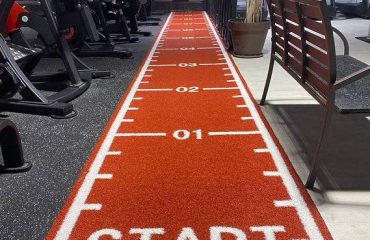
CrossFit box flooring: the zoning plan for rubber, turf and mats
The floor of a cross-training box is never one product: a well-designed 300 m² facility combines thick rubber under the lifting zones, technical artificial turf on the functional lane, standard rubber in cardio and gymnastics areas and softer mats in the mobility corner — for a total flooring budget of roughly 6,000 to 9,200 EUR excluding VAT. The design question is not “which floor?” but “which floor where?”: a lifting platform, a sled lane and a SkiErg bay take completely different loads, impacts and cleaning regimes. This guide sets out the zoning method, with areas, thicknesses and budgets for a typical box or hybrid-racing (Hyrox-style) facility.
The zoning plan for a 300 m² box
| Zone | Area | Recommended surface | Thickness | Budget excluding VAT |
|---|---|---|---|---|
| Weightlifting (bars, racks) | 80 m² | High-density SBR rubber tiles | 40 mm | 2,080 – 2,800 EUR |
| Functional lane (sled, carries, sprints) | 50 m² | Technical turf 12 – 15 mm + 10 mm underlay | 22 – 25 mm total | 1,300 – 2,500 EUR |
| Cardio (rowers, bikes, SkiErgs) | 40 m² | Standard SBR rubber tiles | 20 mm | 480 – 720 EUR |
| Gymnastics (pull-ups, rings, jump boxes) | 40 m² | SBR rubber tiles | 30 mm | 960 – 1,400 EUR |
| Mobility / warm-up | 30 m² | EVA mats or soft tiles | 20 mm | 600 – 900 EUR |
| Reception / circulation | 60 m² | Thin SBR tiles or vinyl | 15 mm | 540 – 900 EUR |
| Total | 300 m² | — | — | 6,000 – 9,200 EUR |
Zoning typically costs around 30 percent less than laying a single premium thickness everywhere — and protects the critical zones better. The reasoning behind each thickness is detailed in our rubber tile thickness by zone guide.
Match the surface to the priority, not the fashion
- Heavy lifting: 40 mm high-density tiles under bars and racks. Laying 20 mm everywhere “to save money” is the classic error — it transfers drop energy into the slab and the neighbours.
- Sled and hybrid-race conditioning: technical turf with an underlay. Landscape or decorative turf with tall fibres is the wrong product: sleds snag, fibres shred, and the lane is unusable within months.
- Versatility on a tight budget: rubber tiles for most of the floor plus a short turf lane. A 10 × 2 m lane already supports sled work, carries and accelerations — formats and fibre specification are covered in our sled track turf guide.
- Sprint-focused training: a longer, flatter lane with denser tufting — see the indoor sprint track specification.
The five zoning mistakes we correct most often
- One thickness everywhere. Over-protects circulation, under-protects the lifting zone, and costs more than zoning.
- Decorative turf in the functional lane. Fibre height above 15 mm and low tuft density cannot take sled runners.
- No underlay beneath the turf. On bare concrete, a thin turf lane is loud, harsh on joints and wears from below.
- Turf lane too narrow or badly placed. Two metres is the working width; place the lane along a wall, not across circulation paths.
- Forgetting the transitions. Height differences between zones need chamfered edge ramps — a 20 mm step is a trip hazard in a facility where people move fast under fatigue.
Beyond the floor: what the zoning decides
The flooring plan is also the acoustic plan (thick rubber under drops is what keeps neighbours quiet), the maintenance plan (turf is brushed, rubber is mopped — different regimes, different products) and the layout plan: once the lifting zone, lane and cardio bay are fixed, rig position and storage follow. If you are building the whole facility, our guide to opening a cross-training box covers the complete project beyond the floor.
Subfloor, installation and transitions
All three surface families assume a sound base: a level concrete slab, dry and free of friable paint or old adhesives. Rubber tiles tolerate minor slab imperfections; turf shows them as ripples in the lane, so the lane area is where any levelling compound budget belongs. Lay the heavy lifting zone first and glue or pin it — drop energy walks loose tiles over months — then run the turf lane with its underlay, seam-taped and edge-fixed so sled runners cannot lift an edge, and finish with the lighter zones where loose-lay is acceptable. Every height change between zones gets a chamfered transition ramp, and doorways and fire-escape routes must keep their clearances after the floor build-up: 40 mm of rubber under a door that opens inward is a snag discovered on installation day if nobody checked the drawings.
Maintaining a zoned floor
- Rubber zones: vacuum weekly, damp-mop monthly with pH-neutral detergent; no solvents, no pressure washers. Inspect the drop zone for compaction and re-glue lifted corners immediately.
- Turf lane: brush against the pile weekly to keep fibres upright, vacuum debris, and rotate sled paths across the width to spread wear — the difference between a five-year lane and an eight-year lane is mostly brushing.
- Mats and EVA: disinfect after classes, replace individual tiles as they wear — modularity is the point.
- Annually: walk the whole floor with the layout drawing, checking seams, ramps and fixings; floor faults grow from millimetres to trip hazards quietly.
Scaling the model: a 150 m² studio box runs the same zoning at roughly half the areas and 3,000 – 5,000 EUR excluding VAT; a 500 m² facility mostly scales the lifting and cardio zones and lands at 10,000 – 15,000 EUR. The lane length, not the total area, is the biggest single cost decision in every case.
Frequently asked questions
What thickness of rubber does a lifting zone really need?
40 mm high-density under free lifting areas, and 50 – 60 mm or platforms where heavy bars are dropped repeatedly. 20 mm is a cardio and machine thickness, not a drop thickness.
Turf or rubber for a Hyrox-style training area?
Both: rubber under the ergs and stations, turf for the sled and lunge lane. The turf lane is what makes the format trainable indoors; 12 – 15 mm dense technical turf with underlay is the working specification.
Can we lay the tiles loose or must they be glued?
Glue or pin the lifting zone and any sled-adjacent edges; heavy interlocked tiles can stay loose elsewhere if the layout is contained. Reversibility matters in leased premises.
How long does a zoned floor last?
Quality SBR tiles run 10 – 15 years; a well-specified turf lane 5 – 8 years under daily sled work. Budget the lane as a mid-life replacement item — it is a few square metres, not the whole floor.
Do we need different flooring under the rig itself?
The rig posts stand on the same 30 – 40 mm rubber as the lifting zone, but through-fix the baseplates to the slab where the manufacturer requires it, with sleeves through the tiles. Rubber alone does not restrain a rig loaded with kipping athletes, and a rig that moves is a structural fault, not a flooring choice. Coordinate the fixing points on the layout drawing before the floor is laid, so the tiles are cut once and cleanly.
Have your box floor zoned by Light In Fitness
Light In Fitness supplies rubber flooring, technical turf lanes and complete box fit-outs across Europe, including layout drawings and installation. Request a zoned flooring quotation with your floor plan and we will return a zone-by-zone specification and price.
Réalisations documentées
- Dalles et sols sportifs : livraisons documentées – plusieurs chantiers
- Sol sportif extérieur, square Georges-Vallerey – Taverny (95)