Optimise Your Outdoor CrossFit Sessions with Light In Fitness
Pratiquer le CrossFit en plein air suppose un matériel traité contre la corrosion et un sol capable d'encaisser les charges lâchées. Les rigs extérieurs se posent sur dalle béton avec ancrage chimique, sous revêtement amortissant. Light In Fitness fabrique ces structures en acier galvanisé ou en inox selon l'exposition du site.
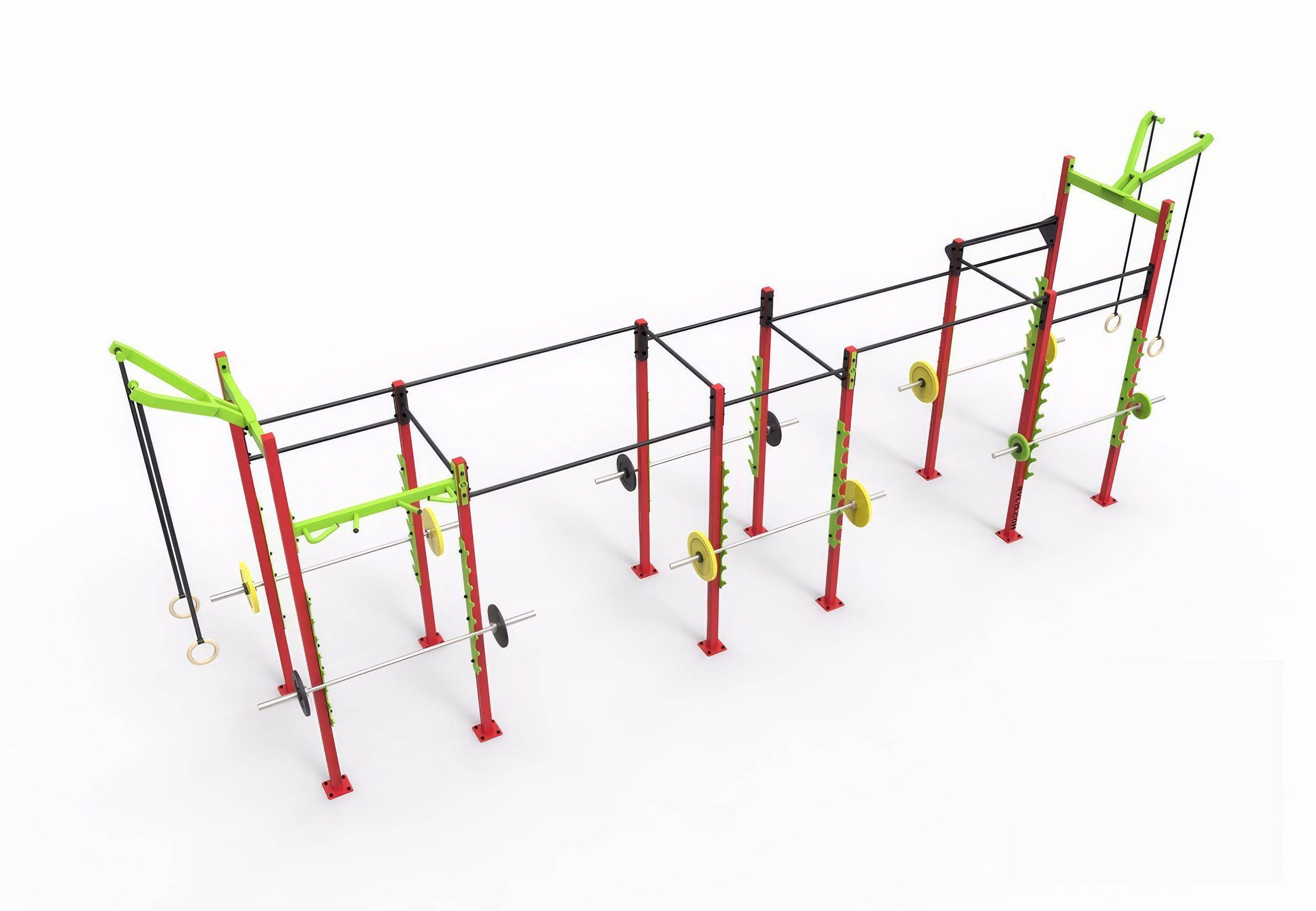
CrossFit is a high-intensity discipline that combines weightlifting, gymnastics and conditioning. Taken outdoors it becomes something a box cannot offer: unlimited height above the rig, natural ventilation, and space for sled lanes and running intervals. It also becomes far more demanding on the equipment. Training in the open air requires hardware treated against corrosion and a surface capable of absorbing dropped loads, and those two requirements are what separate an outdoor training area that lasts from one that has to be replaced after three winters.
What outdoor training asks of your equipment
Outdoor rigs are installed on a concrete slab with chemical anchors, under a shock-absorbing surface. That build-up is not a detail: the slab carries the anchoring loads, and the surface protects both the athlete and the bar. Skip either one and the structure loosens, the plates crack and the area becomes a liability.
The second decision is the material. Light In Fitness manufactures its outdoor structures in galvanised steel or in stainless steel according to the exposure of the site. Galvanised steel covers most inland installations at a lower cost; stainless steel is the answer for coastal sites, for pool surroundings and for anywhere corrosion would otherwise dictate the replacement cycle. That choice is made from the site, not from the catalogue.
Permanently installed outdoor fitness equipment for adults falls under EN 16630, which sets the requirements and test methods for fixed outdoor training installations. If a children’s area adjoins the training zone, it is a separate project governed by EN 1176-1 for the equipment and EN 1177 for the impact-absorbing surfacing.
The outdoor ranges available
The outdoor offer runs from single structures to complete parks. Street workout cages, outdoor strength stations and container gyms all serve open-air functional training, and they differ mainly in footprint, in the number of athletes they take at once and in how much of the training menu they cover.
Our outdoor parkour and CrossFit parks are designed as complete training areas rather than as a collection of items, and our street workout rigs add the body-weight side: bars, uprights and hanging elements at several heights so that beginners and advanced athletes share the same structure.
Every configuration is built to order. Bar heights, the number of stations and the way the modules connect are decided from the surface area available and the size of the groups the site has to handle, which is why an outdoor project starts with a site plan rather than a product reference.
Three configurations worth a closer look
The container gym is a shipping container converted into a complete training space. It arrives fitted out, it can be positioned on a prepared base without building work, and it gives a site a secure, lockable training area. For a campsite, a residential development or a temporary installation, it solves the storage and security question at the same time as the equipment question.
The outdoor strength station is the versatile option: a single structure that covers pulling, pushing, hanging and climbing work. Elements such as a spider web climbing net or a suspended pull-up bar turn one footprint into a full circuit, which is what a site with limited space needs.
The street workout cage is the classic open-air structure. Solid, anchored and open on all sides, it supports supervised group sessions and free access outside class hours, and it is the configuration most often specified by local authorities.
Why specify Light In Fitness
Not all outdoor equipment is built the same way, and the material specification is the point that decides the service life. Our structures are made from high-grade steel and treated for their intended exposure, which is what allows them to stand in the open for years rather than seasons.
The warranties offered are longer than most of what the market provides, which is a straightforward consequence of that specification. Alongside them, the after-sales service covers what an outdoor project actually needs: installation of the equipment, international delivery and a technical team available to work through the configuration before anything is ordered.
Getting the most from your outdoor area
Equipment is half the result; the programme is the other half. An outdoor area works best when the session plan uses what the space offers: longer running intervals, sled work, carries and climbing that a covered box cannot accommodate. A structure specified without that plan is usually over-provided in pull-up stations and short of open ground.
Maintenance is what keeps the area available. Outdoor equipment needs a regular inspection cycle covering anchor points, fixings, moving parts and the condition of the surfacing. Keeping the equipment clean and correctly maintained is what guarantees its longevity, and a documented inspection routine is a requirement in most public settings rather than good practice.
The surface itself is a consumable in the lifting zone. A dedicated outdoor sports flooring solution under the bars takes the impact that would otherwise reach the slab, and it is replaced far more cheaply than a cracked concrete deck.
Frequently asked questions
Can an outdoor rig be installed without a concrete slab?
Not for a permanent installation. The anchoring loads generated by a rig under load have to be transferred into a slab designed for them, and the surfacing sits above that. Alternative foundations exist for specific ground conditions and are decided from a site survey.
Galvanised or stainless steel?
Exposure decides. Coastal air, chlorinated environments and heavy de-icing salt use call for stainless steel; most inland sites are correctly served by galvanised steel at a lower cost.
Can an outdoor area be left in free access?
Yes, and many municipal installations are. Free access raises the requirements on standard conformity, surfacing and the inspection cycle, all of which should be settled at the design stage.
Planning your outdoor training area
An outdoor CrossFit area is a construction project as much as an equipment purchase: structure, anchoring, slab, surfacing and drainage are decided together. Get those right and the area serves supervised classes, free access and event use for years.
Send us the site plan, the exposure of the location and the size of the groups you need to handle, and we will return a configuration with foundations, surfacing and an installation schedule. Request a quote and our technical team will take it from there.
Réalisations documentées
- Cage street workout ultime, Carcassonne – armée française
- Cage street workout ultime, Tahiti – armée française, Polynésie
- Cage SP Max, centre EPIDE de Combrée – établissement public d’insertion
- Cage SP Max, lycée Saint-Bénigne de Dijon – établissement scolaire