Playground Roundabouts: The Fall Height Threshold That Changes Everything
Les dispositifs rotatifs vont de 0,2 à 2,3 m de hauteur de chute libre, et plusieurs carrousels passent sous le seuil de 0,6 m à partir duquel un sol amortissant EN 1177 devient obligatoire. Ces modèles peuvent donc s'implanter sur un sol stabilisé existant, ce qui supprime le poste le plus lourd du projet. Le plateau tournant affleurant est par ailleurs la voie la plus simple vers une aire partiellement inclusive.
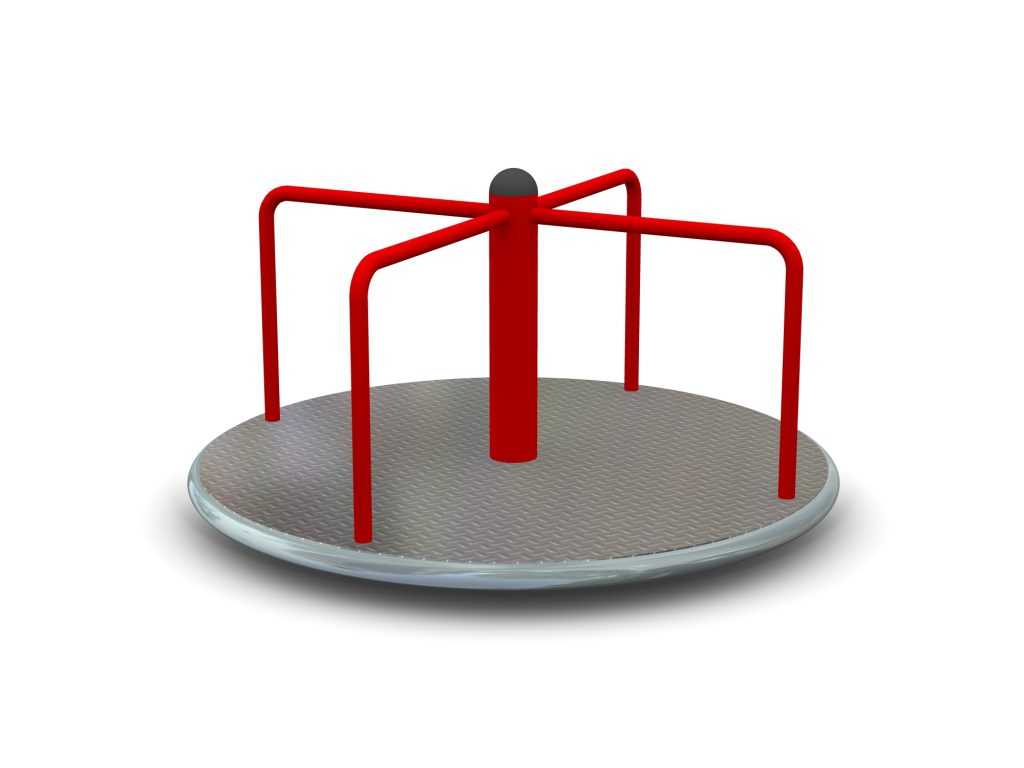
Rotating play equipment covers the widest free fall height range in the catalogue: from 0.2 to 2.3 m depending on the model. That spread has a consequence rarely anticipated at design stage. The lowest models stay under the 0.6 m threshold above which impact-attenuating surfacing to EN 1177 becomes mandatory.
The parameters of the family
| Parameter | Range across the 10 models | Consequence |
|---|---|---|
| Free fall height | 0.2 to 2.3 m | Some models require no impact-attenuating surfacing |
| Foundation depth | 0.3 to 1.0 m | From light anchoring to full excavation |
| Formats | Ground-level roundabout, rotating platform, suspended rotating unit | Accessibility varies with seat height |
| Standard | EN 1176-1 | Clear circular safety zone |
Two different worlds in one family
Low roundabouts, up to 0.7 m
The disc roundabout and the spinning top both peak at 0.2 m free fall height. The classic platform roundabout stays at 0.5 m, the compact roundabout at 0.52 m, the Fusée roundabout at 0.6 m and the Duo roundabout at 0.7 m. Foundation depth goes down to 0.3 m on the disc model.
The disc format is the extreme case: at 0.2 m fall height and 0.3 m of foundation, it is close to the lightest installation possible for a piece of rotating play equipment. See the disc roundabout with anti-slip steel deck.
High rotating units, up to 2.3 m
At the other end, the Pankracix, the Antares and the Deneb combine rope net climbing with rotation, at 2.3 m free fall height and 1.0 m of foundation. The Konusix sits in between at 1.5 m. These models fall under the same surfacing requirements as conventional rope structures, and should be budgeted as such rather than as roundabouts.
The 0.6 m threshold, and what it does to a budget
This is the point to understand before comparing quotations. Below 0.6 m free fall height, certified EN 1177 impact-attenuating surfacing is not required. Several roundabouts in this family fall under that threshold, which means they can be installed on existing stabilised ground, removing the single heaviest line from a playground project.
Two cautions apply. The circular safety zone must be respected in every case, without exception. And the check is made model by model on the data sheet: a roundabout at 0.7 m is back above the threshold, and a model quoted at exactly 0.6 m sits on the boundary and should be confirmed in writing rather than assumed.
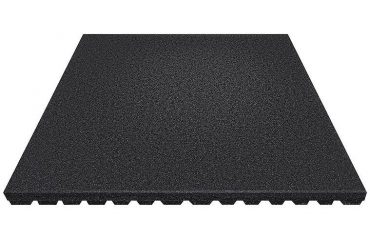
Where surfacing is required, it is worth specifying it properly rather than minimally. Our playground surfacing range covers the certified options.
The ground-level roundabout: the simplest route to an inclusive area
Rotating platforms flush with the ground can be crossed without a step, which makes them usable by an accompanied child in a wheelchair. It is the simplest piece of equipment for making a play area partially inclusive without moving to a dedicated range.
The condition is a passable route to the zone. Without it, accessible equipment is not actually accessible, and that is the most common failure in otherwise well-specified inclusive projects. The path is part of the specification, not a landscaping detail.
On the inclusive side, two swings in the range are designed for children with reduced mobility. Paired with a low roundabout, they cover two different kinds of use. See the playground swing sets range.
Choosing by project type
- Adding to an area without redoing the ground: aim for a roundabout under 0.6 m free fall height, such as the disc or platform models.
- Making the area partially inclusive: a flush rotating platform, with a passable route to it.
- Creating a landmark item: the high climbing rotators, accepting 1.0 m of foundation and the corresponding surfacing.
- Young children: compact roundabouts on bearings, with no mechanism maintenance.
See the full playground roundabouts range. Spring riders follow the same light-installation logic and are worth looking at alongside them.
Frequently asked questions
Does a roundabout always require impact-attenuating surfacing?
No. Below 0.6 m free fall height, certified EN 1177 surfacing is not required. Several models in this family fall under that threshold, including the disc roundabouts at 0.2 m.
Which model suits an accessible area?
A rotating platform flush with the ground, which is crossed without a step and remains usable by an accompanied child in a wheelchair. A passable route to the zone has to be added to it.
What foundation depth should be allowed for?
From 0.3 m on the disc roundabout to 1.0 m on the high climbing rotators. That is the widest spread of any playground equipment family.
What is the difference between roundabouts and climbing rotators?
Roundabouts turn at low height and install lightly. Climbing rotators such as the Deneb or the Antares reach 2.3 m and fall under the same requirements as rope structures.
What maintenance is involved?
Models on bearings are stated as requiring no mechanism maintenance. What remains is the periodic EN 1176-1 inspection and checking of the fixings and of the circular safety zone.
Planning your rotating play equipment
The decision on this family is made on one number. Establish the free fall height of each model you are considering, check it against the 0.6 m threshold, and the surfacing budget follows automatically. Everything else, foundation depth included, is downstream of that.
Light In Fitness has supplied and installed play and sports equipment since 2013, with more than 2,500 customers equipped, for local authorities, campsites, schools, hotels and residential schemes. Send us your site plan and the age range you are equipping for, and we will come back with a layout, the fall heights and the surfacing that follows from them.
Request a layout study for your play area.
Réalisations documentées
- Dalles et sols sportifs : livraisons documentées – plusieurs chantiers
- Sol sportif extérieur, square Georges-Vallerey – Taverny (95)
Sources et références
- Décret n° 96-1136 du 18 décembre 1996 – prescriptions de sécurité relatives aux aires collectives de jeux (Légifrance)
- NF EN 1176-1 – Équipements et sols d’aires de jeux, partie 1 : exigences de sécurité et méthodes d’essai générales (AFNOR)
- NF EN 1177 – revêtements de surface amortissants : détermination de la hauteur de chute critique (AFNOR)