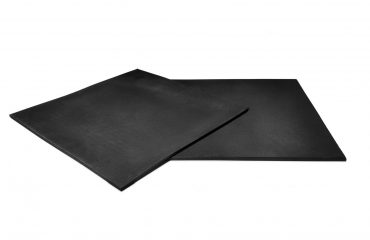
Rubber gym flooring installation and maintenance
Une dalle caoutchouc se choisit sur l'épaisseur, la densité et le classement de réaction au feu, dans cet ordre. Ces trois paramètres commandent l'absorption des chocs, la protection du béton et la conformité du local. Cette FAQ traite également la pose, l'odeur des premières semaines, l'usage extérieur et le prix.
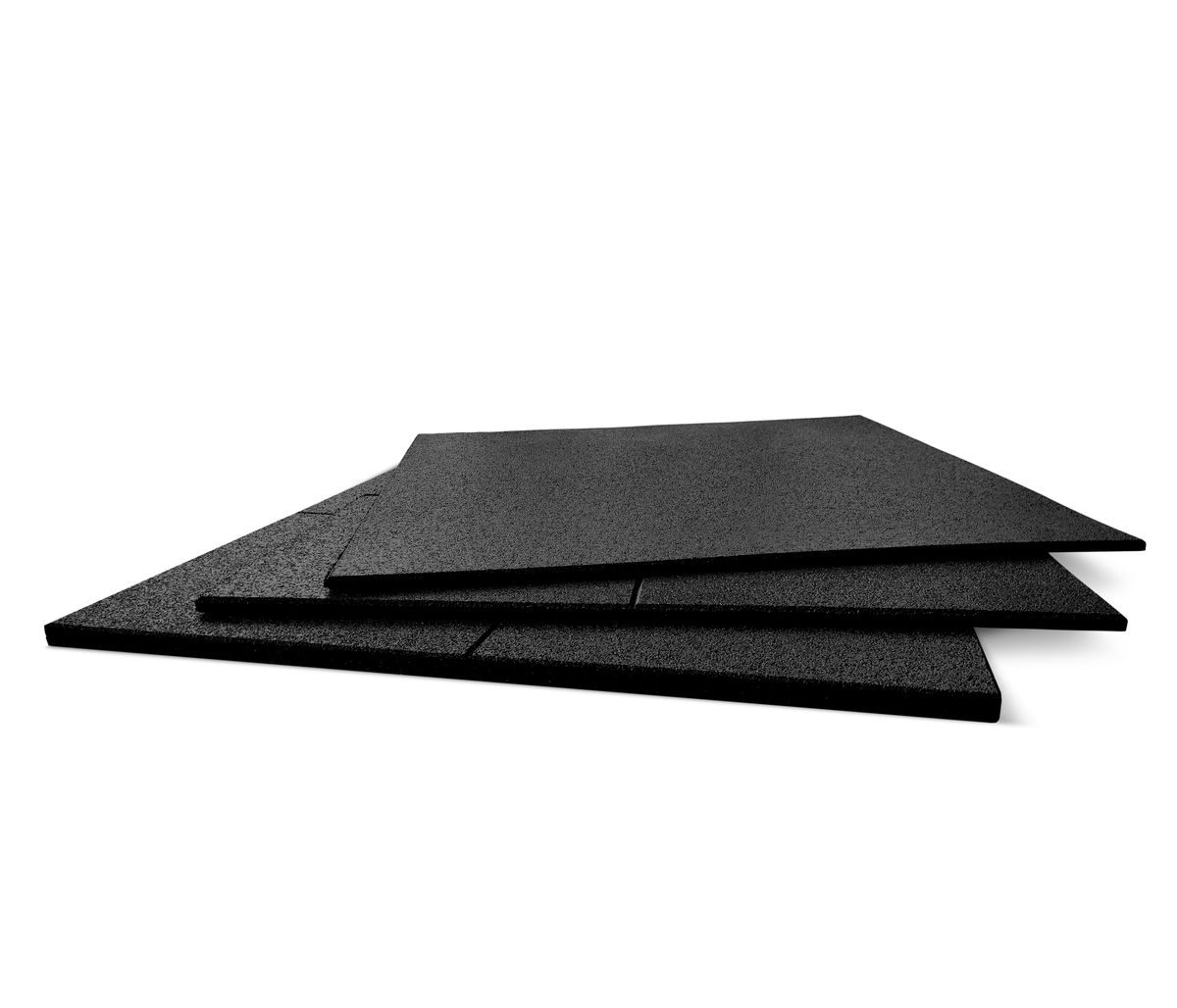
Most rubber gym flooring problems are installation problems, not product problems: an uneven substrate, tiles laid without acclimatising, no edge restraint, or water trapped underneath. The tile itself rarely fails first. This guide covers how to prepare the substrate, when to loose lay and when to bond, how to avoid gaps opening between tiles, and how to clean and maintain the floor so it reaches its expected service life.
Preparing the substrate before anything is delivered
Rubber gym flooring tiles follow the surface underneath them. A tile bridges very small irregularities, but it will rock on a badly finished screed and the joints will open within weeks under machine traffic.
Check four things before the pallets arrive. Flatness, which should be verified with a straightedge across the whole area rather than by eye. Dryness, since residual moisture in a new screed will be trapped under a bonded floor. Soundness, because loose laitance or flaking paint stops any adhesive from working. And falls, since indoor floors should be level while outdoor installations need a slight slope with drainage.
Plan the delivery logistics too. Tiles in 100 by 100 cm format weigh roughly 20 to 28 kg each depending on thickness, so a room of 100 m² arrives as more than two tonnes of material. Confirm access, lift capacity and a dry storage area on site before the delivery date.
Loose laid, bonded or interlocking: choosing the method
| Method | How it works | Use it when | Watch out for |
|---|---|---|---|
| Loose laid | Tiles butted tightly together, held by their own weight and by perimeter restraint | Flat substrate, no strong lateral forces, and where the floor may need to be lifted again, for example a leased unit | Machine push and heavy traffic can creep the field; add skirting, kerbs or perimeter stops |
| Interlocking or puzzle | Tiles joined by moulded connectors or dowels | Small areas, studios, rooms with an irregular outline | The quality of the interlock and the flatness of the substrate decide the result more than the tile itself |
| Bonded, fully or partially | Tiles adhered to the substrate | Intensive commercial or institutional use, wet environments, sloped surfaces, heavy machine zones | Substrate must be dry and sound; the floor is no longer reversible without cost |
In practice, many commercial installations are mixed: bonded under and around machine lines and drop zones, loose laid in the open training area. Bonding the perimeter row alone is often enough to stop a loose laid field from creeping.
Laying the tiles without gaps opening
Rubber expands and contracts with temperature, so tiles delivered from a cold lorry and laid immediately in a heated room will shrink back and open the joints. Three habits prevent almost every joint problem.
Let the tiles acclimatise. Unstack them in the room, at the room’s working temperature, before laying. Lay tight from a corner, working in one direction and pushing each tile firmly against the previous one, using a rubber mallet where the product allows it. Finish with perimeter restraint: skirting, a kerb or a fixed edge stop, so the field has nothing to move into.
Set out the room before cutting. Starting from a wall that is not square leaves a tapering cut row in the most visible part of the floor. Cut tiles are best placed against walls and under fixed equipment, not in circulation routes.
Outdoor installations, water and frost
Rubber tiles can be installed outdoors, but the failure mode outdoors is always the same: water. Standing water under the surface, not cold, is what destroys an outdoor floor.
Rubber itself tolerates low temperatures well. What causes lifting, deformation and staining is water trapped beneath the tiles going through freeze and thaw cycles on an unstable or poorly drained base. Specify a free draining sub base, a slight fall, and an edge restraint that holds the field while allowing drainage. UV stability depends on the material and the surface finish, so confirm the outdoor suitability of the specific reference rather than assuming it.
Odour and indoor air quality
A smell on unpacking can occur, particularly with certain recycled granulates. In normal cases it fades: ventilate the room, clean the surface, and allow a few days of off gassing before the space is used intensively. Small unventilated rooms are the worst case, because there is no air exchange to carry the emissions away.
A strong odour that persists is a different matter and usually indicates a product traceability issue rather than a normal curing effect. Two things reduce the risk at purchase: choosing a tile with a documented composition and a full technical data sheet, and asking the supplier for the emissions classification. For small or poorly ventilated rooms, a low emission product is the safer specification.
Cleaning, maintenance and service life
| Operation | Frequency | Method |
|---|---|---|
| Debris removal | Daily | Vacuum or sweep, paying attention to joints and to the edges of machine bases |
| Damp cleaning | Daily to weekly by traffic | Microfibre mop with a mild neutral detergent; avoid aggressive solvents, which attack the binder |
| Joint inspection | Monthly | Check for opening joints, lifted corners and creep around machine bases |
| Edge and restraint check | Quarterly | Check skirting, kerbs and bonded perimeter rows, particularly on loose laid fields |
| Tile replacement | As needed | Replace damaged tiles individually; keep spare tiles from the original batch for colour consistency |
Service life depends on four variables: granulate quality and density, thickness matched to the actual use, drop frequency and impact intensity, and maintenance. A tile correctly sized for its zone lasts considerably longer than an undersized floor asked to absorb loads it was never specified for, which is why zoning the floor by thickness is a durability decision as much as a budget one.
Noise, vibration and neighbours
Noise complaints from adjacent or lower floors are rarely solved by a thicker tile alone. Three measures work together: increase thickness in the heavy zone or install a dedicated lifting platform, add an acoustic underlay beneath the tiles where the structure transmits vibration, and reduce drop height operationally through coaching, bumper plates and dedicated drop areas. Moving the heaviest lifting away from party walls and from the structural spans above occupied rooms usually produces a larger improvement than any single product change.
Frequently asked questions
Do rubber gym tiles need to be glued down?
Not always. Loose laying works on a flat substrate with proper perimeter restraint and no strong lateral forces. Bond the floor for intensive commercial use, wet environments, sloped surfaces and heavy machine zones, or bond only the perimeter and the machine lines.
Why have gaps appeared between my tiles?
Almost always because the tiles were laid without acclimatising to room temperature, were not butted tightly from a corner, or have no perimeter restraint. Substrate irregularity makes all three worse.
Is a smell from new tiles a defect?
A mild smell on unpacking is common with recycled granulates and normally clears with ventilation and cleaning over a few days. A strong, persistent odour is not normal and should be raised with the supplier along with the product data sheet.
Which standards apply to gym flooring?
Impact attenuation for fall risk is measured to EN 1177, which links a surface to a critical fall height. Indoor sports surfaces are covered by EN 14904. Slip resistance assessment methods sit in EN 16165, and reaction to fire classification for floor coverings is defined in EN 13501 1. Not every fitness tile is designed to meet EN 14904, so check what your project actually requires.
Can tiles be laid over an existing floor?
Over a sound, flat and dry hard floor, yes. Over a soft, hollow or damp substrate, no, because the tile follows what is underneath it and the defect will reappear at the joints.
Plan your floor installation with Light In Fitness
Light In Fitness manufactures and supplies professional sports flooring from Tours, France and has been equipping gyms, public facilities and institutions since 2013. Stock ships in 5 to 10 working days, and we specify the substrate preparation, the laying method and the acoustic build up as part of the quotation rather than after the delivery.
See our rubber gym flooring tiles and acoustic underlay for gym floors, or request a quote and receive a costed proposal within 24 working hours.
Réalisations documentées
- Dalles et sols sportifs : livraisons documentées – plusieurs chantiers
- Sol sportif extérieur, square Georges-Vallerey – Taverny (95)
Sources et références
- Arrêté du 19 avril 2011 – étiquetage des produits de construction ou de revêtement de mur ou de sol sur leurs émissions de polluants volatils (Légifrance)
- Ministère de la Transition écologique – étiquetage des produits de construction : classes d’émission A+ à C
- Décret n° 96-1136 du 18 décembre 1996 – prescriptions de sécurité relatives aux aires collectives de jeux (Légifrance)
- NF EN 1176-1 – Équipements et sols d’aires de jeux, partie 1 : exigences de sécurité et méthodes d’essai générales (AFNOR)
À lire aussi sur le même thème
- Planning a selectorised strength floor: stations, spacing and layout
- FAQ Perte de poids – maigrir et se tonifier (sans s’épuiser, sans se perdre)
- Cardio machine maintenance schedule for commercial gyms
- Rubber Shock-Absorbing Tiles: Choosing the Right Gym Floor
- Sports Flooring Standards: Which Ones Apply and How to Prove Compliance