Buying Aquabikes for Pools: Professional Aquacycling Equipment
Aquacycling has moved from a novelty class to a standing item on the timetable of hotel spas, thalassotherapy centres, campsite pools, rehabilitation units and municipal aquatic centres. For an operator the appeal is simple arithmetic: a pool that was used for lane swimming and lessons now sells a group class as well, on the same water, with equipment that has no motor and no electronics to fail.
This guide covers what an aquabike is, how the ranges differ, what the pool environment does to the frame, and the practical questions a facilities manager should settle before ordering a fleet rather than a single bike.
What aquacycling is
Aquacycling, also called aquabiking, comes from the aquafitness family. The session works like riding an ergometer, except the rider is immersed roughly to chest height. The pedalling pattern of cycling is combined with the properties of water: resistance in every direction, hydrostatic pressure on the legs, and support that removes most of the rider’s apparent body weight.
Aquabikes are built in stainless steel or aluminium. Both resist corrosion, and contact with pool water does not shorten their service life the way it would with a coated steel frame. Weight matters more than it looks: lighter aluminium frames are easier for one staff member to lift in and out, while stainless steel gives the mass that keeps a bike planted on the pool floor under a strong rider.
Why operators install aquabikes
The training argument and the commercial argument point the same way.
- Low impact. Water spreads the load across the whole body instead of concentrating it on specific joints and ligaments, so members with joint problems can keep training. This is what makes aquabiking usable in rehabilitation and senior programmes, not just in fitness classes.
- Circulation. The gentle movement of water around the legs supports circulation and works the connective tissue while the rider pedals.
- Adjustable intensity. Most models offer several resistance levels, so the same bike serves a first session and a conditioned athlete.
- No fixed installation. The bike is mobile enough to be lifted in and out of the water, yet stays stable on the pool floor during the session. Nothing is bolted down, nothing is drilled, and the pool returns to lane use the moment the class ends.
One point to keep out of your marketing copy: claims that aquacycling burns two or three times the calories of dry-land cycling circulate widely and are not supported. Sell the class on joint comfort, on accessibility and on the fact that it fills water at hours when nobody swims.
The three aquabike ranges
Our aquatic fitness equipment range divides into three levels, and the difference between them is almost entirely how resistance is produced and adjusted.
Basic: the entry model
Basic aquabikes are the least expensive because the adjustment options have been reduced to a minimum. Pedalling resistance is constant. For an operator this is not automatically a weakness: for a hotel or campsite pool where the bike is used a few hours a week by guests with no coach present, a machine with nothing to set wrong is often the right machine.
Standard: paddles on the pedals
Standard aquabikes carry paddles fixed to the pedals, which increases the resistance the rider works against and makes the session more demanding. The limitation is that resistance can only be set coarsely, and reaching a harder session often means extending the length of the class rather than turning up the load.
Professional: adjustable resistance
Only a few manufacturers build this level. Resistance is set with a stepped switch or with a rotary knob acting on a brake-disc arrangement, and the decisive advantage is that it can be readjusted during the session, without leaving the bike. That is what makes interval formats and mixed-ability classes possible on one fleet. The Falcon aquabike belongs to this category and uses that adjustable resistance; its heavily padded pedals also mean riders do not need aqua shoes. Where a lighter professional frame is preferred, the WR MAX aquabike covers the same use.
Installing an aquabike
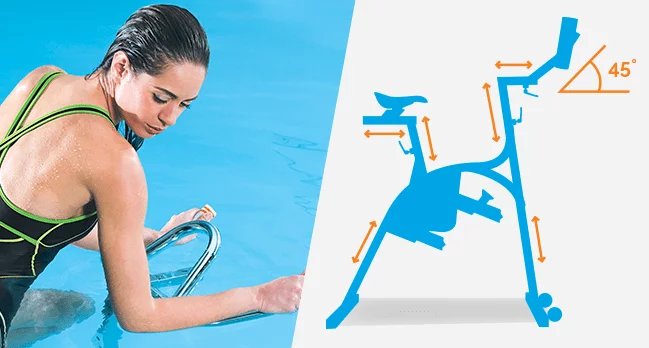
Assembly happens on the deck, not in the water. The bike goes together quickly, then saddle height and handlebar height are set. Once everything is adjusted, the bike is lifted into the pool and the session can start. For a fleet, plan two things at the same time: a lifting route from the store room to the water that does not cross a wet, unmarked walkway, and a place to rack the bikes when they come out, so they drain rather than stand in a puddle.
Who aquabiking suits
Young or not so young, beginner or competitive, lean or carrying extra weight: aquabiking is aimed at anyone who wants to improve their health or simply be active in water. It trains the whole body gently but effectively, which is why the same fleet serves a senior class in the morning, a rehabilitation slot at midday and a high-intensity group in the evening.
Because the rider carries only a small part of their own body weight, the format is an accessible way into regular training for people who find land-based sessions uncomfortable. Programmes for pregnant participants, for people managing diabetes and for older adults are common on aquabikes, and they should be run on medical advice and with a qualified instructor rather than offered as unsupervised open access.
Specifying a fleet rather than a bike
- Water chemistry. Chlorinated, salt-electrolysed and seawater pools are not equally aggressive. Tell your supplier which you run before the frame material is fixed.
- Handling. Count how many bikes one member of staff has to move, and how far. This decides aluminium versus stainless steel more often than the training specification does.
- Pool depth. Immersion to roughly chest height is what the format assumes. A pool with a strongly sloping floor will limit where the class can be positioned.
- Storage and drying. Racking, drainage and a rinse point extend service life more than any coating.
- Class size. Fleet numbers should match the width of usable water, not the size of the timetable slot you hope to fill.
Frequently asked questions
Does an aquabike need to be fixed to the pool floor?
No. The bike stays stable on the floor under load through its own geometry and weight, and it is lifted out again after the class. Nothing is anchored and the pool structure is untouched.
Stainless steel or aluminium?
Aluminium for lighter handling, stainless steel for mass and stability under strong riders. Both are corrosion resistant, which is the reason neither is replaced by a painted frame.
Can beginners and trained riders share one class?
On a professional-range bike, yes, because each rider adjusts resistance individually during the session. On fixed-resistance models the class has to be built around one common load.
Do riders need aqua shoes?
It depends on the pedal. Some professional models are padded enough that footwear is not required; on others, shoes protect the foot and improve grip. Decide this before you write the class rules, not after.
Buying from people who install pools every week
An aquabike fleet is a small line in a pool budget and a large change to what the water earns. Tell us the pool dimensions and depth profile, the water treatment you use, the class sizes you plan and who will be lifting the bikes, and we will specify the range, the frame material and the storage that goes with it. Request a quote for a costed proposal.