Choosing an outdoor fitness supplier: what a manufacturer and distributor changes
Une aire de fitness outdoor destinée à une collectivité, un camping, une école ou une résidence se juge sur trois points : conformité EN 16630, tenue du matériau dans le temps et plan de maintenance. Light In Fitness fabrique ces agrès en acier galvanisé ou en inox selon l'exposition du site. Étude d'implantation, pose et dossier de conformité sont fournis avec le matériel.
Buying outdoor fitness equipment from a supplier that both manufactures and distributes changes three things: the price, because there is no intermediate margin; the specification, because ranges can be mixed instead of forced into one catalogue; and the after sales position, because spare parts come from the same source that shipped the equipment. This is how Light In Fitness is set up, and this article explains what it means in practice when you are specifying an outdoor fitness trail or a street workout area.
If you are a local authority, a campsite, a company, a school, a hotel, a residential estate or a public space manager, the requirement is straightforward. You want an outdoor fitness area that attracts users, lasts, and does not create problems: a project that is safe, compliant, low maintenance and worthwhile in footfall, image and quality of life.
What buyers actually want, and what goes wrong
Across these projects the objectives are consistent. A space that gets used, not one that is opened and then forgotten. A durable solution that handles rain, ultraviolet exposure, frost and public use. Low maintenance. Clear safety, for the users and for the operator’s peace of mind. A positive image, whether that is an active town, a premium campsite or an attractive employer. And a simple choice rather than two hundred incomprehensible references.
The failure modes are equally consistent. A layout that is too demanding, so nobody dares use it. A layout that is too basic, so nothing is perceived as valuable. The wrong material near the coast, which means corrosion and replacement cost. And a poorly considered layout, where circulation is awkward and half the stations sit unused.
A six step method for an outdoor project
We work from your area, your users and your constraints, then propose a core specification plus options.
| Step | What it settles |
|---|---|
| Identify | Who will use the space, and how you want it to live |
| Measure | Area, access, ground conditions, neighbours, climate |
| Plan | A simple, legible, progressive route with rest points |
| Assure | Safety, free space zones, compliant layout distances |
| Compose | The mix of cardio, strength, mobility and inclusive stations |
| Sustain | Materials, corrosion protection, low maintenance, room to extend |
The single most useful thing you can send at the start is one paragraph: the type of organisation, the area in square metres, the environment, urban, park, coastal or mountain, the target users, and the objective, whether that is health, attractiveness, wellbeing or social cohesion. That is enough for a first costed proposal.
Material choice, decided by environment
| Material | Advantage | Recommended when |
|---|---|---|
| Timber | Premium appearance, integrates into landscaping | Parks, campsites, tourism settings |
| Galvanised steel | Durable, reduced maintenance, best return on investment | Local authority sites, intensive use, inland |
| Stainless steel, 316L grade | Maximum corrosion resistance and service life | Coastal sites, humid and salt laden environments |
This is the decision with the largest whole life cost consequence, and the one most often made on catalogue price alone. Painted steel on a seafront promenade is cheap once and expensive twice.
Compact station or modular trail
| Format | What it gives you | Choose it when |
|---|---|---|
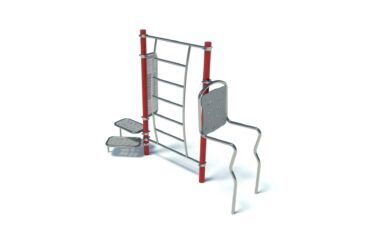
| Compact multi station | Maximum usable exercise per square metre, immediately legible, one foundation | Small area, optimised budget, high footfall site |
| Modular trail | A progressive route with stations distributed along a walk | Large park, promenade, fitness trail across a site |
Configurations by type of organisation
Local authority, aiming at intergenerational use and durability: gentle cardio, simple strengthening, mobility and balance, in galvanised steel, with accessible modules as an option for inclusion.
Campsite and tourism, aiming at attractiveness and image: a legible, approachable route, with timber for landscape integration or a compact station to maximise use per square metre.
Coastal site, aiming at longevity: stainless steel and corrosion resistant fixings, with a layout designed to stay clean and stay standing.
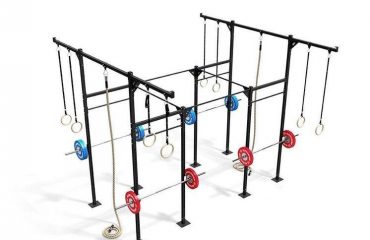
Youth and performance, aiming at a destination: a street workout rig and strength modules, which build a community around the site and make it visible.
Health and accessibility, aiming at inclusion: accessible and rehabilitation modules with gentle mobility, coordination and strengthening, which widen the user base substantially.
The pre purchase checklist
Before you go to market, settle these ten points and the specification writes itself. Your users: intergenerational, sporty, older adults, reduced mobility. Your objective: attractiveness, health, cohesion, tourism. Your area in square metres and the access route for installation. Your environment: urban, park, coastal, mountain. Your priority: low maintenance, longevity or appearance. Your format: compact station or modular trail. Your mix: cardio, strength, mobility, balance. Your options: street workout, accessible stations. Your material: galvanised, stainless or timber. And the shape of the offer you want: a core specification plus options, with a layout drawing.
What a manufacturer and distributor position changes
Three concrete effects. Price: selling direct removes an intermediate margin on equipment that is otherwise identical. Range: with more than 2,000 references and twelve distributed brands alongside our own manufacturing, a project can mix the best answer for each zone rather than force one catalogue across the whole site. And continuity: warranties of two to five years depending on range, with spare parts and after sales support from the same source, which is what keeps a public installation open in year seven.
Light In Fitness has operated from Tours, France, since 2013, with more than 2,500 customers equipped and installations delivered on three continents. Standard delivery covers France, Belgium, Switzerland and Luxembourg, with export priced per project, and stock references ship within 5 to 10 working days.
Frequently asked questions
Which equipment mix produces the highest usage?
Accessible cardio, simple strengthening, mobility and balance, with a street workout zone added where the objective includes attracting a younger, performance minded community. A route made only of bodyweight bars limits itself to users who already train.
What if we only have a small area?
A compact multi station gives the best ratio of usable exercise to square metre: more than 20 exercises on one module, up to 10 users at once, one foundation and one installation.
Which material near the coast?
Stainless steel, 316L grade in particular, for corrosion resistance. It costs more at purchase and less across the life of the installation.
Do you supply accessible equipment?
Yes, a dedicated range for accessible and rehabilitation use, which is one of the most effective ways to increase the number of people who use an outdoor fitness area.
How does a project start?
With one message giving your area, your users, your environment and your objective. We return a core specification plus options, with the matching product references and a quotation, within 24 working hours.
Get a recommendation and a quotation
Tell us your area, your users, your environment and your objective, and we will propose a layout, a material specification and a costed offer. Request a quotation and we reply within 24 working hours. Explore the outdoor fitness trail, outdoor gym equipment, street workout rigs and stainless steel outdoor fitness ranges, or read more about us and our turnkey projects.
Réalisations documentées
- Cage street workout ultime, Carcassonne – armée française
- Cage street workout ultime, Tahiti – armée française, Polynésie
- Cage SP Max, centre EPIDE de Combrée – établissement public d’insertion
- Cage SP Max, lycée Saint-Bénigne de Dijon – établissement scolaire
Sources et références
- NF EN 16630 – modules fixes d’entraînement physique de plein air : exigences de sécurité et méthodes d’essai (AFNOR)
- Code du sport, article L322-2 – garanties d’hygiène et de sécurité des établissements d’activités physiques et sportives (Légifrance)
À lire aussi sur le même thème
- The Council Checklist for a Successful Street Workout Park
- Street Workout Park: Installation, Budget and Training Guide
- Street Workout and Calisthenics Parks for Local Authorities: Key Steps, Materials and Configurations
- Outdoor Fitness and Street Workout: Building an Area That Lasts, Stays Safe and Pays Off