How to Choose a Vandal-Resistant, Weatherproof Street Workout Park
La résistance d'un parc de street workout au vandalisme et aux intempéries repose sur trois éléments : le matériau, la conception sans pièce démontable et le mode d'ancrage. L'inox et l'acier galvanisé épais résistent là où l'acier peint mince marque et rouille. La conformité EN 16630 encadre la sécurité, pas la durabilité : les deux se vérifient séparément.

When a municipality, a school, a campsite, a housing association or a resort buys a street workout park, the brochure is the least useful document in the file. Two structures that look identical in a rendering can behave completely differently after three winters and one determined weekend. Durability outdoors comes down to three things that can each be checked on paper before you sign: safety conformity, the corrosion protection specification, and a design that survives deliberate abuse. This guide sets out what to ask a manufacturer, and what a credible answer looks like.
What you are actually buying when a supplier says resistant
Buyers usually describe the requirement as a station that lasts ten years. In practice that outcome depends on five variables, and a supplier who only controls the first one cannot promise the result.
- Exposure: rain, UV, freeze-thaw cycles, coastal salt, urban pollution.
- Corrosion protection: the wrong treatment for the environment degrades fast, whatever the steel underneath.
- Installation: anchoring, ground support, drainage.
- Vandalism: impact, attempted dismantling, tagging, targeted damage.
- Maintenance: inspection, retightening, replacement of wear parts.
A genuine turnkey manufacturer documents all five, not just the structure. If the offer stops at a product sheet, the risk on the other four transfers quietly to you.
Safety conformity: the non-negotiable point
For permanently installed, freely accessible outdoor fitness equipment, EN 16630 is the reference standard. It covers safety requirements and test methods, and it also addresses installation, inspection and maintenance. That last part matters more than buyers expect: conformity is not only a property of the product, it is a property of how the product is installed and kept in service.
Note carefully what the standard does and does not do. EN 16630 frames safety. It does not certify that a structure will still look good after ten years on a seafront. Durability and safety are verified separately, with separate documents, and a supplier who answers a corrosion question by citing a safety standard has not answered the question.
One more distinction that causes real problems on mixed sites: adult outdoor fitness equipment falls under EN 16630, while children playground equipment falls under EN 1176-1, with EN 1177 covering impact-attenuating surfacing. These are different families of requirement and they are never interchangeable. If your project puts a workout area next to a play area, each zone is specified against its own standard.
What to require in a public-sector offer
- A stated reference to EN 16630 conformity, with the supporting documentation.
- Installation instructions and anchoring prescriptions.
- Inspection and maintenance schedule: intervals and check points.
- A written warranty: scope, exclusions, and who carries responsibility for installation and upkeep.
Weather: the materials and treatments that decide the outcome
Two material families dominate outdoor structures: stainless steel, and carbon steel with a protective system. Judge them on standards and specifications rather than on adjectives in a catalogue.
Hot-dip galvanised steel
Hot-dip galvanising is normally specified through EN ISO 1461, which sets the properties and test methods for the coating. On an outdoor structure the objective is long-term corrosion protection with a coating thickness matched to the exposure, applied after fabrication so that welds and cut edges are protected too.
Duplex systems and anticorrosion paint
For harsher exposures the usual answer is a duplex system, galvanising plus a paint system on top, or a paint specification chosen for the corrosivity of the environment. ISO 12944 is the reference for selecting protective paint systems by corrosivity category, which is why a serious specification names the environment (urban, coastal, mountain) before it names a colour.
Stainless steel
Stainless steel is specified by grade, and the grade must match the exposure. It is the usual answer for coastal and high-salt environments and for sites where repainting is not realistic. It costs more up front and removes a recurring maintenance line from the budget.
| Requirement | What to ask for | Reference |
|---|---|---|
| Galvanising | Coating properties and thickness, applied after fabrication | EN ISO 1461 |
| Paint system | Corrosivity category of the site, full system build-up | ISO 12944 |
| Stainless steel | Grade stated, matched to exposure | Manufacturer declaration |
| Safety | Conformity, installation, inspection and maintenance | EN 16630 |
Vandal resistance: design, fixings and spare parts
Vandalism is never reduced to zero. Good design makes it harder and makes the repair cheap. Ask for evidence on the following points rather than a general reassurance.
- Tamper-resistant or shielded fasteners, so opportunistic dismantling is not possible with a pocket tool.
- Reinforced joints and impact zones dimensioned for abuse rather than for nominal training loads.
- Surfaces and coatings chosen for scratching, abrasion and moisture, not only for appearance.
- A design with no unnecessary fragile parts.
- Module-level replaceability: a damaged bar or grip is swapped without dismantling the structure.
- Stated spare-part availability and a documented after-sales procedure.
The modular argument is the one that shows up in the budget. On a public park, the ability to replace one bar, one grip or one section quickly determines both downtime and total cost of ownership. A structure that has to be removed entirely to repair a single element is expensive long after the invoice is paid.
Installation, ground and anchoring: where projects actually fail
The best structure in the catalogue underperforms if the anchoring and the ground are wrong. A manufacturer working turnkey should check and put in writing:
- The support: slab or foundations, bearing capacity, flatness.
- Drainage and water management, to avoid standing water and the corrosion that follows it.
- Site constraints: buried services, machine access, restricted zones.
- The maintenance plan: inspection and retightening intervals from day one.
Impact-attenuating surfacing under the structure is part of the same conversation, and it is specified against the free height of fall rather than chosen by appearance.
The manufacturer checklist
Take this list into the meeting and ask for an answer in writing for each line. The answers, not the renderings, tell you who can deliver.
- EN 16630 conformity, with installation, inspection and maintenance documents.
- Materials: stainless steel with the grade stated, or protected steel with galvanising to EN ISO 1461, powder coating, or a duplex system.
- Anticorrosion specification tied to the target environment: urban, coastal, mountain.
- Fasteners and assemblies: anti-dismantling solutions, protected fixings.
- Repairability: replaceable parts, availability, lead times, after-sales procedure.
- Installation: foundations and anchors, drainage plan, site handover.
- Warranty in writing, with exclusions and responsibilities for installation and maintenance.
How Light In Fitness approaches outdoor projects
Light In Fitness manufactures and supplies outdoor structures for intensive public use, in galvanised steel and in stainless steel depending on the range, with EN 16630 conformity stated on the relevant outdoor categories. The working method is the one described above: start from the exposure of the site, choose the material and treatment accordingly, then secure the installation, the maintenance plan and the spare parts.
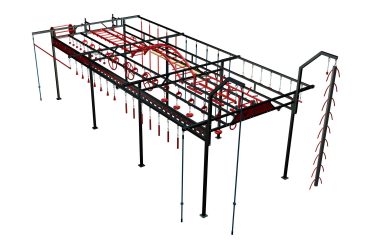
To see the level of finish, start with the street workout rigs range and the complete street workout parks for multi-station projects. Where the site is coastal or otherwise aggressive, the stainless steel street workout cages are the relevant starting point, and the Mix D street workout cage is a representative reference in galvanised and coated steel.
Frequently asked questions
Which criteria prove a street workout park really resists the weather?
The materials and anticorrosion treatments, stated with their specification: hot-dip galvanising, stainless steel with the grade named, or a duplex system, together with the application requirements. Add EN 16630 conformity, a written inspection and maintenance plan, spare-part availability and the warranty conditions. Adjectives are not a specification.
What makes a structure more resistant to vandalism?
A design without unnecessary fragile parts, reinforced assemblies, tamper-resistant fasteners, protected fixings, replaceable components such as bars and grips, surfaces and coatings suited to outdoor abuse, and a realistic maintenance routine of inspection and retightening. A turnkey offer must also cover installation and anchoring adapted to the site.
Which standard applies to outdoor equipment accessible to the public?
EN 16630 covers permanently installed, freely accessible outdoor fitness equipment, with safety requirements, test methods, and provisions for installation, inspection and maintenance. Children playground equipment is a separate family, covered by EN 1176-1 with EN 1177 for impact-attenuating surfacing.
What information does a manufacturer need for an accurate quotation?
A plan or dimensions, photographs, the nature of the ground, service and access constraints, the objective of the installation, whether sport-focused or intergenerational, the exposure level such as coastal, polluted or freeze-thaw, plus budget and timetable. Public buyers should add their conformity and maintenance requirements.
Framing your project
An exposed site, a high-traffic location or a freeze-thaw climate changes the material, the treatment, the anchoring and the maintenance plan at the same time. Gather the constraints in one document and ask for a configuration built against them. Send your plan, photographs, ground details and exposure with a quotation request, and you will get a specification for your site rather than a catalogue extract.
Réalisations documentées
- Cage street workout ultime, Carcassonne – armée française
- Cage street workout ultime, Tahiti – armée française, Polynésie
- Cage SP Max, centre EPIDE de Combrée – établissement public d’insertion
- Cage SP Max, lycée Saint-Bénigne de Dijon – établissement scolaire
Sources et références
- NF EN 16630 – modules fixes d’entraînement physique de plein air : exigences de sécurité et méthodes d’essai (AFNOR)
- Code du sport, article L322-2 – garanties d’hygiène et de sécurité des établissements d’activités physiques et sportives (Légifrance)