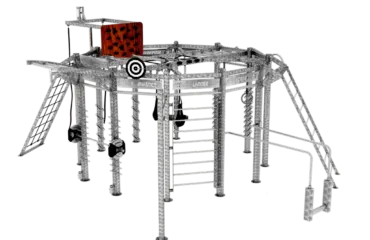
Which Standard Applies to Outdoor Street Workout Cages? EN 16630 Explained
La norme EN 16630 encadre les équipements de fitness fixés de manière permanente en plein air, en accès libre comme surveillé. Elle vise les utilisateurs de plus de 1 400 millimètres et fixe les exigences de conception, d'espaces libres et d'ancrage. C'est la référence applicable à une cage de street workout installée en extérieur.
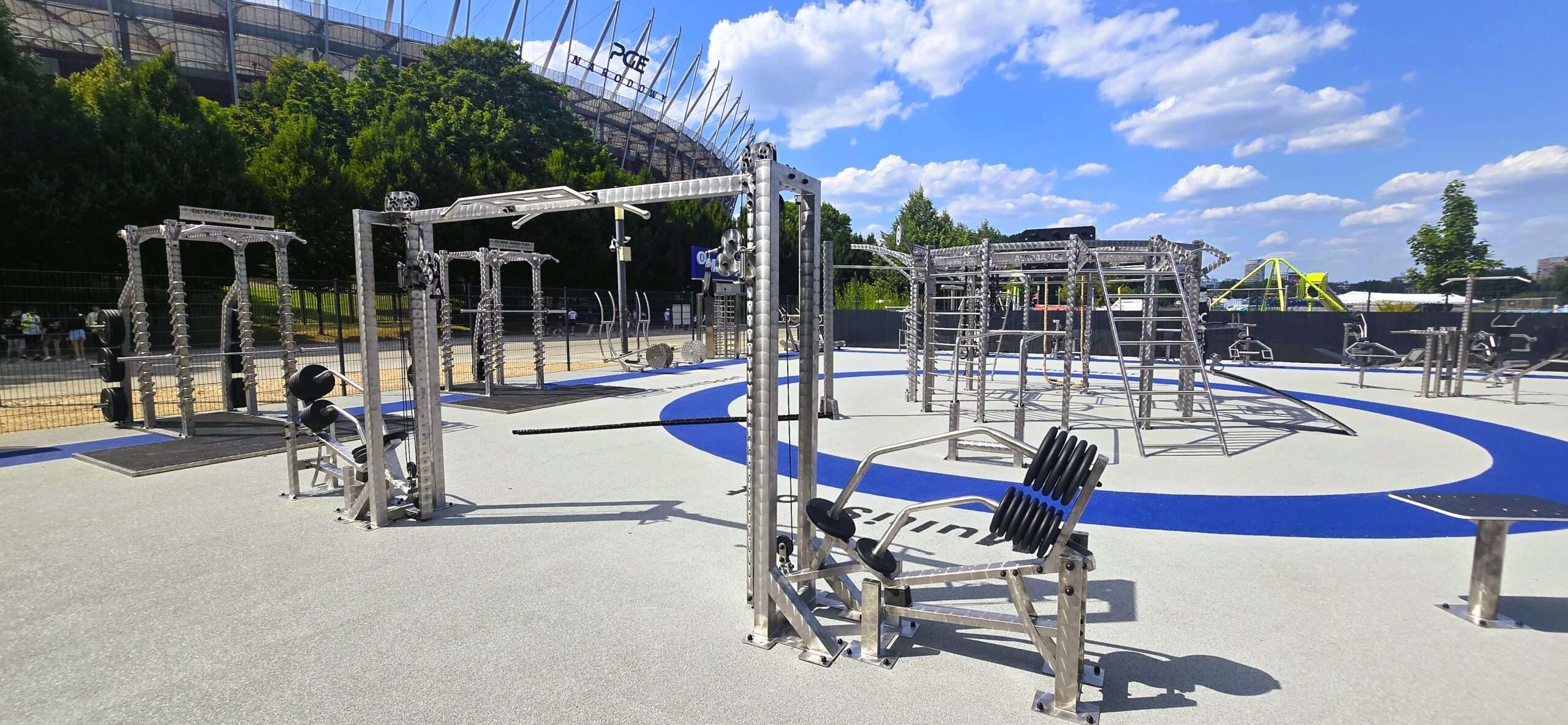
The standard that applies to a permanently installed outdoor street workout cage is EN 16630 — “Permanently installed outdoor fitness equipment: safety requirements and test methods”. It covers every fixed open-air fitness module, whether free-access or supervised, and it is the reference that courts, insurers and public tenders rely on. Before investing in an outdoor calisthenics structure, here is what the standard requires and how to verify compliance.
What exactly is EN 16630?
EN 16630 specifies general safety, inspection and maintenance requirements for outdoor fitness equipment. The essentials of its scope:
- It covers modules permanently fixed to the ground — cages, bars, pull-up stations, fitness trails.
- The equipment concerned carries no removable, user-adjustable additional loads (no free weights).
- It is written for users of at least 1.40 m in stature — smaller children fall under EN 1176, the playground standard.
- It covers recreational use, individual or collective, in free practice.
EN 16630 vs the other standards: do not mix them up
| Standard | Scope | Context |
|---|---|---|
| EN 16630 | Fixed outdoor fitness equipment | Street workout cages, outdoor stations, open-air fitness trails |
| EN 1176 | Children’s playgrounds | Slides, swings, play structures |
| EN ISO 20957-1:2024 (formerly EN 957) | Indoor stationary training equipment | Selectorised machines, racks, benches — classes S, H and I |
| EN 14904 | Indoor sports surfaces | Gymnasium and sports hall floors |
| EN 1177 | Impact-attenuating surfacing | Shock-absorbing floors beneath equipment with fall height |
The trap to avoid: an indoor CrossFit rig falls under EN ISO 20957-1:2024; the moment the same type of structure is permanently installed outdoors, EN 16630 takes over. And where a site combines fitness modules with children’s play equipment, the boundary between the two standards matters — we cover it in EN 16630 vs EN 1176: outdoor fitness or playground?
The key EN 16630 requirements for an outdoor cage
Materials and corrosion resistance
The standard requires materials to withstand weather, UV and corrosion over the long term. This is precisely why stainless steel is the ideal material for outdoor street workout cages: 304 and 316L grades meet the requirement natively, with no surface treatment to monitor. Hot-dip galvanised structures are also compliant, but the protective layer must be inspected and maintained over the years.
Safety zones and clearances
- A minimum safety zone of 1.50 m around each piece of equipment, free of any obstacle — walls, trees, lighting columns, other structures.
- Clearances between modules must allow the full amplitude of every movement.
- Elevated elements need a vertical clearance free of overhead obstacles.
Free fall height and surfacing
Free fall height (FFH) is a central criterion — it dictates the surfacing under the cage:
- FFH under 60 cm: natural ground (grass, compacted earth) may be sufficient.
- FFH between 60 cm and 1 m: impact-absorbing surfacing such as rubber tiles is recommended.
- FFH over 1 m: surfacing compliant with EN 1177 is mandatory, with thickness matched to the fall height.
A classic street workout cage with a high pull-up bar usually exceeds 1.50 m of free fall height, making certified impact surfacing indispensable. Our guide to safety surfacing and fall height explains how thickness is determined.
Entrapment prevention and handle design
- Gaps between bars must be either under 8 mm or over 25 mm to prevent finger entrapment.
- Handles need ergonomic diameters with closed or rounded ends.
- No sharp edges, protruding bolts or accidental snag points may be accessible — clothing entrapment (drawstrings, hoods) is part of the test scope.
- Any chains or cables must be dimensioned for intensive use without failure.
Is EN 16630 legally mandatory?
Strictly speaking, EN 16630 is a voluntary standard in most European countries — but in practice it is unavoidable for any public or professional installation:
- Civil and criminal liability: after an accident on non-compliant equipment, the owner (council, company, hotel) carries the liability, and failure to follow the recognised standard is treated as presumptive fault.
- Insurance: most insurers require EN 16630 conformity to cover public outdoor fitness spaces.
- Public procurement: tender specifications across Europe systematically impose the standard.
- Judicial reference: in the absence of specific national regulation, courts refer to the European standard as the expected level of safety.
In short: skipping EN 16630 is a major legal and financial risk, not a saving.
How Light In Fitness builds compliance in
- European manufacture: our outdoor cages are produced in 304 or 316L stainless steel — exceeding the standard’s corrosion requirements — or in hot-dip galvanised steel; browse the stainless steel street workout cages.
- Anti-entrapment design: standardised gap dimensions, closed end caps and smooth TIG welds.
- Documentation delivered: every order ships with the conformity certificate, a layout plan showing safety zones, and surfacing recommendations.
- Site study: we calculate the free fall height of your configuration and specify the compliant surfacing.
- Simplified maintenance: stainless steel needs no structural upkeep, which makes the standard’s periodic inspection obligations easy to honour.
Pre-purchase compliance checklist
- Does the manufacturer deliver an EN 16630 conformity certificate?
- Are the materials corrosion-resistant without maintenance (stainless 304/316L) or with a planned maintenance schedule (galvanised)?
- Does the layout provide the minimum 1.50 m clearance zones?
- Has the free fall height been calculated and the surfacing specified accordingly?
- Does the design eliminate entrapment risks for fingers, head and clothing?
- Is a maintenance plan in place — periodic inspections and an inspection log?
- Does the supplier provide full support: study, delivery, installation, after-sales service?
For help weighing manufacturers against these criteria, see our street workout cage brand comparison framework.
Frequently asked questions
Does EN 16630 apply to a cage in a private hotel garden or campsite?
Yes, in practice. The standard covers permanently installed outdoor fitness equipment regardless of who owns the land; any facility accessible to guests or the public will be judged against it by insurers and courts.
What inspections does the standard expect after installation?
Three levels, mirroring playground practice: routine visual checks (weekly to monthly), operational inspections of wear and stability (every 1–3 months), and an annual main inspection — all recorded in an inspection log kept by the operator.
Can adults-only equipment be installed next to a playground?
Yes, but the two zones must be visually and physically distinct, each compliant with its own standard, and the fitness equipment should be signed as unsuitable for children under 1.40 m.
Who certifies EN 16630 conformity?
The manufacturer declares conformity, ideally supported by type-testing from an accredited laboratory. Ask for the test reports, not just a logo on the brochure — serious manufacturers provide both.
Get a compliant outdoor project quote
Light In Fitness supports your project from site study to installation, and the conformity certificate ships with your order. Request your free quote.
Réalisations documentées
- Cage street workout ultime, Carcassonne – armée française
- Cage street workout ultime, Tahiti – armée française, Polynésie
- Cage SP Max, centre EPIDE de Combrée – établissement public d’insertion
- Cage SP Max, lycée Saint-Bénigne de Dijon – établissement scolaire
Sources et références
- NF EN 16630 – modules fixes d’entraînement physique de plein air : exigences de sécurité et méthodes d’essai (AFNOR)
- Code du sport, article L322-2 – garanties d’hygiène et de sécurité des établissements d’activités physiques et sportives (Légifrance)
- Décret n° 96-1136 du 18 décembre 1996 – prescriptions de sécurité relatives aux aires collectives de jeux (Légifrance)
- NF EN 1176-1 – Équipements et sols d’aires de jeux, partie 1 : exigences de sécurité et méthodes d’essai générales (AFNOR)
À lire aussi sur le même thème
- Case study: an adapted-exercise circuit for a care home - indoor and compact outdoor
- Case Study: Deploying a Fitness Trail Network Across 12 Municipalities
- Outdoor Stainless Steel Street Workout Stations: the Municipal Project Playbook
- Ninja and parkour park design: standards, configurations and landing systems