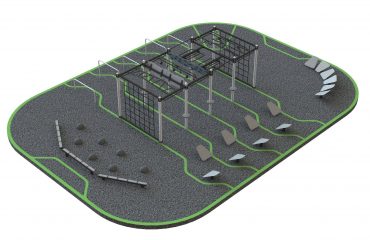
Turnkey Outdoor Street Workout Stations for Local Authorities
Une station de street workout clé en main pour une commune comprend la structure, l'étude d'implantation, le sol amortissant, la pose et le dossier de conformité EN 16630. Beaucoup de fournisseurs vendent la structure seule et laissent la commune gérer le sol et la pose. Le périmètre exact doit être vérifié avant comparaison des offres.
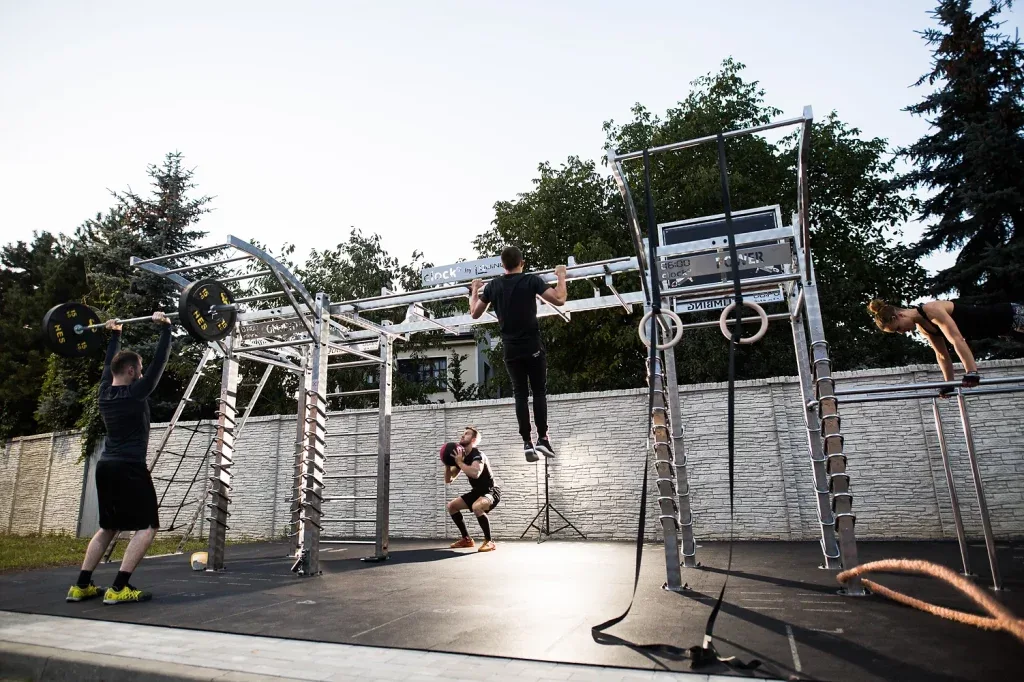
Plenty of suppliers can sell a local authority an outdoor structure. Far fewer can hand over an installation that the authority can actually operate: sited correctly, compliant, properly surfaced, anchored, signed, and covered by a maintenance regime that survives the first winter. The gap between those two offers is where most municipal outdoor fitness projects go wrong, and it rarely shows up in the price comparison. This guide sets out how to recognise a manufacturer capable of delivering a genuinely turnkey street workout area, what to demand in the tender file, and how to brief a supplier so the quotation you receive is comparable to the others on your desk.
What turnkey has to mean in a public tender
Before comparing manufacturers, fix the scope in writing. Otherwise you will compare a full installation against a pallet of steel delivered to the depot, and the cheaper line will win a contract it was never scoped to fulfil. For a public authority, a turnkey scope typically covers:
- Feasibility study and a siting proposal for the specific plot
- Module selection and a configuration matched to the intended users
- Manufacture, supply, logistics and delivery to site
- Installation, anchoring, handover inspection and site securing during works
- User instructions, signage and posted rules of use
- Warranty, and a defined preventive maintenance framework
Write that list into the specification and require each bidder to price it line by line. A supplier who cannot quote the anchoring or the surfacing is not offering a turnkey solution, whatever the covering letter says, and the difference will land on the authority’s own works budget later.
Standards and safety: the non-negotiable section
Permanently installed outdoor fitness equipment in open public access falls under EN 16630. The standard sets the safety requirements and test methods for this equipment, and it also covers what happens after delivery: installation, inspection and maintenance. A manufacturer working with public authorities should be able to produce that documentation without being chased for it.
Two boundaries matter and are regularly confused in tender files. EN 16630 covers adult outdoor fitness equipment. Children’s play equipment is a different regime: the equipment falls under EN 1176-1 and the impact-attenuating surfacing under EN 1177, which are two separate standards and are never interchangeable with each other or with EN 16630. If your project places an adult street workout rig next to a children’s play area, you are managing two compliance regimes on one site, and both need their own documentation, their own use zones and their own inspection schedule.
What to require in the file
- Compliance references for the exact equipment supplied, with the associated technical documents
- The installation manual and the substrate prerequisites it assumes
- Inspection and maintenance instructions, with the recommended frequencies
- The warranty and, explicitly, what it does and does not cover
- The use zone drawing for each module, dimensioned
Siting: where municipal projects actually fail
Public projects rarely fail on the choice of a pull-up bar. They fail on siting. A turnkey manufacturer should be working through the plot with you before a single module is chosen:
- Movement and flows: entry and exit, pedestrian circulation, coexistence with play areas, skate facilities and sports pitches
- The use zone around every station and the clearances between modules
- Height, orientation and module mix against wind, sun, sightlines and neighbouring housing
- Accessibility of the approach and the surrounding circulation, not only of the equipment
- Visibility and natural surveillance, which does more for the condition of an installation than any specification clause
- Signage and posted instructions, legible from the approach
Planning, heritage and utility constraints are decided nationally and locally, and they differ from one jurisdiction to the next. Establish early which consents, buried-services checks and heritage approvals apply to your site under the rules in force where you are, and put the answer in the brief rather than discovering it after the anchors are set. Our street workout rigs range is designed to be configured around those site constraints rather than dropped onto a plot.
Choosing the modules: sporting, progressive or intergenerational
An authority usually has to reconcile two aims: allowing genuine athletic practice, and remaining usable by residents who are not athletes. A capable manufacturer offers configurations rather than a single product:
- Sporting. Multi-height pull-up bars, dips, parallel bars, monkey bars, core modules – the classic calisthenics vocabulary, for users who already train.
- Progressive. Graded difficulty across the rig so beginners and advanced users share one structure, which is what keeps a small site viable.
- Intergenerational. Mobility, balance and coordination stations that widen the user base well beyond the calisthenics community.
- Accessible. Stations usable from a wheelchair, which turn a sports facility into a public amenity. See the accessible outdoor gym range.
Complete configurations are set out in the complete street workout parks range, from a single functional station to a full park.
Reference configurations and order of magnitude
Budget questions come early in a municipal process, so here are catalogue reference points for four typical configurations. These are list prices for the structure itself: surfacing, groundworks, anchoring and installation are quoted per site and are not included in these figures.
| Configuration | Catalogue price |
|---|---|
| HEX functional calisthenics station | 8,000.00 EUR excluding VAT |
| S17 complete street workout structure | 21,500.00 EUR excluding VAT |
| Z4 street workout cage | 24,500.00 EUR excluding VAT |
| C12 stainless steel street workout station | 24,999.00 EUR excluding VAT |
Stainless steel costs more at purchase and changes the maintenance economics over the life of the installation, which is the comparison an authority should be running rather than a purchase-price comparison. Guarantees run up to 20 years on our steel structures and for life on stainless steel.
Surfacing and anchoring: what decides the service life
The hard part of a turnkey contract is not the rig. It is the relationship between structure, substrate, drainage, freeze-thaw cycling and anchoring. A serious manufacturer states clearly:
- The substrate prerequisites: stability, levelness, water evacuation
- The anchoring method: foundations, grouted fixings, base plates, and the loads each transmits
- The surfacing under and around the equipment, sized to the free height of fall of the modules installed, as EN 16630 requires
- Safety and usability finishes: edging, circulation zones, cleanability
- The maintenance plan: inspection intervals, re-torquing, visual checks, anticorrosion
Surfacing is where authorities are most often left to improvise. Ask for it to be quoted with the structure, not as a variation afterwards: our outdoor sports flooring range is specified against the fall heights of the modules it sits under.
How to brief a supplier and get a comparable quotation
Most unusable quotations are caused by an incomplete brief rather than an unwilling supplier. Send the following and the responses become comparable:
- Site address and location, with photographs from several angles
- A dimensioned plan or measurements of the available area
- The nature of the ground, and the known constraints: buried services, machine access, restricted zones
- The intended users and the objective: athletic practice, intergenerational use, fitness trail
- Whether accessibility for users with reduced mobility is required
- An indicative budget and the intended timetable, including any funding decision dates
The budget line matters more than authorities expect. A supplier who knows the envelope proposes a configuration that fits it; a supplier who does not proposes the catalogue and wastes a round of exchanges.
Frequently asked questions
What does a turnkey street workout station include?
Typically: siting study, module selection, adaptation to the site, supply, transport, installation and anchoring, signage and posted instructions, and a maintenance and warranty framework. The exact scope must be written into the offer, because the term itself is not defined by anything.
Which safety standard applies to open-access outdoor fitness equipment?
EN 16630, for permanently installed outdoor fitness equipment. It sets safety requirements and test methods and covers installation, inspection and maintenance. Children’s play equipment is separate: EN 1176-1 for the equipment, EN 1177 for the impact-attenuating surface.
What surfacing should surround an outdoor station?
It depends on the site and on the free height of fall of the modules installed. Stabilisation, drainage, use, accessibility and durability all feed the choice. The turnkey supplier should validate the substrate, the anchors and the finishes, and supply the maintenance plan with them.
Who inspects the installation once it is open?
The operator remains responsible for the equipment in service. The manufacturer supplies the inspection instructions and the frequencies; the authority organises routine visual checks, periodic operational inspections and the annual main inspection, and keeps the records. Ask for that schedule at handover, not a year later.
Can a street workout area sit next to a children’s playground?
Yes, and it often should for the sake of family use, provided the two are treated as two separate compliance regimes with their own use zones, their own surfacing and their own inspection records.
Moving your project forward
Light In Fitness manufactures and installs outdoor street workout structures in steel and stainless steel for local authorities, parks, schools and clubs, and has equipped more than 2,500 customers since 2013. We work from the plot: siting study, configuration, surfacing, anchoring, installation and the compliance file that goes with them.
Send us your plan, your photographs and your site constraints and you will get back a siting proposal, a configuration and a costed offer: request a quotation.
Réalisations documentées
- Cage street workout ultime, Carcassonne – armée française
- Cage street workout ultime, Tahiti – armée française, Polynésie
- Cage SP Max, centre EPIDE de Combrée – établissement public d’insertion
- Cage SP Max, lycée Saint-Bénigne de Dijon – établissement scolaire
Sources et références
- NF EN 16630 – modules fixes d’entraînement physique de plein air : exigences de sécurité et méthodes d’essai (AFNOR)
- Code du sport, article L322-2 – garanties d’hygiène et de sécurité des établissements d’activités physiques et sportives (Légifrance)