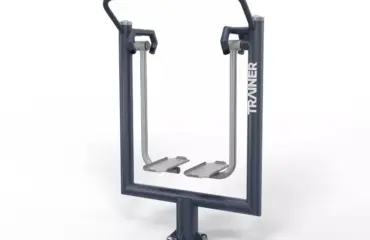
Outdoor fitness equipment for parks: how to turn every square metre into activity
Une aire de fitness en accès libre transforme une surface de parc en équipement de santé publique, utilisable sans inscription ni horaire. Son efficacité dépend de l'implantation, de la visibilité depuis les cheminements et de la diversité des agrès proposés. La norme EN 16630 encadre la conception de ces équipements.

Outdoor fitness equipment turns a park from a space people cross into a space people stay in, and the compact multi station format now delivers that far more efficiently than scattered single apparatus. A compact module built around a central column offers more than 20 exercises, takes up to 10 users at the same time, and is installed by two people in under four hours once the foundation slab is ready. Less civil engineering, less concrete, lower maintenance and a much better ratio of usable exercise per square metre.
Written for town councils, park managers, grounds and open space teams, campsites and residential estates. The regulatory framework is EN 16630 for the equipment and EN 1177 for the impact attenuating surface beneath it.
Why outdoor fitness earns its place in a park
Outdoor fitness equipment provides free, unsupervised physical activity that is genuinely open to everyone: teenagers, adults, older people, recreational athletes and complete beginners. The equipment is designed to be intuitive, the exercise range covers cardiovascular work, strengthening and mobility, and the same station serves a beginner learning a movement and an experienced user adding intensity.
The social effect matters as much as the physical one. These spaces become places where people meet, encourage each other, exchange advice and train as families or as colleagues. For a park manager that translates into three things: more use of existing space without changing its character, a shift of emphasis from treatment to prevention, and physical activity that is visible, simple and attractive rather than hidden behind a subscription.
The two standards that protect you
EN 16630 is the European standard for permanently installed outdoor fitness equipment. It sets safety requirements and test methods covering free space around each station, the absence of pinch and entrapment points, anchoring stability, and the marking and user information that must be provided. Any equipment destined for a public space has to comply.
EN 1177 covers impact attenuating surfacing and its performance in a fall. As soon as a station presents a significant free fall height, the receiving surface has to be specified for that height. Certified rubber tiles satisfy this requirement outdoors. A serious outdoor fitness project is always specified as a pair: the apparatus and its surface. Neglecting the second undermines the legal position of the first.
Which apparatus for which use
The question every park manager asks is where to start. This comparison covers the main families.
| Apparatus | Muscles worked | Difficulty | Recommended use |
|---|---|---|---|
| Pull up bars, multiple heights | Back, biceps, forearms, core | Intermediate to advanced | Street workout, teenagers and active adults |
| Parallel bars for dips | Chest, triceps, shoulders | Intermediate | Upper body strength, calisthenics progressions |
| Outdoor elliptical | Cardiovascular, legs, glutes | Beginner | Older users, gentle reconditioning, warm up |
| Outdoor rower | Back, legs, full cardiovascular | Beginner to intermediate | Full body cardio without joint impact |
| Load bearing guided machines | Targeted groups by machine | Beginner to advanced | Safe resistance training, learning movement patterns |
| Wall bars and mobility frames | Flexibility, core, stretching | All levels | Older users, recovery, physical preparation |
| Compact multi station | Full body, more than 20 exercises | All levels | Small parks, pocket parks, high footfall sites |
Matching provision to the users you have
An outdoor fitness area fails for one of two reasons: it is too demanding, so nobody dares use it, or it is too basic, so nobody values it. Segmenting the provision solves both.
| User group | What they need | What to install |
|---|---|---|
| Beginners and older adults | Guided, legible movements with no visible risk of failure | Guided load machines, gentle cardio, wall bars, a progressive fitness trail |
| Experienced users | Intensity and variety | Multi height pull up bars, dips, monkey bars, load machines, street workout rig |
| Teenagers and young adults | A credible meeting point with visual appeal | Calisthenics structures and combined modules, stainless steel finishes |
| Users with reduced mobility | Access and gentle progression | Accessible stations, coordination and mobility modules |
The first barrier to use is not motivation, it is intimidation. Beginners need movements they can perform correctly on the first attempt, in public, without an audience noticing a failure. That is why guided load machines and gentle cardio belong at the entrance to the area, and the demanding calisthenics equipment further in.
Getting more value out of every square metre
Most outdoor ranges are sold as isolated stations distributed across a park, with no coherence of route and limited usable exercise per unit. The result is familiar: some apparatus is barely touched, and small sites or pocket parks cannot offer anything worthwhile because there is no room for six separate stations.
Concentrating exercise value into a minimum footprint answers both problems. Stations grouped around a central column, up to 10 simultaneous users on a single unit, and more than 20 possible exercises depending on configuration. For a park manager that means real impact on a small area, provision that is legible to the public, and a far better usable exercise to square metre ratio. The honest measure of an outdoor investment is not how many items you bought, it is how many people can train at once and with how many movement variations.
Material choice by environment
Material is not a cosmetic decision, it is a whole life cost decision. Galvanised steel is the workhorse for inland municipal sites under intensive use. Stainless steel, and 316L grade in particular, is the answer near the coast and in humid or salt laden environments where painted or galvanised finishes corrode and have to be replaced. Timber integrates well into landscaped and tourism settings but calls for more regular maintenance. Getting this wrong on a seafront site means replacing equipment within a few years rather than maintaining it for fifteen.
Working within a constrained budget
Park and open space projects are almost always constrained: a capped budget, grant funding to secure, and trade offs inside a wider masterplan. Every euro counts across equipment, groundworks, concrete, landscaping and installation. The way to protect the budget is to optimise total cost rather than catalogue price. A compact multi station means fewer units to buy for a genuine training zone, less concrete and less landscaping to fund, and a short installation window that keeps the site closed for hours rather than days.
Frequently asked questions
How much space does an outdoor fitness area need?
Less than most people assume, provided the equipment is chosen for the space. A compact multi station serving up to 10 users at once fits into a pocket park where six separate stations plus their free space zones would not. What cannot be compressed is the free space required around each station by EN 16630, and the impact area where a fall height exists.
Do we have to install impact attenuating surfacing?
Wherever the equipment creates a significant free fall height, yes, and it has to be specified for that height under EN 1177. Grass is not a certified impact attenuating surface. Bonded rubber tiles on a free draining slab are the usual solution outdoors.
How long does installation take?
For a compact module, two people in under four hours once the foundation slab has cured. The critical path is the groundworks, not the assembly, which is why the slab should be programmed well ahead of the delivery date.
What maintenance should we plan for?
A documented inspection regime: routine visual checks, a monthly operational check of moving parts, and an annual main inspection by an independent body. Beyond that, maintenance on correctly specified galvanised or stainless equipment is limited to cleaning, fixings and occasional part replacement. Each item is delivered with a maintenance logbook that supports your inspection records.
What warranty applies?
Two to five years depending on the range, with spare parts available afterwards. That matters more than the headline figure: on a public installation, the ability to source a single replacement part in year seven is what keeps the area open.
Planning an outdoor fitness area?
Send us your available area, your target users and your environment, coastal or inland, and we return a proposal with a layout, a material specification and a detailed quotation. Light In Fitness has been manufacturing and supplying professional fitness equipment from Tours, France, since 2013, with more than 2,500 customers equipped. Request a quotation and we reply within 24 working hours. See our outdoor gym equipment, street workout rigs, outdoor fitness trail and stainless steel outdoor fitness ranges, and our outdoor sports flooring for the surfacing.
Réalisations documentées
- Cage street workout ultime, Carcassonne – armée française
- Cage street workout ultime, Tahiti – armée française, Polynésie
- Cage SP Max, centre EPIDE de Combrée – établissement public d’insertion
- Cage SP Max, lycée Saint-Bénigne de Dijon – établissement scolaire
Sources et références
- NF EN 16630 – modules fixes d’entraînement physique de plein air : exigences de sécurité et méthodes d’essai (AFNOR)
- Code du sport, article L322-2 – garanties d’hygiène et de sécurité des établissements d’activités physiques et sportives (Légifrance)
- Décret n° 96-1136 du 18 décembre 1996 – prescriptions de sécurité relatives aux aires collectives de jeux (Légifrance)
- NF EN 1176-1 – Équipements et sols d’aires de jeux, partie 1 : exigences de sécurité et méthodes d’essai générales (AFNOR)