Street Workout Park: Installation, Budget and Training Guide
La France compte plus de 3 000 parcs de street workout accessibles gratuitement. Les plateformes Calisthenics Parks et Street Workout List recensent les spots par commune. Les grandes villes disposent chacune de plusieurs dizaines d'installations, de qualité et d'ancienneté très variables.
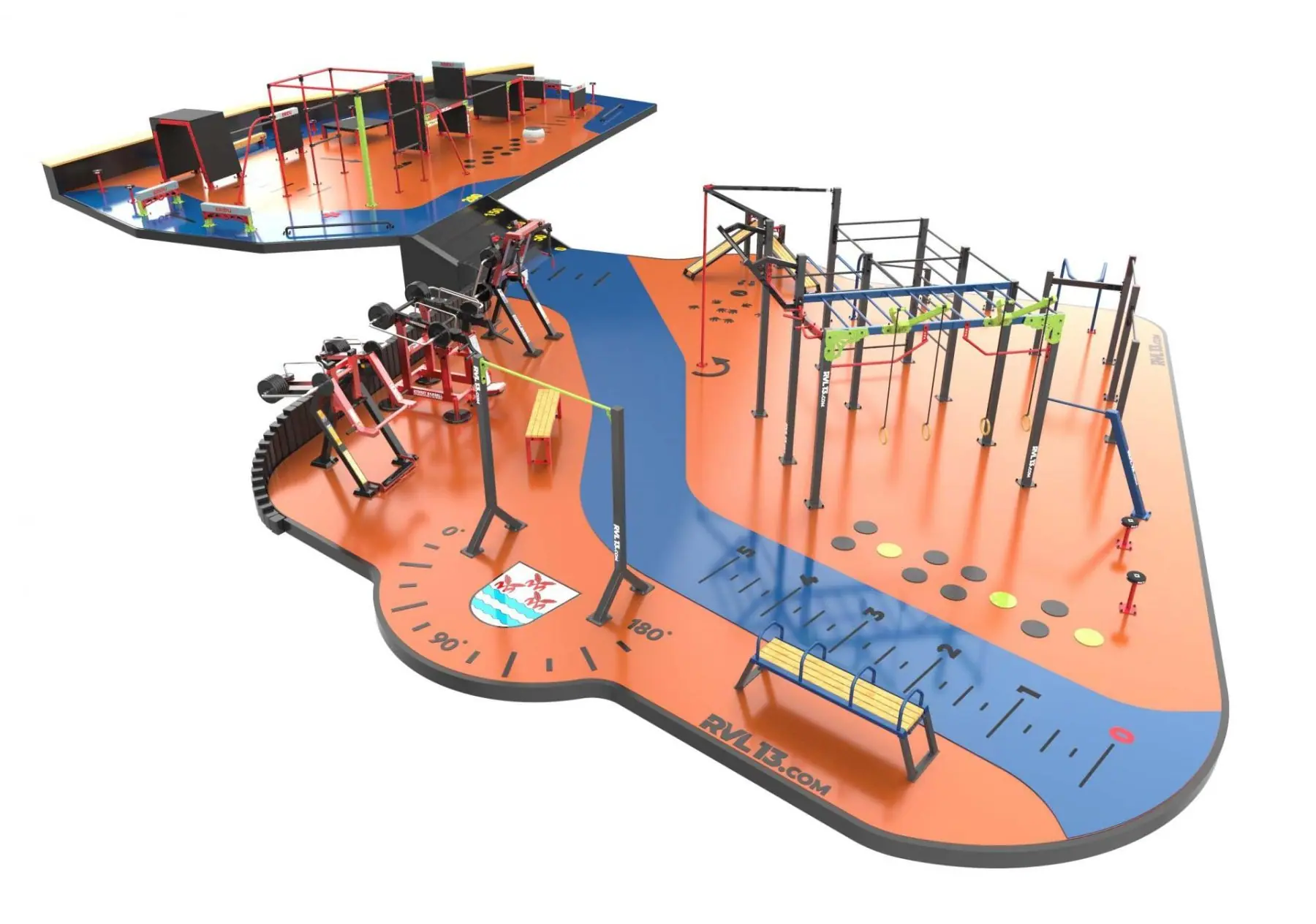
Installing a street workout park costs from 474.00 EUR excluding VAT for a single steel station to 6,550.00 EUR excluding VAT and above for a complete structure, before the impact-attenuating surface, which starts at 49.00 EUR excluding VAT per square metre. Light In Fitness has designed and supplied EN 16630 outdoor fitness equipment for councils, social landlords and institutions since 2013. This guide covers both sides of the subject: how to specify and install a park, and how to train on one.
Street workout, also called calisthenics, has grown fast as a discipline. It turns an outdoor space into an open-air training area and needs no membership, no supervision and very little maintenance once installed correctly. For a council, a campus or a residential developer, it is one of the highest-use pieces of sports infrastructure per euro invested.
Installing a street workout park: equipment and budget
Councils, social landlords, campsites, schools, universities and defence sites all follow the same sequence. Site survey, selection of EN 16630 certified apparatus, impact-attenuating surface compliant with EN 1177 according to the free height of fall, then installation on base plates or by embedding into foundations.
| Item | Range excluding VAT | Notes |
|---|---|---|
| Single station (parallel bars, dip station, balance beam and similar) | 474.00 to 888.00 EUR | Steel, EN 16630 |
| Complete street workout structure | From 6,550.00 EUR | Depending on configuration and number of stations |
| Impact-attenuating rubber tile surface | From 49.00 EUR per square metre | EN 1177 according to the free height of fall |
Every project needs its own survey and quotation, because the foundation depends on the ground you actually have and the surfacing depends on the equipment selected. Note that EN 16630 governs the equipment while EN 1177 governs the impact-attenuating surface; they are two separate requirements and both apply.
What a complete park should contain
A park is only useful if it lets users work the whole body. Four families of apparatus cover that.
- Pull-up bars: essential for back and arms. Provide bars at several heights so users of different statures and levels can all train.
- Parallel bars and dip stations: the core module for chest, triceps and shoulders.
- Monkey bars: horizontal ladders for agility and grip strength.
- Abdominal benches: for controlled leg raises and trunk work.
Beyond the apparatus list, plan the spacing. Each station needs a clear working envelope so that a user swinging or dropping from a bar never reaches the neighbouring structure, and the circulation between stations has to work for the least mobile user you expect.
Materials, siting and safety
Steel is the standard structural material, with stainless steel specified for coastal or heavily exposed sites. Site the park where it is visible and naturally supervised, on ground that can take the foundations, and check the free height of fall of every apparatus, since that is what determines the surfacing specification underneath.
Before every session, users should check the stability of the structure and the condition of the ground. For the operator, that translates into a documented inspection routine: fixings, wear on bars and welds, condition of the surface, and cleaning.
Finding a park to train in
Public outdoor fitness areas are now dense in most countries. Dedicated platforms such as Calisthenics Parks and Street Workout List map thousands of sites with photographs and equipment lists. A search for street workout or outdoor fitness plus a city name in a mapping application returns most public installations, with user reviews that tell you the real condition of the bars. Local social media groups and city-specific hashtags are the fastest way to find the less obvious spots and to join a training community.
Five exercises to start with outdoors
No advanced skill is needed to begin. This routine works in almost any park.
- Australian pull-ups: use a low bar to build back strength progressively.
- Assisted dips: if the parallel bars are too demanding, keep the feet on the ground to unload part of the bodyweight.
- Incline push-ups: use a bench or a low bar to adjust the difficulty.
- Plank: work the trunk on a stable surface.
- Lunges and squats: outdoor furniture can serve as a support point for balance work on the legs.
Accessories that support progression
- Chalk: for reliable grip on metal bars, particularly in hot weather.
- Resistance bands: to assist pull-ups or add load to dips.
- Push-up bars: to protect the wrists and increase range of movement.
- Weight belt: to add load once bodyweight work becomes easy.
Frequently asked questions
Is street workout free to use?
Yes. Training in a public street workout park is free. These installations are funded by local authorities as part of urban sports policy, and no registration or membership is required.
What is the difference between street workout and calisthenics?
Both describe bodyweight training. Street workout refers to the outdoor practice on urban bars, often with a collective and street culture dimension. Calisthenics is the more technical term covering the study of the movements, from the Greek kallos, meaning beauty, and sthenos, meaning strength. Both aim at mastery of one’s own bodyweight.
Can an organisation install its own street workout area?
Yes. Councils, schools, universities, campsites, residential developers and employers all install outdoor calisthenics areas. The equipment must comply with EN 16630 and the surface with EN 1177 according to the free height of fall.
Which standard applies?
EN 16630 for permanently installed outdoor fitness equipment in free public access, and EN 1177 for the impact-attenuating surfacing. Children’s playground equipment is a separate matter and falls under EN 1176-1.
Specifying your park
Send the plot dimensions, the ground conditions, the expected number of simultaneous users and any accessibility requirements, and compare complete configurations rather than headline prices. Browse the street workout rigs, the complete street workout parks and the outdoor sports flooring, or request a quote for your project.
Réalisations documentées
- Cage street workout ultime, Carcassonne – armée française
- Cage street workout ultime, Tahiti – armée française, Polynésie
- Cage SP Max, centre EPIDE de Combrée – établissement public d’insertion
- Cage SP Max, lycée Saint-Bénigne de Dijon – établissement scolaire
Sources et références
- NF EN 16630 – modules fixes d’entraînement physique de plein air : exigences de sécurité et méthodes d’essai (AFNOR)
- Code du sport, article L322-2 – garanties d’hygiène et de sécurité des établissements d’activités physiques et sportives (Légifrance)
À lire aussi sur le même thème
- Street Workout and Calisthenics Parks for Local Authorities: Key Steps, Materials and Configurations
- Outdoor Fitness and Street Workout: Building an Area That Lasts, Stays Safe and Pays Off
- Turnkey Outdoor Street Workout Stations for Local Authorities
- RPM, Les Mills or Spinning: Indoor Cycling Formats
- Professional Sports Flooring: How to Choose the Right Surface Without Costly Mistakes