Outdoor Fitness Equipment: Getting More From Outdoor Training
Les équipements de fitness en plein air se répartissent en trois familles : agrès au poids du corps, machines à charge réglable et modules de mobilité. Tous relèvent de la norme EN 16630 dès lors qu'ils sont installés à demeure en accès libre. Le choix se fait sur le public visé, l'exposition du site et le sol de réception disponible.

Outdoor fitness equipment falls into three families: bodyweight apparatus, machines with adjustable load, and mobility modules. All of them fall under EN 16630 as soon as they are permanently installed with free public access. The choice between them comes down to three questions: who will use the site, how exposed it is, and what impact-absorbing surface you can lay underneath.
That is the short answer. The rest of this guide explains how each family behaves in service, what outdoor training actually offers the people who use it, and how to specify a site that still looks good in its fifth winter.
From novelty to standard provision
There was a time when outdoor exercise meant going for a run and nothing else. That has changed. Fitness trails and outdoor training stations have spread through parks, campsites, residential developments and school grounds, and they are now an expected part of public sports provision rather than a curiosity.
For the organisation paying for the installation, the appeal is straightforward. An outdoor site is open all day, needs no staff on the door, no changing rooms and no membership system, and it reaches people who would never walk into a gym. That is why municipalities, campsite operators, social landlords, schools and hotels now specify outdoor equipment as a matter of course.
The three families of outdoor fitness equipment
Bodyweight apparatus
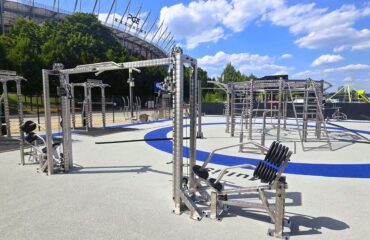
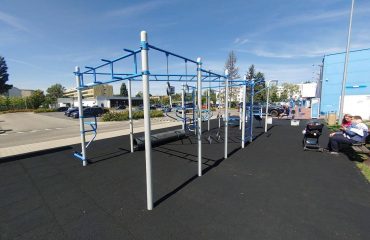
This is the largest family and the one most people picture first: pull-up bars, parallel bars, balance beams, suspension rings and the calisthenics and street workout structures built around them. The user’s own weight provides the resistance, so there is nothing to adjust, nothing to set and nothing that can be left in the wrong position by the previous user.
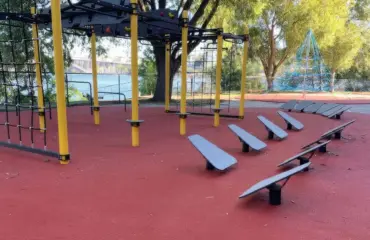
Fitness trails belong here too. A trail spreads its apparatus along a route, adding walking or running between stations, which suits sites with length available rather than a single hard-surfaced area. Explore our outdoor fitness trails and the individual fitness trail stations that make them up.
Machines with adjustable load
These are recognisably gym machines built for permanent outdoor service: press stations, pull stations, leg machines, and standalone cardio units such as outdoor cross trainers and rowing formats. They let a user set a resistance appropriate to their strength, which widens the range of people a site can serve, and they are the family that most closely reproduces an indoor training session.
They also demand the most from the specification. Every bearing, pivot and fastening is exposed to weather, so material choice and surface treatment matter far more than the movement pattern. Our range of outdoor gym equipment covers both galvanised steel and stainless steel builds for that reason.
Mobility modules
The third family is the quietest and the most often forgotten at specification stage: shoulder wheels, rotation discs, pendulum and stepping modules, and the low-amplitude stations designed for joint mobility rather than strength or endurance. They ask very little of the user, which makes them the entry point for older residents, for people returning to activity and for mixed-ability sites.
A site built only from the first two families looks impressive and serves a narrow population. Adding mobility modules is usually what turns an installation that is used at weekends by a handful of athletic users into one that is busy on a Tuesday morning.
What outdoor training offers the people who use it
The case for training outdoors is not only that it is pleasant, although it is. Working in fresh air, surrounded by greenery and natural sound, is widely associated with better mental wellbeing, and daylight exposure supports the body’s own production of vitamin D. Physical activity is also a well-established way of managing stress.
It is worth being honest about the strength of these claims: they describe general benefits of outdoor physical activity, not medical outcomes you can promise. An outdoor gym will not prevent illness. What it reliably does is remove the barriers that stop people exercising at all, which is where the real health effect comes from.
The social dimension is easier to verify and often decisive. An outdoor site is a public space as well as a training space. People meet at it, train alongside each other and come back because others are there, which is precisely the behaviour a municipality is usually trying to encourage when it funds the installation.
How to specify the right outdoor equipment
Start with the audience, not the catalogue. A site aimed at teenagers, one aimed at a residential population and one aimed at rehabilitation users share almost no equipment. Decide who the site is for before you decide what goes on it, because that single answer determines the mix of the three families.
Match the equipment to the space. Every station needs its own safety area around it, and those areas cannot overlap. A generous-looking plot fills up faster than expected once the clearances are drawn, so plan the layout before fixing the equipment list rather than after.
Take exposure seriously. A sheltered inland park and an exposed coastal or mountain site are not the same brief. Salt air, driving rain, freeze-thaw cycles and strong sun all attack a structure differently, and the right answer is to choose the material and finish for the site rather than to buy the same range everywhere. Stainless steel exists in these ranges for exactly this reason.
Do not treat the surfacing as an afterthought. The ground under the equipment is part of the installation, not a separate decision, and it is frequently what determines whether a site can be signed off.
Set a budget and hold it. The temptation is to spend everything on visible apparatus and leave nothing for the groundwork, signage and installation. That is the single most common way an outdoor project goes wrong.
Standards: what applies to what
Permanently installed outdoor fitness equipment intended for adults and open to free public access falls under EN 16630. This is the reference standard for the equipment itself and for the safety areas around it, and it is what a public purchaser will expect to see referenced in a tender response.
Equipment intended for children is a different regime entirely and must not be specified against EN 16630. Children’s play equipment falls under EN 1176-1, and the impact-absorbing surfacing under it falls under EN 1177. The two standards are separate and cover different things: the apparatus on one hand, the ground on the other. Sites that mix an adult fitness area with a children’s play area need both regimes handled correctly and separately.
The three families side by side
| Family | Typical equipment | Best suited to | Specification priority |
|---|---|---|---|
| Bodyweight apparatus | Pull-up and parallel bars, rings, balance beams, calisthenics structures | Teenagers, active adults, street workout users | Structure and anchoring |
| Adjustable-load machines | Outdoor press and pull stations, leg machines, outdoor cardio units | Mixed adult populations, sites replacing indoor provision | Corrosion resistance of moving parts |
| Mobility modules | Shoulder wheels, rotation discs, pendulum and stepping stations | Older users, rehabilitation, inclusive sites | Accessibility and low barrier to use |
Frequently asked questions
Which standard applies to an outdoor fitness area for adults?
EN 16630, as soon as the equipment is permanently installed and freely accessible to the public. It covers the equipment and the safety areas around it.
Can the same equipment serve adults and children?
No. Children’s equipment is governed by EN 1176-1 and its surfacing by EN 1177, and adult outdoor fitness equipment is governed by EN 16630. A site can host both, but the two zones are specified, installed and inspected under their own regimes.
Galvanised steel or stainless steel?
The site decides. Galvanised steel is the standard answer for ordinary inland conditions. Stainless steel is specified where the atmosphere is aggressive, most obviously near the coast, and where the appearance of the installation has to hold up over a very long service life.
How much space does an outdoor fitness area need?
More than the footprint of the equipment, because each station carries its own safety area and those areas cannot overlap. The usable answer comes from laying out your actual plot rather than from a figure in a brochure, which is why we work from your site plan.
Does an outdoor site need supervision?
Free-access sites are designed to be used without staff, which is a large part of their appeal. What they do need is correct signage, a defined inspection routine and a maintenance plan, because an unmaintained outdoor site becomes a liability rather than an asset.
Specifying your site
Outdoor fitness works because it removes every barrier between a person and physical activity: no opening hours, no subscription, no reception desk. The equipment only delivers that if it is chosen for the people who will actually use it and built for the weather it will actually face.
Light In Fitness has been equipping professional and public facilities since 2013, for municipalities, parks, campsites, residential developments, schools, hotels and rehabilitation centres. Send us your site plan, the audience you want to reach and your budget, and request a quote: you will get a layout with the three families balanced for your users, not a list of apparatus.
Réalisations documentées
- Cage street workout ultime, Carcassonne – armée française
- Cage street workout ultime, Tahiti – armée française, Polynésie
- Cage SP Max, centre EPIDE de Combrée – établissement public d’insertion
- Cage SP Max, lycée Saint-Bénigne de Dijon – établissement scolaire
Sources et références
- NF EN 16630 – modules fixes d’entraînement physique de plein air : exigences de sécurité et méthodes d’essai (AFNOR)
- Code du sport, article L322-2 – garanties d’hygiène et de sécurité des établissements d’activités physiques et sportives (Légifrance)
À lire aussi sur le même thème
- Timber Fitness Trail Equipment for Public Parks
- Équipement Bancs Parcours Santé pour Abdominaux – Acier Galvanisé – Extérieur : Un Investissement Durable pour le Bien-être
- Galvanised Steel Outdoor Sit-Up Benches for Fitness Trails
- How much does a street workout structure cost? The full budget breakdown