Timber Fitness Trail Equipment for Public Parks
Un parcours santé en bois s'intègre visuellement à un parc mais impose un contrôle régulier des fixations et de l'état du bois, contrairement au métal. Les essences traitées classe 4 résistent au contact permanent avec le sol. Le choix entre bois et acier se fait sur l'entretien acceptable par la collectivité, pas sur l'esthétique seule.

Fitness trail equipment has become a standard part of what a local authority is expected to provide in a public park. It turns a green space into a place where people train rather than only walk through, and it does so without a subscription, an opening time or a member of staff. When that equipment is specified in timber, it raises a set of questions that a purchasing department needs answered before the tender, not after.
A timber fitness trail integrates visually into a park but requires regular inspection of the fixings and of the condition of the wood, which steel does not to the same degree. Timber treated to use class 4 withstands permanent ground contact. The choice between timber and steel comes down to the level of maintenance the authority can sustain, not to appearance alone.
What timber actually offers
Three arguments hold up under scrutiny, and one commonly made argument does not.
Responsible sourcing. Timber from certified, sustainably managed forests is a renewable material with a documented chain of custody, which matters increasingly in public procurement where environmental criteria carry weight in the award.
Resistance to weather. Timber treated for outdoor use withstands heat, cold, rain and constant handling. Posts in permanent ground contact require use class 4 treatment; a lower class in that position will fail at the ground line regardless of the quality of the timber above it.
Visual integration. This is the argument that actually wins the decision in most parks. Timber sits in a landscaped setting without dominating it, which is why it is often chosen for wooded parks, riverside paths and heritage settings where a galvanised steel structure would be refused by the planning officer.
The argument that does not hold up is that timber is lower maintenance than steel. It is not. Timber requires a regular inspection cycle covering the fixings, the ground line and the surface condition of the wood, together with periodic treatment. A galvanised steel trail asks less of the maintenance team over its life. An authority choosing timber should choose it for what it offers and budget honestly for what it asks in return.
What the users get out of it
The public health case for outdoor fitness equipment is straightforward. It removes the two barriers that keep most people out of a gym, cost and intimidation, and it puts strength and mobility work within walking distance of home. Pull-up bars, parallel bars, step-up platforms and balance elements cover the patterns that matter most for everyday function.
Outdoor training also has effects that indoor training does not replicate. Time spent in green space is associated with reduced stress and improved mood, and a park where people exercise tends to be a park where people also meet. Trails become informal meeting points, and the social dimension is often what keeps use high after the opening month.
The design consequence is that a trail should serve more than one population. A single-level pull-up bar serves the fit and excludes everyone else. Stations offering an assisted variation, a lower height or a seated option turn a facility for the already-active into a facility for the whole neighbourhood, which is usually what the funding was awarded for.
Design and integration
Timber structures blend into a landscaped park in a way that few other materials do, and that is not a small consideration when a scheme has to satisfy landscape officers, residents and a heritage constraint at the same time.
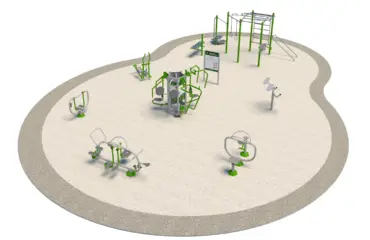
Configuration is where the specification is actually made. A trail assembled for a Nordic walking group needs stretching and mobility stations. A trail intended to absorb the energy of local children needs climbing and balance modules, and those fall under a different standard entirely. A trail serving an ageing population needs handholds, seated stations and clear circulation.
The standards distinction is not optional. Permanently installed outdoor fitness equipment for adults falls under EN 16630. Play equipment for children falls under EN 1176-1, with the impact-attenuating surfacing beneath it covered by EN 1177. A children’s climbing module cannot be specified to EN 16630, and a trail that mixes both populations needs both sets of requirements addressed separately in the tender.
Planning the installation
Four decisions determine whether a trail is used or ignored, and all four are made before anything is ordered.
- Location. On an existing path, visible from a route people already take. A trail placed out of sight at the edge of a park attracts misuse rather than use.
- Surfacing. Specified for the equipment above it and for the drainage of the site. This is where budgets are most often cut and most often regretted.
- Signage. Each station needs a clear instruction and a visible progression. Without it, half the equipment is used incorrectly or not at all.
- Inspection regime. Agreed before installation, with a named owner and a defined frequency. For timber this is not a formality; it is the condition on which the safety of the installation depends.
Our wooden fitness trail range covers timber stations designed for public installation, and the fitness trail stations range lets a route be assembled station by station around the population it serves. Where the maintenance burden of timber is the deciding factor, the galvanised steel fitness trail covers the same functions with a longer inspection interval, and the wider outdoor fitness trail range sets both options side by side.
Frequently asked questions
Is timber lower maintenance than steel?
No. Timber requires regular inspection of fixings, ground line and surface condition, plus periodic treatment. It is chosen for its integration into a landscape, not to reduce maintenance.
What treatment do timber posts need?
Posts in permanent ground contact require use class 4 treatment. Anything below that will fail at the ground line, which is where timber structures almost always fail first.
Which standard applies to a public fitness trail?
EN 16630 for permanently installed outdoor fitness equipment for adults. Children’s play equipment is covered by EN 1176-1 and its impact-attenuating surfacing by EN 1177; the two must not be mixed in a specification.
Can one trail serve every age group?
Yes, provided the stations are chosen for that. Assisted variations, varied heights and seated options are what make a trail usable across generations rather than only by those already fit.
Specifying your trail
Tell us the site, the population you want to reach and the inspection resources you have, and we will propose a route, a station list and a quotation. Request a quote and our team will come back with a configuration matched to the park and to the maintenance you can sustain.