Guided Leg Press Machines: The Complete Professional Guide

Selectorised leg press machines are core equipment for lower-body strength on any commercial gym floor. They load the quadriceps and the gluteals through a guided path, with the hamstrings and hip extensors contributing as the hip opens, and they deliver that load in a controlled, supervised-safe way. This guide covers what the machine does, how it should be used, why it belongs in a balanced programme and what to look for when you specify one for a club, a hotel or a rehabilitation centre.
Why specify a guided leg press
A guided leg press is designed to deliver a controlled, secure movement, which is what makes it valuable for beginners and for members returning from injury. It loads the legs precisely, with far less scope for the technique errors that a loaded barbell squat invites when nobody is coaching.
For an operator, that translates directly into floor economics: the leg press is one of the few stations a new member will use correctly on their first visit without an induction, which is why it carries such high utilisation in commercial circuits.
Benefits of a leg press machine
- Safety. The guided path minimises incorrect movement and the injuries that follow, which matters most for beginners.
- Focused loading. The effort is concentrated on the quadriceps and the gluteals, with the posterior chain assisting, so the lower body gets a heavy stimulus with minimal spinal load.
- Ease of use. The weight is quickly adjustable, so progression follows the user’s strength and goals without a spotter.
- Injury prevention. Stronger leg musculature improves knee and hip stability, which reduces the risk of injury in sport and daily activity.
How a leg press machine works
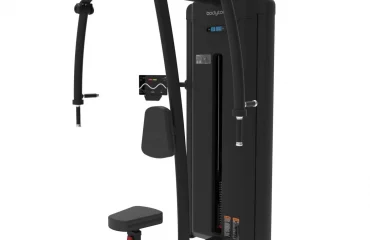
A leg press has an adjustable seat and a foot platform connected to a weight system. The user pushes the platform away with the feet, extending the legs against resistance, which loads mainly the thigh and gluteal muscles. Selectorised versions use a weight stack with a pin; plate-loaded and vertical versions load the carriage directly.
Vertical designs, such as those in the vertical leg press range, take up considerably less floor area than a 45-degree sled, which is often the deciding factor in a compact studio or hotel gym.
Correct use
- Seat adjustment. Set the seat so the knees are slightly flexed when the feet are on the platform, with the back firmly supported against the backrest.
- Foot position. Sit in the machine with the feet shoulder-width apart on the platform and the toes turned slightly outward.
- Execution. Push the platform away by extending the legs until they are almost straight, without locking the knees out completely. Return slowly to the start position under control.
Where the leg press fits in a training programme
The leg press is a versatile exercise that builds lower-body strength and muscle mass. It complements squats and lunges effectively, supporting balanced development of the legs. It is a key station for leg power, athletic performance and joint stability, and it lets a member train heavy on days when spinal loading is not an option.
Performance and rehabilitation
Beyond strengthening the legs, leg press machines are useful in rehabilitation. They allow the muscles to be worked in a controlled way, which matters during recovery from a knee or hip injury. Range of motion and load can both be dialled in precisely, which is exactly what a rehabilitation protocol needs, and progression can be tracked from one session to the next.
Specifying a leg press for a commercial floor
Three points decide whether a leg press works in a professional setting. First, the build: specify EN ISO 20957-1 class S, the class defined for supervised commercial use. Second, the carriage and bearings, since a leg press takes the heaviest loads on the floor and a rough carriage is the first thing members complain about. Third, the footprint and the loading side, which determine how the station sits in the circuit.
A guided circuit such as the Gold Line selectorised range keeps seat adjustments and load increments consistent from one station to the next, which is what makes a circuit usable without an instructor at every machine. Where floor area is tight, the Gold Line vertical leg press delivers the same movement in a much smaller footprint.
Frequently asked questions
What are the benefits of the leg press for the legs?
The leg press strengthens the quadriceps and gluteals, with the posterior chain assisting, improves knee and hip stability, and contributes to injury prevention.
How often should the leg press be trained?
Two to three times a week within a leg training routine is a common recommendation, depending on the overall programme and the goals set.
Is the leg press suitable for people with knee pain?
With an appropriate load, a controlled range of motion and correct technique, the leg press can strengthen the legs without aggravating knee pain, and it is widely used for exactly that reason in rehabilitation settings. Anyone with existing knee pain should have the movement and the range cleared by a healthcare professional before starting.
Selectorised, plate-loaded or vertical?
Selectorised is fastest to adjust and best suited to a general membership. Plate-loaded suits strength-focused floors and heavier loads. Vertical is the answer when floor area is the binding constraint.
Choosing your leg press
A guided leg press is a valuable tool for anyone strengthening the legs safely and effectively, and it belongs in almost every commercial circuit, from a first-time member to an experienced athlete. Which version fits depends on your floor area, your membership and the rest of your circuit. Light In Fitness has equipped more than 2,500 customers since 2013 and can specify the right leg press for yours. Request a quote for your project.