Hip Thrust Machine: Choosing and Specifying a Glute Station
The hip thrust has moved from a coaching cue to a fixed point on the strength floor. Operators who once treated glute work as a bench-and-band afterthought now dedicate a station to it, because members ask for it by name and because the movement carries real training value. If you run a gym, a cross-training box, a hotel fitness suite or a rehabilitation centre, the question is no longer whether to offer hip thrusts, but on what equipment.
A dedicated hip thrust machine turns an awkward floor exercise into a repeatable, supervised, high-throughput station. It removes the loading and unloading gymnastics of the barbell version, it protects the lower back, and it lets a member move from an empty bar equivalent to a heavy working set without a spotter. This article looks at what the machine actually does, what it brings to a commercial facility, the variations available, and how to programme it so the investment pays back in member retention.
What a hip thrust machine is
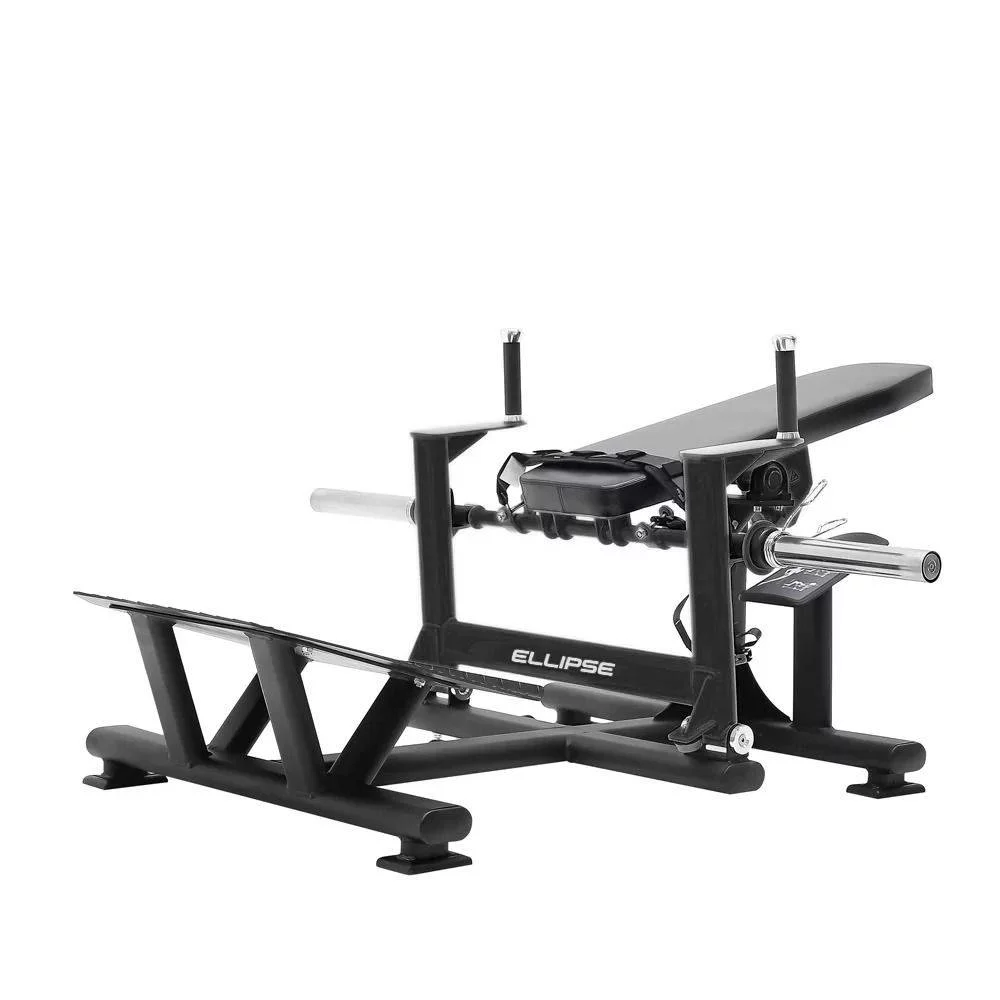
A hip thrust machine is purpose-built equipment for a single movement pattern. The hip thrust is a variant of the glute bridge, but it shifts the emphasis firmly onto the gluteal and hip musculature by raising the upper back onto a support and increasing the range through which the hips travel.
The typical configuration is a back pad set at an angle, a padded hip restraint or horizontal bar positioned across the hips, and a loading system. The user sits with the upper back against the pad, positions the bar across the hips, then drives the hips upward by contracting the glutes and hip extensors, holds briefly at lockout, and lowers under control. The movement targets the glutes primarily, with meaningful involvement from the hamstrings and lower back stabilisers.
Compared with performing the exercise on the floor or against a bench, the machine adds three things a commercial operator cares about. It adds resistance in a controlled and easily adjusted way. It supports the back, which reduces injury risk and helps a member hold position through the set. And it makes progression obvious: adding load is a matter of a pin or a plate, not a coaching intervention.
For facilities building out a lower-body zone, the machine sits naturally alongside the rest of a professional strength range, and it pairs well with leg press and posterior chain stations rather than replacing them.
Why the movement earns floor space
Floor space in a commercial gym is the scarcest resource there is. A hip thrust station earns it for several reasons.
Muscular development. The hip thrust loads the glutes intensely through a range where they are mechanically strong. Progressive loading on the machine drives hypertrophy and strength in a way that bodyweight bridging cannot match.
Posterior chain and lower back support. Beyond the glutes, the movement recruits the hamstrings and the muscles of the lower back. That region is chronically under-trained in a general membership, and strengthening it improves overall trunk stability.
Athletic transfer. Hip extension under load is the engine behind sprinting, jumping and change of direction. Clubs, academies and armed forces training facilities value the hip thrust precisely because it develops explosive hip strength that shows up in field performance.
Posture. By strengthening the glutes and the lower back together, the movement supports correct spinal alignment. For an ageing or desk-bound membership, that is a benefit worth communicating.
Body composition. As with any resistance training, the hip thrust contributes to energy expenditure, and the additional lean mass it builds raises resting metabolic rate. It is a legitimate part of a body composition programme rather than a standalone fat-loss tool.
The breadth of that list is what makes the station commercially useful. It is not a niche machine for one demographic: it suits beginners and advanced lifters, men and women, general members and competitive athletes, and it can be scaled to each of them without any change to the hardware.
Machine variations and loading options
Not every hip thrust station is the same, and the choice matters for throughput and for the kind of member you serve.
Plate-loaded stations. Load is added as Olympic plates on a loading horn or sleeve. These stations suit strength-focused facilities and cross-training boxes, where members are comfortable handling plates and where peak loads are high. Our SRX63 hip thruster is an example of this configuration.
Selectorised stations. A weight stack and pin make load changes instant, which matters in a busy facility where members circulate quickly and where staff want to minimise loose plates on the floor. The Gold Line hip thrust machine works this way.
Standing hip thrust units. A vertical configuration changes the body position and the loading vector while keeping the same hip extension pattern. These units have a small footprint and are easy to approach, which makes them well suited to hotel fitness suites and compact club gyms.
Free-weight and accessory variations. Independent of the machine, coaches will use single-leg work to expose and correct side-to-side asymmetry, resistance bands around the thighs to add abduction demand, and unstable surfaces to increase stabiliser recruitment. These are programming tools rather than equipment purchases, but they extend the value of the station you install.
Choosing between these comes down to member profile and traffic. High-turnover general fitness sites usually favour selectorised units. Strength and performance sites favour plate-loaded. Mixed facilities often install one of each and find the two serve different populations at different times of day.
Coaching the movement well
A machine reduces risk but does not eliminate the need for instruction. The points below are the ones your floor staff should be reinforcing.
Technique first. The back stays neutral, the shoulders stay back against the pad, and the trunk stays braced through the whole repetition. Lockout is hip extension, not lumbar extension.
Progressive loading. Members start light and add resistance as strength develops. Gradual progression drives adaptation and avoids the plateau that comes from jumping to a load the member cannot control.
Angle variation. Where the machine allows the back pad angle to be changed, varying it shifts emphasis across the gluteal complex. It is a simple way to keep a long-term member progressing on the same station.
Programme context. The hip thrust is effective, but it is not a complete lower-body programme on its own. It belongs in a session that also includes knee-dominant and hinge patterns so the whole lower body develops in balance.
Recovery. Muscle is rebuilt between sessions, not during them. Rest days between heavy glute sessions prevent accumulated fatigue and the overuse problems that follow it.
Programming the station
For an operator writing member programmes or briefing personal trainers, the following framework is a sound default.
Frequency. Two to three sessions per week allows adequate recovery between exposures while providing enough stimulus for adaptation.
Volume. Three to four sets of eight to twelve repetitions is an appropriate starting point. Volume increases gradually as strength and work capacity develop.
Combination with other work. Programme the hip thrust within a full lower-body session that also trains the quadriceps, hamstrings and hip abductors, so the member develops a balanced lower body rather than an isolated strength.
Recovery. Allow sufficient rest between sets and between sessions. Stretching, soft tissue work and foam rolling all support the recovery process and are worth building into the member journey.
Members with existing conditions should be referred to a health professional or a qualified trainer before starting a new programme. That referral pathway is worth formalising in writing if your facility serves a rehabilitation or senior population.
Common mistakes to design out
Most of the problems that arise on a hip thrust station are predictable, which means they can be designed out with signage, induction and staff presence.
Poor technique. The two frequent faults are rounding the back during the lift and driving the hips past a neutral lockout. Both are corrected by cueing a braced trunk and a straight back throughout.
Excessive load. Members who load heavily from the outset sacrifice range and position. Starting light and building progressively produces better results and fewer incidents.
Skipping the warm-up. A short preparation of dynamic stretching, joint rotations or light cardio readies the tissues for loaded hip extension.
Skipping recovery. Insufficient rest between sets and between sessions limits adaptation and raises injury risk.
Training without guidance. Members new to the station benefit from an induction with a trainer who can demonstrate the movement and set the machine up correctly for their build.
Frequently asked questions
Is a hip thrust machine only useful for glute training? No. The glutes are the primary target, but the movement also loads the hamstrings and the lower back stabilisers, which makes it a genuine posterior chain station rather than a single-muscle machine.
Selectorised or plate-loaded for a commercial gym? Selectorised units change load faster and keep plates off the floor, which suits high-traffic general fitness sites. Plate-loaded units suit strength-focused facilities and allow higher peak loads. Many operators install both.
Can beginners use the station safely? Yes, provided they receive an induction. The back support and the fixed movement path make the machine version considerably more forgiving than the barbell equivalent.
How much space should we allow? Allow the machine footprint plus clear access on the loading side and enough room for a trainer to stand alongside. Exact dimensions vary by model and are supplied with each specification sheet.
Does the station suit a rehabilitation setting? The supported position and the controlled range make it a candidate for progressive strengthening under professional supervision. Programming decisions in that setting belong to the clinical team.
Specifying your station
A hip thrust station is one of the few pieces of equipment that satisfies general members, physique-focused members and performance athletes at the same time. Chosen well, it becomes one of the busiest machines on the floor and one of the easiest to justify at the next equipment review.
The right choice depends on your traffic, your member profile and the space you have. Tell us how your floor is laid out and who trains on it, and we will put forward a configuration that fits. Request a quote and we will come back with a costed proposal.